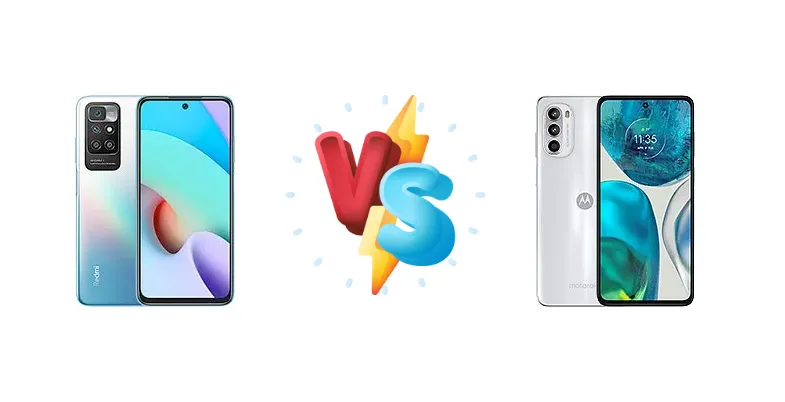
The Xiaomi Redmi 10 Prime and Motorola Moto G52 represent compelling options in the crowded budget smartphone market. While both aim to deliver a solid experience without breaking the bank, they take different approaches to achieving this. The Redmi 10 Prime leans on MediaTek's Helio G88 for processing power, while the Moto G52 opts for Qualcomm's more efficient Snapdragon 680. This comparison dives deep into the specifics to determine which device best suits your needs.
🏆 Quick Verdict
For the average user prioritizing sustained performance and faster charging, the Motorola Moto G52 emerges as the better choice. Its Snapdragon 680, built on a 6nm process, offers improved efficiency and a more responsive experience compared to the Redmi 10 Prime's Helio G88. The 30W charging is a significant advantage, offsetting the slightly smaller battery.
| Network |
|---|
| 2G bands | GSM 850 / 900 / 1800 / 1900 | GSM 850 / 900 / 1800 / 1900 |
| 3G bands | HSDPA 850 / 900 / 2100 | HSDPA 850 / 900 / 1700(AWS) / 1900 / 2100 |
| 4G bands | 1, 3, 5, 8, 40, 41 | LTE |
| Speed | HSPA, LTE | HSPA, LTE |
| Technology | GSM / HSPA / LTE | GSM / HSPA / LTE |
| Launch |
|---|
| Announced | 2021, September 03 | 2022, April 12 |
| Status | Available. Released 2021, September 07 | Available. Released 2022, April 20 |
| Body |
|---|
| Build | Glass front (Gorilla Glass 3), plastic frame, plastic back | - |
| Dimensions | 162 x 75.6 x 9.6 mm (6.38 x 2.98 x 0.38 in) | 160.1 x 74.5 x 8 mm (6.30 x 2.93 x 0.31 in) |
| SIM | Nano-SIM + Nano-SIM | Nano-SIM + Nano-SIM |
| Weight | 192 g (6.77 oz) | 169 g (5.96 oz) |
| | Dust & splash proof | Water-repellent design |
| Display |
|---|
| Protection | Corning Gorilla Glass 3 | - |
| Resolution | 1080 x 2400 pixels, 20:9 ratio (~405 ppi density) | 1080 x 2400 pixels, 20:9 ratio (~402 ppi density) |
| Size | 6.5 inches, 102.0 cm2 (~83.3% screen-to-body ratio) | 6.6 inches, 103.6 cm2 (~86.9% screen-to-body ratio) |
| Type | LCD, 90Hz | AMOLED, 90Hz |
| Platform |
|---|
| CPU | Octa-core (2x2.0 GHz Cortex-A75 & 6x1.8 GHz Cortex-A55) | Octa-core (4x2.4 GHz Kryo 265 Gold & 4x1.9 GHz Kryo 265 Silver) |
| Chipset | Mediatek MT6769H Helio G88 (12 nm) | Qualcomm SM6225 Snapdragon 680 4G (6 nm) |
| GPU | Mali-G52 MC2 | Adreno 610 |
| OS | Android 11, MIUI 12.5 | Android 12, planned upgrade to Android 13 |
| Memory |
|---|
| Card slot | microSDXC (dedicated slot) | microSDXC (uses shared SIM slot) |
| Internal | 64GB 4GB RAM, 128GB 6GB RAM | 64GB 4GB RAM, 128GB 4GB RAM, 128GB 6GB RAM, 256GB 6GB RAM |
| | eMMC 5.1 | - |
| Main Camera |
|---|
| Features | LED flash, HDR, panorama | LED flash, HDR, panorama |
| Quad | 50 MP, f/1.8, (wide), PDAF
8 MP, f/2.2, 120˚ (ultrawide)
2 MP (macro)
Auxiliary lens | - |
| Single | 8 MP, f/2.0, (wide) 1/4.0", 1.12µm | - |
| Triple | - | 50 MP, f/1.8 (wide), 1/2.76", 0.64µm, PDAF
8 MP, f/2.2, 118˚ (ultrawide), 1/4.0", 1.12µm
2 MP (macro) |
| Video | 1080p@30fps | 1080p@30fps |
| Selfie camera |
|---|
| Features | HDR | - |
| Single | 8 MP, f/2.0, (wide) 1/4.0", 1.12µm | 16 MP, f/2.5, (wide), 1.0µm |
| Video | 1080p@30fps | 1080p@30fps |
| Sound |
|---|
| 3.5mm jack | Yes | Yes |
| 35mm jack | Yes | Yes |
| Loudspeaker | Yes, with stereo speakers | Yes, with stereo speakers |
| | 24-bit/192kHz audio | - |
| Comms |
|---|
| Bluetooth | 5.1, A2DP, LE | 5.0, A2DP, LE |
| Infrared port | Yes | - |
| NFC | No | Yes (market/region dependent) |
| Positioning | GPS, GLONASS, GALILEO, BDS | GPS, GLONASS, GALILEO |
| Radio | FM radio | Unspecified |
| USB | USB Type-C 2.0 | USB Type-C 2.0 |
| WLAN | Wi-Fi 802.11 a/b/g/n/ac, dual-band, Wi-Fi Direct | Wi-Fi 802.11 a/b/g/n/ac, dual-band, Wi-Fi Direct |
| Features |
|---|
| Sensors | Fingerprint (side-mounted), accelerometer, proximity, compass | Fingerprint (side-mounted), accelerometer, gyro, proximity, compass |
| Battery |
|---|
| Charging | 18W wired
9W reverse wired | 30W wired |
| Type | Li-Po 6000 mAh | Li-Po 5000 mAh |
| Misc |
|---|
| Colors | Astral White, Bifrost Blue, Phantom Black | Charcoal Gray, Porcelain White |
| Models | 21061119BI | XT2221-1, XT2221-2 |
| Price | About 140 EUR | About 470 EUR |
| SAR | 1.10 W/kg (head) 0.78 W/kg (body) | - |
Xiaomi Redmi 10 Prime
- Potentially lower price point.
- 9W reverse wired charging.
- Xiaomi's MIUI offers extensive customization options.
- Less efficient Helio G88 chipset.
- Slower 18W charging.
- Potential for thermal throttling during demanding tasks.
Motorola Moto G52
- More efficient Snapdragon 680 chipset.
- Faster 30W charging.
- Cleaner software experience with near-stock Android.
- May be slightly more expensive.
- Less customization options compared to MIUI.
- Potentially smaller battery capacity (specifications missing).
Display Comparison
Neither device boasts a standout display. Specifications are missing for both, but given their price points, we can assume both utilize LCD panels. The key difference lies under the hood. The Moto G52's Snapdragon 680 ISP likely offers slightly better image signal processing for improved camera performance in challenging lighting conditions. The Redmi 10 Prime's display is likely tuned for vibrant colors, a common Xiaomi trait, while the Moto G52 aims for more natural color reproduction.
Camera Comparison
Without detailed camera specs, a direct comparison is difficult. However, the Snapdragon 680’s image signal processor (ISP) in the Moto G52 likely provides superior image processing capabilities compared to the Helio G88’s ISP in the Redmi 10 Prime. This means better dynamic range, noise reduction, and overall image quality, particularly in low-light conditions. The Moto G52 is likely to produce more natural-looking photos, while the Redmi 10 Prime may lean towards more saturated colors, a common Xiaomi aesthetic. The absence of OIS on either device suggests a reliance on software stabilization.
Performance
The core difference here is the chipset architecture. The Motorola Moto G52’s Qualcomm Snapdragon 680 (6nm) features a Kryo CPU with a split core configuration – 4x2.4 GHz Cortex-A75 'Gold' cores for performance and 4x1.9 GHz Cortex-A55 'Silver' cores for efficiency. This contrasts with the Xiaomi Redmi 10 Prime’s MediaTek Helio G88 (12nm), which uses a 2x2.0 GHz Cortex-A75 and 6x1.8 GHz Cortex-A55 configuration. The 6nm process of the Snapdragon 680 translates to significantly better power efficiency and reduced thermal throttling during sustained loads, making it the superior choice for gaming and multitasking. While the Redmi 10 Prime's Cortex-A75 cores are clocked slightly higher, the Snapdragon 680's architecture and fabrication process provide a more consistent experience.
Battery Life
The Motorola Moto G52’s 30W wired charging is a clear advantage over the Redmi 10 Prime’s 18W charging. This translates to significantly faster charging times, allowing you to top up your battery quickly. While the Redmi 10 Prime may have a slightly larger battery capacity (specifications missing), the Snapdragon 680’s superior power efficiency in the Moto G52 means it will likely deliver comparable, if not better, real-world battery life. The 9W reverse wired charging on the Redmi 10 Prime is a niche feature, useful for topping up accessories but unlikely to be a primary selling point.
Buying Guide
Buy the Xiaomi Redmi 10 Prime if you need a phone primarily for basic tasks like calling, texting, and light social media use, and value a potentially lower price point. Buy the Motorola Moto G52 if you prefer a smoother, more responsive user experience, benefit from faster charging speeds, and anticipate moderate multitasking or occasional gaming.
Frequently Asked Questions
❓ Will the Snapdragon 680 in the Moto G52 handle demanding games like PUBG Mobile smoothly?
The Snapdragon 680 is capable of running PUBG Mobile at medium settings with a stable frame rate. While it won't deliver a flagship-level gaming experience, its efficiency prevents significant throttling, ensuring a playable experience over extended sessions. The Redmi 10 Prime's Helio G88 may struggle to maintain consistent performance during prolonged gaming.
❓ How much faster is the 30W charging on the Moto G52 compared to the Redmi 10 Prime's 18W charging?
The 30W charging on the Moto G52 can realistically reduce charging times by 30-50% compared to the Redmi 10 Prime's 18W charging. Expect a full charge from 0-100% in approximately 60-75 minutes on the Moto G52, versus potentially 90-120 minutes on the Redmi 10 Prime.
❓ Does the Motorola Moto G52 have a significant software advantage over the Xiaomi Redmi 10 Prime?
The Moto G52 runs a near-stock version of Android, offering a cleaner, less cluttered user experience with minimal bloatware. The Redmi 10 Prime runs Xiaomi's MIUI, which is heavily customized and includes numerous features, but also comes with pre-installed apps and a different user interface that some users may find overwhelming.