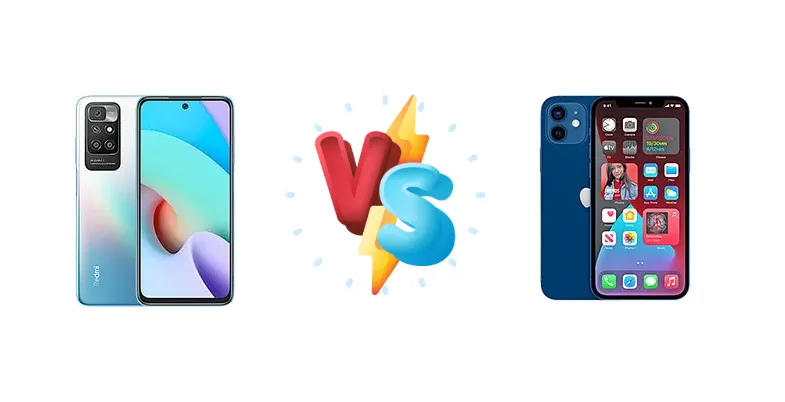
The smartphone market offers a vast range of options, from budget-friendly devices to premium flagships. Today, we're pitting the Xiaomi Redmi 10 Prime, a popular budget contender, against the Apple iPhone 12, a well-established and powerful smartphone. This comparison will help you determine which device best suits your needs and budget.
🏆 Quick Verdict
The iPhone 12 wins decisively in performance, camera quality, and overall ecosystem integration. However, the Redmi 10 Prime offers incredible value for money, providing a solid experience for basic users on a tight budget. It's a clear case of premium versus affordability.
| Network |
|---|
| 2G bands | GSM 850 / 900 / 1800 / 1900 | GSM 850 / 900 / 1800 / 1900 |
| 3G bands | HSDPA 850 / 900 / 2100 | HSDPA 850 / 900 / 1700(AWS) / 1900 / 2100 |
| 4G bands | 1, 3, 5, 8, 40, 41 | 1, 2, 3, 4, 5, 7, 8, 12, 13, 14, 17, 18, 19, 20, 25, 26, 28, 29, 30, 32, 34, 38, 39, 40, 41, 42, 46, 48, 66, 71 - A2172 |
| 5G bands | - | 1, 2, 3, 5, 7, 8, 12, 20, 25, 28, 38, 40, 41, 66, 71, 77, 78, 79, 260, 261 Sub6/mmWave - A2172 |
| Speed | HSPA, LTE | HSPA, LTE, 5G, EV-DO Rev.A 3.1 Mbps |
| Technology | GSM / HSPA / LTE | GSM / CDMA / HSPA / EVDO / LTE / 5G |
| Launch |
|---|
| Announced | 2021, September 03 | 2020, October 13 |
| Status | Available. Released 2021, September 07 | Available. Released 2020, October 23 |
| Body |
|---|
| Build | Glass front (Gorilla Glass 3), plastic frame, plastic back | Glass front, glass back, aluminum frame |
| Dimensions | 162 x 75.6 x 9.6 mm (6.38 x 2.98 x 0.38 in) | 146.7 x 71.5 x 7.4 mm (5.78 x 2.81 x 0.29 in) |
| SIM | Nano-SIM + Nano-SIM | · Nano-SIM + eSIM· Nano-SIM + Nano-SIM (China) |
| Weight | 192 g (6.77 oz) | 164 g (5.78 oz) |
| | Dust & splash proof | - |
| Display |
|---|
| Protection | Corning Gorilla Glass 3 | Ceramic Shield glass |
| Resolution | 1080 x 2400 pixels, 20:9 ratio (~405 ppi density) | 1170 x 2532 pixels, 19.5:9 ratio (~460 ppi density) |
| Size | 6.5 inches, 102.0 cm2 (~83.3% screen-to-body ratio) | 6.1 inches, 90.2 cm2 (~86.0% screen-to-body ratio) |
| Type | LCD, 90Hz | Super Retina XDR OLED, HDR10, Dolby Vision, 625 nits (HBM), 1200 nits (peak) |
| Platform |
|---|
| CPU | Octa-core (2x2.0 GHz Cortex-A75 & 6x1.8 GHz Cortex-A55) | Hexa-core (2x3.1 GHz Firestorm + 4x1.8 GHz Icestorm) |
| Chipset | Mediatek MT6769H Helio G88 (12 nm) | Apple A14 Bionic (5 nm) |
| GPU | Mali-G52 MC2 | Apple GPU (4-core graphics) |
| OS | Android 11, MIUI 12.5 | iOS 14.1, upgradable to iOS 26.1 |
| Memory |
|---|
| Card slot | microSDXC (dedicated slot) | No |
| Internal | 64GB 4GB RAM, 128GB 6GB RAM | 64GB 4GB RAM, 128GB 4GB RAM, 256GB 4GB RAM |
| | eMMC 5.1 | - |
| Main Camera |
|---|
| Dual | - | 12 MP, f/1.6, 26mm (wide), 1.4µm, dual pixel PDAF, OIS
12 MP, f/2.4, 13mm, 120˚ (ultrawide), 1/3.6" |
| Features | LED flash, HDR, panorama | Dual-LED dual-tone flash, HDR (photo/panorama) |
| Quad | 50 MP, f/1.8, (wide), PDAF
8 MP, f/2.2, 120˚ (ultrawide)
2 MP (macro)
Auxiliary lens | - |
| Single | 8 MP, f/2.0, (wide) 1/4.0", 1.12µm | - |
| Video | 1080p@30fps | 4K@24/25/30/60fps, 1080p@25/30/60/120/240fps, HDR, Dolby Vision HDR (up to 30fps), stereo sound rec. |
| Selfie camera |
|---|
| Features | HDR | HDR |
| Single | 8 MP, f/2.0, (wide) 1/4.0", 1.12µm | 12 MP, f/2.2, 23mm (wide), 1/3.6", 1.0µm
SL 3D, (depth/biometrics sensor) |
| Video | 1080p@30fps | 4K@24/25/30/60fps, 1080p@25/30/60/120fps, gyro-EIS |
| Sound |
|---|
| 3.5mm jack | Yes | No |
| 35mm jack | Yes | No |
| Loudspeaker | Yes, with stereo speakers | Yes, with stereo speakers |
| | 24-bit/192kHz audio | - |
| Comms |
|---|
| Bluetooth | 5.1, A2DP, LE | 5.0, A2DP, LE |
| Infrared port | Yes | - |
| NFC | No | Yes |
| Positioning | GPS, GLONASS, GALILEO, BDS | GPS, GLONASS, GALILEO, QZSS |
| Radio | FM radio | No |
| USB | USB Type-C 2.0 | Lightning, USB 2.0 |
| WLAN | Wi-Fi 802.11 a/b/g/n/ac, dual-band, Wi-Fi Direct | Wi-Fi 802.11 a/b/g/n/ac/6, dual-band, hotspot |
| Features |
|---|
| Sensors | Fingerprint (side-mounted), accelerometer, proximity, compass | Face ID, accelerometer, gyro, proximity, compass, barometer |
| Battery |
|---|
| Charging | 18W wired
9W reverse wired | Wired, PD2.0, 50% in 30 min
15W wireless (MagSafe)
15W wireless (Qi2) - requires iOS 17.4 update |
| Type | Li-Po 6000 mAh | Li-Ion 2815 mAh (10.78 Wh) |
| Misc |
|---|
| Colors | Astral White, Bifrost Blue, Phantom Black | Black, White, Red, Green, Blue, Purple |
| Models | 21061119BI | A2403, A2172, A2402, A2404, iPhone13,2 |
| Price | About 140 EUR | $ 190.00 / C$ 307.99 / £ 190.00 / € 219.00 / ₹ 54,900 |
| SAR | 1.10 W/kg (head) 0.78 W/kg (body) | - |
| SAR EU | - | 0.99 W/kg (head) 0.99 W/kg (body) |
| Tests |
|---|
| Battery life | - | Endurance rating 84h |
| Camera | - |
Photo / Video |
| Display | - |
Contrast ratio: Infinite (nominal) |
| Loudspeaker | - |
-24.4 LUFS (Very good) |
| Performance | - |
AnTuTu: 568674 (v8)
GeekBench: 4067 (v5.1)
GFXBench: 58fps (ES 3.1 onscreen) |
Xiaomi Redmi 10 Prime
- Excellent value for money
- Large display
- Decent camera for the price
- Reverse wired charging
- Lower performance compared to flagship phones
- IPS LCD display
- Less premium build quality
- Slower charging speeds
Apple iPhone 12
- Exceptional performance
- Premium design and build quality
- Outstanding camera system
- Long-term software support
- Fast charging (PD 2.0) and wireless charging (MagSafe/Qi2)
- High price
- Limited customization options compared to Android
- No charger included in the box
Display Comparison
The iPhone 12 boasts a superior OLED display with vibrant colors, deep blacks, and excellent viewing angles. While the Redmi 10 Prime has a large IPS LCD display, it lacks the contrast and color accuracy of the iPhone 12. The iPhone 12's display also supports HDR content, a feature absent on the Redmi 10 Prime.
Camera Comparison
The iPhone 12's camera system is a clear winner. It captures stunning photos and videos with excellent dynamic range, detail, and color accuracy. The computational photography capabilities are also superior. The Redmi 10 Prime's camera is decent for its price range, but it struggles in low-light conditions and lacks the advanced features of the iPhone 12.
Performance
The Apple A14 Bionic chip in the iPhone 12 utterly dominates the Mediatek Helio G88 in the Redmi 10 Prime. The iPhone 12 offers significantly faster processing speeds, smoother multitasking, and better gaming performance. The A14 Bionic's efficiency also contributes to better overall battery management despite the similar battery capacities.
Battery Life
While both phones have similar battery capacities, the iPhone 12's efficient A14 Bionic chip allows it to achieve significantly longer battery life. The iPhone 12's endurance rating of 84h is exceptional. The Redmi 10 Prime's battery life is respectable, but it doesn't match the iPhone 12's longevity.
Buying Guide
The Xiaomi Redmi 10 Prime is ideal for budget-conscious users who prioritize affordability and basic functionality. It's great for social media, casual gaming, and everyday tasks. The Apple iPhone 12 is perfect for users who demand top-tier performance, a premium camera, seamless iOS integration, and long-term software support, and are willing to pay a premium.
Frequently Asked Questions
❓ Is the Redmi 10 Prime good for gaming?
The Redmi 10 Prime can handle casual games, but demanding titles may experience lag or reduced graphics settings due to its less powerful chipset.
❓ Does the iPhone 12 come with a charger?
No, Apple no longer includes a charger with the iPhone 12. You'll need to purchase one separately.
❓ Which phone has better software support?
The Apple iPhone 12 will receive longer software updates and security patches compared to the Xiaomi Redmi 10 Prime.
❓ What is reverse wired charging?
Reverse wired charging allows the Redmi 10 Prime to charge other devices using its USB port, acting as a power bank.