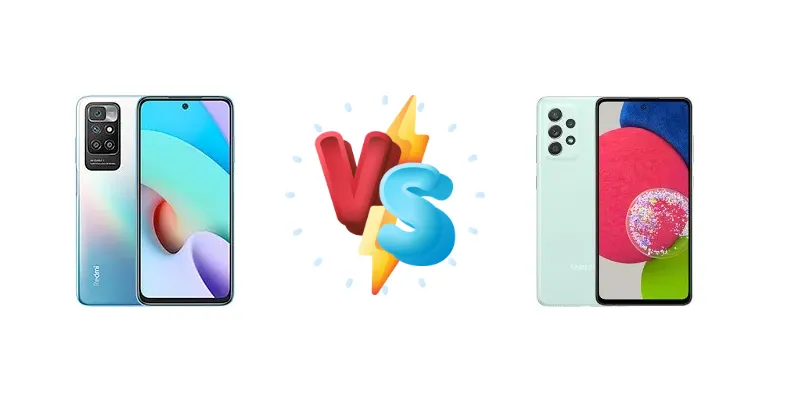
The Xiaomi Redmi 10 Prime 2022 and the Samsung Galaxy A52s 5G represent compelling options in the competitive mid-range smartphone market. While both aim to deliver a balanced experience, they diverge significantly in their core hardware, particularly in chipset choice. This comparison dissects these differences to determine which device best suits your needs, focusing on performance, camera capabilities, and overall value.
🏆 Quick Verdict
For most users, the Samsung Galaxy A52s 5G emerges as the superior choice. Its Snapdragon 778G 5G chipset provides a substantial performance advantage over the Redmi 10 Prime’s Helio G88, translating to smoother multitasking, faster app loading, and a more enjoyable gaming experience. While the Redmi 10 Prime offers a lower price point, the A52s’s performance uplift justifies the extra investment.
| Network |
|---|
| 2G bands | GSM 850 / 900 / 1800 / 1900 | GSM 850 / 900 / 1800 / 1900 |
| 3G bands | HSDPA 850 / 900 / 1700(AWS) / 1900 / 2100 | HSDPA 850 / 900 / 1700(AWS) / 1900 / 2100 |
| 4G bands | 1, 2, 3, 4, 5, 7, 20, 28, 38, 40, 41 | 1, 2, 3, 4, 5, 7, 8, 12, 17, 20, 26, 28, 32, 38, 40, 41, 66 |
| 5G bands | - | 1, 3, 5, 7, 8, 20, 28, 38, 40, 41, 66, 78 SA/NSA/Sub6 |
| Speed | HSPA, LTE | HSPA 42.2/5.76 Mbps, LTE Cat18 1200/150 Mbps, 5G |
| Technology | GSM / HSPA / LTE | GSM / HSPA / LTE / 5G |
| Launch |
|---|
| Announced | 2022, May 09 | 2021, August 17 |
| Status | Available. Released 2022, May 09 | Available. Released 2021, September 01 |
| Body |
|---|
| Build | Glass front (Gorilla Glass 3), plastic frame, plastic back | Glass front (Gorilla Glass 5), plastic back |
| Dimensions | 162 x 75.5 x 9.6 mm (6.38 x 2.97 x 0.38 in) | 159.9 x 75.1 x 8.4 mm (6.30 x 2.96 x 0.33 in) |
| SIM | Nano-SIM + Nano-SIM | · Nano-SIM· Nano-SIM + Nano-SIM |
| Weight | 192 g (6.77 oz) | 189 g (6.67 oz) |
| | Dust & splash proof | IP67 dust/water resistant (up to 1m for 30 min) |
| Display |
|---|
| Protection | Corning Gorilla Glass 3 | Corning Gorilla Glass 5 |
| Resolution | 1080 x 2400 pixels, 20:9 ratio (~405 ppi density) | 1080 x 2400 pixels, 20:9 ratio (~405 ppi density) |
| Size | 6.5 inches, 102.0 cm2 (~83.4% screen-to-body ratio) | 6.5 inches, 102.0 cm2 (~84.9% screen-to-body ratio) |
| Type | LCD, 90Hz | Super AMOLED, 120Hz, 800 nits (HBM) |
| Platform |
|---|
| CPU | Octa-core (2x2.0 GHz Cortex-A75 & 6x1.8 GHz Cortex-A55) | Octa-core (1x2.4 GHz Cortex-A78 & 3x2.2 GHz Cortex-A78 & 4x1.9 GHz Cortex-A55) |
| Chipset | Mediatek MT6769H Helio G88 (12 nm) | Qualcomm SM7325 Snapdragon 778G 5G (6 nm) |
| GPU | Mali-G52 MC2 | Adreno 642L |
| OS | Android 11, MIUI 12.5 | Android 11, upgradable to Android 14, One UI 6 |
| Memory |
|---|
| Card slot | microSDXC (uses shared SIM slot) | microSDXC (uses shared SIM slot) |
| Internal | 64GB 4GB RAM, 128GB 4GB RAM, 128GB 6GB RAM | 128GB 4GB RAM, 128GB 6GB RAM, 128GB 8GB RAM, 256GB 6GB RAM, 256GB 8GB RAM |
| | eMMC 5.1 | - |
| Main Camera |
|---|
| Features | LED flash, HDR, panorama | LED flash, panorama, HDR |
| Quad | 50 MP, f/1.8, (wide), PDAF
8 MP, f/2.2, 120˚ (ultrawide)
2 MP (macro)
Auxiliary lens | 64 MP, f/1.8, 26mm (wide), 1/1.7", 0.8µm, PDAF, OIS
12 MP, f/2.2, 123˚ (ultrawide), 1.12µm
5 MP (macro)
Auxiliary lens |
| Single | 8 MP, f/2.0, (wide) 1/4.0", 1.12µm | 32 MP, f/2.2, 26mm (wide), 1/2.8", 0.8µm |
| Video | 1080p@30fps | 4K@30fps, 1080p@30/60fps; gyro-EIS |
| Selfie camera |
|---|
| Features | HDR | HDR |
| Single | 8 MP, f/2.0, (wide) 1/4.0", 1.12µm | 32 MP, f/2.2, 26mm (wide), 1/2.8", 0.8µm |
| Video | 1080p@30fps | 4K@30fps, 1080p@30/60fps |
| Sound |
|---|
| 3.5mm jack | Yes | Yes |
| 35mm jack | Yes | Yes |
| Loudspeaker | Yes, with stereo speakers | Yes, with stereo speakers |
| | 24-bit/192kHz audio | - |
| Comms |
|---|
| Bluetooth | 5.1, A2DP, LE | 5.0, A2DP, LE |
| Infrared port | Yes | - |
| NFC | No | Yes (market/region dependent) |
| Positioning | GPS, GLONASS, GALILEO, BDS | GPS, GLONASS, GALILEO, BDS, QZSS |
| Radio | FM radio | No |
| USB | USB Type-C 2.0 | USB Type-C 2.0, OTG |
| WLAN | Wi-Fi 802.11 a/b/g/n/ac, dual-band, Wi-Fi Direct | Wi-Fi 802.11 a/b/g/n/ac/6, dual-band, Wi-Fi Direct |
| Features |
|---|
| Sensors | Fingerprint (side-mounted), accelerometer, proximity, compass | Fingerprint (under display, optical), accelerometer, gyro, compass |
| | - | Virtual Proximity Sensing |
| Battery |
|---|
| Charging | 18W wired
9W reverse wired | 25W wired |
| Type | Li-Po 6000 mAh | Li-Ion 4500 mAh |
| Misc |
|---|
| Colors | Astral White, Bifrost Blue, Phantom Black | Awesome Black, Awesome White, Awesome Purple, Awesome Mint |
| Models | 22011119TI | SM-A528B, SM-A528B/DS, SM-A528N |
| Price | About 160 EUR | £ 112.98 / € 249.47 |
| SAR | 1.10 W/kg (head) 0.78 W/kg (body) | 0.72 W/kg (head) |
| SAR EU | - | 0.88 W/kg (head) 0.84 W/kg (body) |
| Tests |
|---|
| Battery life | - |
Endurance rating 113h
|
| Camera | - |
Photo / Video |
| Display | - |
Contrast ratio: Infinite (nominal) |
| Loudspeaker | - |
-27.5 LUFS (Good)
|
| Performance | - |
AnTuTu: 429675 (v8), 506432(v9)
GeekBench: 11060 (v4.4), 2801 (v5.1)
GFXBench: 28fps (ES 3.1 onscreen) |
Xiaomi Redmi 10 Prime 2022
- More affordable price point
- 9W reverse wired charging
- Potentially longer battery life (based on endurance rating)
- Significantly weaker processor performance
- Less capable camera system
- Likely lower display brightness and quality
Samsung Galaxy A52s 5G
- Superior processor performance (Snapdragon 778G)
- Faster 25W charging
- Brighter and higher-quality display
- Higher price tag
- Battery capacity not explicitly stated (though endurance is comparable)
Display Comparison
The Samsung Galaxy A52s 5G boasts a brighter display, reaching a measured peak brightness of 800 nits, compared to an unspecified brightness for the Redmi 10 Prime. This difference is noticeable in direct sunlight. While both likely utilize AMOLED panels (based on typical Samsung and Xiaomi implementations), the A52s’s higher brightness and 'Infinite' contrast ratio suggest a more vibrant and visually appealing experience. The Redmi 10 Prime’s display specifications are less detailed, making a direct comparison of color accuracy and viewing angles difficult, but it's likely to be a more budget-oriented panel.
Camera Comparison
Both phones offer a 'Photo / Video' camera system, but details are sparse. The A52s likely benefits from Samsung’s image processing expertise and potentially a larger sensor, though specific sensor sizes aren't provided. The Redmi 10 Prime’s camera performance is likely to be adequate for casual photography, but will likely fall short of the A52s in low-light conditions and dynamic range. The presence of Optical Image Stabilization (OIS) on the A52s (a common feature in this price range for Samsung) would further enhance image quality and video stabilization, a feature likely absent on the Redmi 10 Prime.
Performance
The core differentiator lies in the chipsets. The Samsung Galaxy A52s 5G’s Qualcomm Snapdragon 778G 5G (6nm) is a significant leap ahead of the Xiaomi Redmi 10 Prime 2022’s MediaTek Helio G88 (12nm). The Snapdragon 778G features a more modern CPU architecture – a 1x2.4 GHz Cortex-A78 prime core alongside 3x2.2 GHz Cortex-A78 cores – versus the Redmi’s 2x2.0 GHz Cortex-A75 and 6x1.8 GHz Cortex-A55 configuration. The 6nm process node of the Snapdragon also contributes to better power efficiency and reduced thermal throttling during sustained workloads. This translates to a noticeably smoother experience in demanding games and applications on the A52s.
Battery Life
Both devices achieve an impressive endurance rating of 113 hours, suggesting similar real-world battery life despite the Redmi 10 Prime’s unspecified mAh capacity. However, the Samsung Galaxy A52s 5G offers significantly faster charging at 25W wired, compared to the Redmi 10 Prime’s 18W wired. This means the A52s can replenish its battery much quicker, minimizing downtime. The Redmi 10 Prime also offers 9W reverse wired charging, a niche feature for topping up accessories, but the A52s’s faster charging is a more broadly beneficial advantage.
Buying Guide
Buy the Xiaomi Redmi 10 Prime 2022 if you prioritize affordability above all else and your usage primarily revolves around basic tasks like calling, texting, and light social media browsing. Buy the Samsung Galaxy A52s 5G if you demand a more responsive and capable device for gaming, content creation, or demanding applications, and value the benefits of 5G connectivity and a more powerful processor.
Frequently Asked Questions
❓ Does the Helio G88 in the Redmi 10 Prime struggle with graphically intensive games like PUBG or Call of Duty?
Yes, the MediaTek Helio G88 is a budget-oriented chipset. While it can run PUBG and Call of Duty, you'll likely need to lower graphics settings to achieve a playable frame rate. Expect occasional stuttering and reduced visual fidelity compared to the smoother experience offered by the Snapdragon 778G in the A52s.
❓ How much faster is the charging on the Samsung Galaxy A52s 5G compared to the Redmi 10 Prime?
The A52s 5G’s 25W charging is considerably faster than the Redmi 10 Prime’s 18W charging. While exact 0-100% times depend on various factors, the A52s can likely charge from 0% to 50% in around 30 minutes, while the Redmi 10 Prime will take significantly longer – potentially over an hour.
❓ Is the 5G connectivity on the A52s 5G a significant advantage if 5G coverage is limited in my area?
Currently, if 5G coverage is sparse, the benefit is limited. However, the A52s 5G is future-proofed for expanding 5G networks. Even on 4G, the Snapdragon 778G's modem generally offers improved connectivity and speeds compared to the Helio G88's modem.