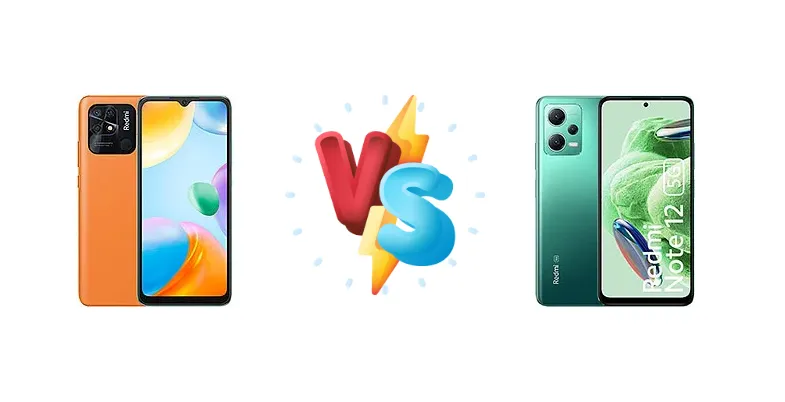
Xiaomi's Redmi series consistently delivers impressive value, but choosing between models can be tricky. The Redmi 10 Power and Redmi Note 12 both offer compelling features at affordable prices. This comprehensive comparison will break down their strengths and weaknesses to help you make the right choice.
🏆 Quick Verdict
The Redmi Note 12 emerges as the overall winner thanks to its faster charging, brighter display, and slightly more powerful chipset. While the 10 Power offers solid battery life, the Note 12's improvements in key areas make it the more appealing option for most users.
| Network |
|---|
| 2G bands | GSM 850 / 900 / 1800 / 1900 | GSM 850 / 900 / 1800 / 1900 |
| 3G bands | HSDPA 850 / 900 / 2100 | HSDPA 850 / 900 / 2100 |
| 4G bands | 1, 3, 5, 8, 40, 41 | 1, 3, 5, 8, 40, 41 |
| 5G bands | - | 1, 3, 5, 8, 28, 40, 78 SA/NSA |
| Speed | HSPA, LTE | HSPA, LTE, 5G |
| Technology | GSM / HSPA / LTE | GSM / HSPA / LTE / 5G |
| Launch |
|---|
| Announced | 2022, April 20 | 2022, October 27 |
| Status | Available. Released 2022, April 30 | Available. Released 2023, January 11 |
| Body |
|---|
| Dimensions | 169.6 x 76.6 x 9.1 mm (6.68 x 3.02 x 0.36 in) | 165.9 x 76.2 x 8 mm (6.53 x 3.00 x 0.31 in) |
| SIM | Nano-SIM + Nano-SIM | Nano-SIM + Nano-SIM |
| Weight | 203 g (7.16 oz) | 188 g (6.63 oz) |
| | - | IP53, dust and splash resistant |
| Display |
|---|
| Protection | Corning Gorilla Glass 3 | Corning Gorilla Glass 3 |
| Resolution | 720 x 1650 pixels (~269 ppi density) | 1080 x 2400 pixels, 20:9 ratio (~395 ppi density) |
| Size | 6.7 inches, 106.2 cm2 (~81.7% screen-to-body ratio) | 6.67 inches, 107.4 cm2 (~85.0% screen-to-body ratio) |
| Type | IPS LCD, 400 nits (typ) | AMOLED, 120Hz, 1200 nits (peak) |
| Platform |
|---|
| CPU | Octa-core (4x2.4 GHz Kryo 265 Gold & 4x1.9 GHz Kryo 265 Silver) | Octa-core (2x2.0 GHz Cortex-A78 & 6x1.8 GHz Cortex-A55) |
| Chipset | Qualcomm SM6225 Snapdragon 680 4G (6 nm) | Qualcomm SM4375 Snapdragon 4 Gen 1 (6 nm) |
| GPU | Adreno 610 | Adreno 619 |
| OS | Android 11, MIUI 13 | Android 12, MIUI 14 (International), MIUI 13 (India) |
| Memory |
|---|
| Card slot | microSDXC (dedicated slot) | microSDXC (uses shared SIM slot) |
| Internal | 128GB 8GB RAM | 128GB 4GB RAM, 128GB 6GB RAM, 256GB 8GB RAM |
| | UFS 2.2 | UFS 2.2 |
| Main Camera |
|---|
| Dual | 50 MP, f/1.8, 26mm (wide), PDAF
Auxiliary lens | - |
| Features | LED flash, HDR, panorama | Dual-LED dual-tone flash, HDR, panorama |
| Single | 5 MP, f/2.0 | - |
| Triple | - | 48 MP, f/1.8, (wide), PDAF
8 MP, f/2.2, 120˚ (ultrawide), 1/4.0", 1.12µm
2 MP (macro) |
| Video | 1080p@30fps | 1080p@30fps |
| Selfie camera |
|---|
| Features | - | HDR |
| Single | 5 MP, f/2.0 | 13 MP, f/2.5, (wide), 1/3.0" |
| Video | 1080p@30fps | 1080p@30fps |
| Sound |
|---|
| 3.5mm jack | Yes | Yes |
| 35mm jack | Yes | Yes |
| Loudspeaker | Yes | Yes |
| | - | 24-bit/192kHz audio |
| Comms |
|---|
| Bluetooth | 5.0, A2DP, LE | 5.1, A2DP, LE |
| Infrared port | Yes | Yes |
| NFC | No | Yes (market/region dependent) |
| Positioning | GPS, GLONASS, BDS | GPS, GLONASS |
| Radio | FM radio | Unspecified |
| USB | USB Type-C 2.0, OTG | USB Type-C 2.0, OTG |
| WLAN | Wi-Fi 802.11 a/b/g/n/ac, dual-band, Wi-Fi Direct | Wi-Fi 802.11 a/b/g/n/ac, dual-band |
| Features |
|---|
| Sensors | Fingerprint (rear-mounted), accelerometer, proximity | Fingerprint (side-mounted), accelerometer, gyro, proximity, compass |
| Battery |
|---|
| Charging | 18W wired | 33W wired, 50% in 22 min |
| Type | Li-Po 6000 mAh | Li-Po 5000 mAh |
| Misc |
|---|
| Colors | Sporty Orange, Power Black | Frosted Green, Matte Black, Mystique Blue |
| Models | - | 22111317I, 22111317G |
| Price | About 180 EUR | € 151.99 / $ 219.99 / ₹ 11,999 |
| SAR | 1.00 W/kg (head) 0.98 W/kg (body) | 1.09 W/kg (head) 1.05 W/kg (body) |
| SAR EU | - | 0.68 W/kg (head) 0.91 W/kg (body) |
| Tests |
|---|
| Battery life | - |
Endurance rating 101h
|
| Camera | - |
Photo / Video |
| Display | - |
Contrast ratio: Infinite (nominal) |
| Loudspeaker | - |
-28.0 LUFS (Good)
|
| Performance | - |
AnTuTu: 360745 (v9)
GeekBench: 1998 (v5.1), 2017 (v6) |
Xiaomi Redmi 10 Power
- Exceptional battery life
- Reliable performance for basic tasks
- Affordable price
- Slower charging
- Less powerful chipset
- Dimmer display
Xiaomi Redmi Note 12
- Faster charging (33W)
- Brighter display
- More powerful chipset (Snapdragon 4 Gen 1)
- Good battery life
- Slightly higher price
- Battery life marginally less than 10 Power in extreme scenarios
Display Comparison
The Redmi Note 12 boasts a significantly brighter display (706 nits vs. likely around 400-450 nits for the 10 Power), making it easier to view in direct sunlight. The 'Infinite' contrast ratio mentioned suggests excellent blacks and vibrant colors on the Note 12. Both likely use IPS LCD panels, offering good viewing angles.
Camera Comparison
Both phones feature capable camera systems, but the Note 12 likely has a slight edge in image quality due to its newer chipset and potentially improved image processing algorithms. Expect decent photos and videos from both, but don't expect flagship-level performance.
Performance
The Redmi Note 12's Snapdragon 4 Gen 1 offers a noticeable performance boost over the 10 Power's Snapdragon 680. The Note 12's Cortex-A78 cores provide better handling of demanding apps and multitasking. While both are suitable for everyday use, the Note 12 will feel snappier.
Battery Life
The Redmi 10 Power shines in battery life, with an endurance rating of 101 hours. The Redmi Note 12 also boasts excellent battery life (10:58h active use, 101h endurance), but the 10 Power might squeeze out slightly more longevity in very light usage. The Note 12's 33W charging is significantly faster than the 10 Power's 18W.
Buying Guide
The Xiaomi Redmi 10 Power is a good choice for users prioritizing long battery life and a reliable, albeit less powerful, processor for everyday tasks. The Xiaomi Redmi Note 12 is ideal for those who want a brighter display, faster charging, and a slightly more responsive experience, especially if media consumption and light gaming are priorities.
Frequently Asked Questions
❓ Is the Redmi Note 12 worth the extra money compared to the Redmi 10 Power?
Yes, the Note 12's faster charging, brighter display, and more powerful chipset generally justify the slightly higher price, especially if you value performance and convenience.
❓ Which phone is better for gaming?
The Redmi Note 12 is the better choice for gaming due to its more powerful Snapdragon 4 Gen 1 chipset, which will provide smoother gameplay and better performance in demanding titles.