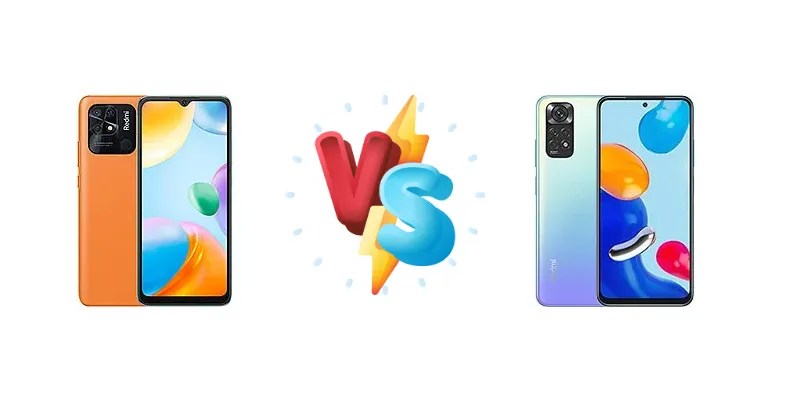
Xiaomi's Redmi series consistently delivers impressive value, but choosing between models can be tricky. The Redmi 10 Power and Redmi Note 11 both offer compelling features at affordable prices. This comprehensive comparison will break down their strengths and weaknesses to help you make the right choice.
🏆 Quick Verdict
The Redmi Note 11 edges out the 10 Power thanks to its faster charging, brighter display, and slightly more refined software experience. While the 10 Power boasts a larger battery, the Note 11's overall package makes it the better pick for most users.
| Network |
|---|
| 2G bands | GSM 850 / 900 / 1800 / 1900 | GSM 850 / 900 / 1800 / 1900 |
| 3G bands | HSDPA 850 / 900 / 2100 | HSDPA 850 / 900 / 1700(AWS) / 1900 / 2100 |
| 4G bands | 1, 3, 5, 8, 40, 41 | 1, 2, 3, 4, 5, 7, 8, 20, 28, 38, 40, 41 |
| Speed | HSPA, LTE | HSPA, LTE |
| Technology | GSM / HSPA / LTE | GSM / HSPA / LTE |
| Launch |
|---|
| Announced | 2022, April 20 | 2022, January 26 |
| Status | Available. Released 2022, April 30 | Available. Released 2022, February 09 |
| Body |
|---|
| Dimensions | 169.6 x 76.6 x 9.1 mm (6.68 x 3.02 x 0.36 in) | 159.9 x 73.9 x 8.1 mm (6.30 x 2.91 x 0.32 in) |
| SIM | Nano-SIM + Nano-SIM | Nano-SIM + Nano-SIM |
| Weight | 203 g (7.16 oz) | 179 g (6.31 oz) |
| | - | IP53, dust and splash resistant |
| Display |
|---|
| Protection | Corning Gorilla Glass 3 | Corning Gorilla Glass 3 |
| Resolution | 720 x 1650 pixels (~269 ppi density) | 1080 x 2400 pixels, 20:9 ratio (~409 ppi density) |
| Size | 6.7 inches, 106.2 cm2 (~81.7% screen-to-body ratio) | 6.43 inches, 99.8 cm2 (~84.5% screen-to-body ratio) |
| Type | IPS LCD, 400 nits (typ) | AMOLED, 90Hz, 700 nits, 1000 nits (peak) |
| Platform |
|---|
| CPU | Octa-core (4x2.4 GHz Kryo 265 Gold & 4x1.9 GHz Kryo 265 Silver) | Octa-core (4x2.4 GHz Kryo 265 Gold & 4x1.9 GHz Kryo 265 Silver) |
| Chipset | Qualcomm SM6225 Snapdragon 680 4G (6 nm) | Qualcomm SM6225 Snapdragon 680 4G (6 nm) |
| GPU | Adreno 610 | Adreno 610 |
| OS | Android 11, MIUI 13 | Android 11, upgradable to Android 13, HyperOS |
| Memory |
|---|
| Card slot | microSDXC (dedicated slot) | microSDXC (dedicated slot) |
| Internal | 128GB 8GB RAM | 64GB 4GB RAM, 64GB 6GB RAM, 128GB 4GB RAM, 128GB 6GB RAM |
| | UFS 2.2 | UFS 2.2 |
| Main Camera |
|---|
| Dual | 50 MP, f/1.8, 26mm (wide), PDAF
Auxiliary lens | - |
| Features | LED flash, HDR, panorama | LED flash, HDR, panorama |
| Quad | - | 50 MP, f/1.8, 26mm (wide), 1/2.76", 0.64µm, PDAF
8 MP, f/2.2, 118˚ (ultrawide), 1/4.0", 1.12µm
2 MP (macro)
Auxiliary lens |
| Single | 5 MP, f/2.0 | 13 MP, f/2.4, (wide), 1/3.1", 1.12µm |
| Video | 1080p@30fps | 1080p@30fps |
| Selfie camera |
|---|
| Single | 5 MP, f/2.0 | 13 MP, f/2.4, (wide), 1/3.1", 1.12µm |
| Video | 1080p@30fps | 1080p@30fps |
| Sound |
|---|
| 3.5mm jack | Yes | Yes |
| 35mm jack | Yes | Yes |
| Loudspeaker | Yes | Yes, with stereo speakers |
| | - | 24-bit/192kHz audio |
| Comms |
|---|
| Bluetooth | 5.0, A2DP, LE | 5.0, A2DP, LE |
| Infrared port | Yes | Yes |
| NFC | No | Yes (market/region dependent) |
| Positioning | GPS, GLONASS, BDS | GPS, GLONASS, BDS, GALILEO |
| Radio | FM radio | FM radio |
| USB | USB Type-C 2.0, OTG | USB Type-C 2.0, OTG |
| WLAN | Wi-Fi 802.11 a/b/g/n/ac, dual-band, Wi-Fi Direct | Wi-Fi 802.11 a/b/g/n/ac, dual-band, Wi-Fi Direct |
| Features |
|---|
| Sensors | Fingerprint (rear-mounted), accelerometer, proximity | Fingerprint (side-mounted), accelerometer, gyro, compass |
| | - | Virtual proximity sensing |
| Battery |
|---|
| Charging | 18W wired | 33W wired, PD3.0, QC3, 100% in 60 min |
| Type | Li-Po 6000 mAh | Li-Po 5000 mAh |
| Misc |
|---|
| Colors | Sporty Orange, Power Black | Graphite Gray, Twilight Blue, Star Blue |
| Models | - | 2201117TG, 2201117TI, 2201117TY, 2201117TL |
| Price | About 180 EUR | £ 95.00 / € 97.99 / ₹ 11,950 |
| SAR | 1.00 W/kg (head) 0.98 W/kg (body) | 0.97 W/kg (head) 0.93 W/kg (body) |
| SAR EU | - | 0.60 W/kg (head) 0.99 W/kg (body) |
| Tests |
|---|
| Battery life | - |
Endurance rating 126h
|
| Camera | - |
Photo / Video |
| Display | - |
Contrast ratio: Infinite (nominal) |
| Loudspeaker | - |
-25.8 LUFS (Very good)
|
| Performance | - |
AnTuTu: 228044 (v8), 244526 (v9)
GeekBench: 1662 (v5.1)
GFXBench: 6.8fps (ES 3.1 onscreen) |
Xiaomi Redmi 10 Power
- Exceptional battery life
- Simple and clean software
- Affordable price
- Slow charging (18W)
- Less bright display
- Basic camera features
Xiaomi Redmi Note 11
- Faster charging (33W)
- Brighter display
- Slightly more refined software
- Slightly smaller battery than 10 Power
- Infinite contrast ratio is nominal
Display Comparison
The Redmi Note 11 takes the display crown with a measured peak brightness of 736 nits, significantly brighter than the 10 Power. While both feature similar LCD panels, the Note 11's higher brightness makes it more usable in direct sunlight. The Note 11 also boasts a theoretically infinite contrast ratio, though this is a nominal value.
Camera Comparison
Camera performance is comparable between the two, with both offering decent image quality in good lighting conditions. The Note 11 might have a slight edge in post-processing and software features. Both phones offer standard camera setups suitable for casual photography.
Performance
Both phones share the same Qualcomm Snapdragon 680 chipset and CPU configuration, meaning performance will be largely similar for everyday tasks and light gaming. Don't expect flagship-level performance from either device, but they're both capable of handling typical usage.
Battery Life
The Redmi 10 Power has a larger battery capacity, but the Redmi Note 11's 33W fast charging significantly reduces charging times. The Note 11 can reach 100% in approximately 60 minutes, while the 10 Power's 18W charging takes considerably longer.
Buying Guide
The Xiaomi Redmi 10 Power is ideal for users prioritizing maximum battery life and a simple, straightforward experience. The Redmi Note 11 is a better choice for those who value faster charging, a brighter display for outdoor visibility, and a slightly more polished software experience.
Frequently Asked Questions
❓ Which phone has better battery life?
The Redmi 10 Power has a larger battery capacity, potentially offering slightly longer usage time, but the Redmi Note 11's faster charging makes up for it.
❓ Is the Redmi Note 11 worth the extra cost?
Generally, yes. The faster charging, brighter display, and slightly improved software experience justify the price difference for most users.