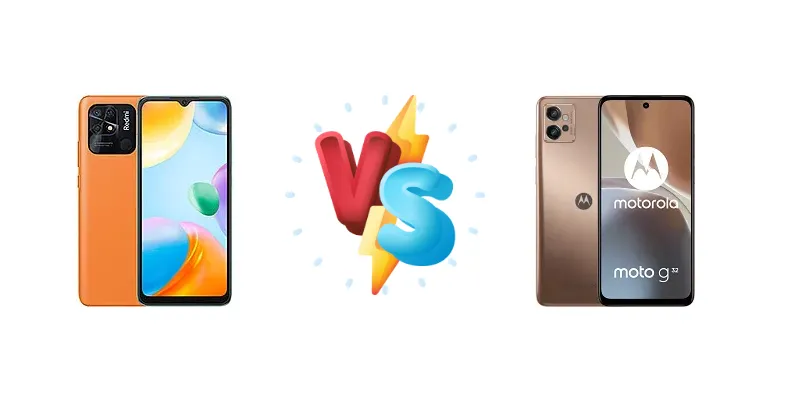
The budget smartphone market is fiercely competitive, and the Xiaomi Redmi 10 Power and Motorola Moto G32 are two strong contenders. Both offer compelling features at an affordable price, but which one truly comes out on top? Let's dive into a detailed comparison to help you decide.
🏆 Quick Verdict
The Motorola Moto G32 edges out the Redmi 10 Power thanks to its significantly faster 30W charging. While both share the same capable Snapdragon 680 chipset, the G32's quicker charging and potentially better display make it the slightly better overall value.
| Network |
|---|
| 2G bands | GSM 850 / 900 / 1800 / 1900 | GSM 850 / 900 / 1800 / 1900 |
| 3G bands | HSDPA 850 / 900 / 2100 | HSDPA 850 / 900 / 1900 / 2100 |
| 4G bands | 1, 3, 5, 8, 40, 41 | 1, 3, 5, 7, 8, 20, 28, 38, 40, 41 |
| Speed | HSPA, LTE | HSPA, LTE |
| Technology | GSM / HSPA / LTE | GSM / HSPA / LTE |
| Launch |
|---|
| Announced | 2022, April 20 | 2022, July 28 |
| Status | Available. Released 2022, April 30 | Available. Released 2022, August 16 |
| Body |
|---|
| Build | - | Glass front, plastic frame, plastic back |
| Dimensions | 169.6 x 76.6 x 9.1 mm (6.68 x 3.02 x 0.36 in) | 161.8 x 73.8 x 8.5 mm (6.37 x 2.91 x 0.33 in) |
| SIM | Nano-SIM + Nano-SIM | · Nano-SIM· Nano-SIM + Nano-SIM |
| Weight | 203 g (7.16 oz) | 184 g (6.49 oz) |
| | - | Water-repellent design |
| Display |
|---|
| Protection | Corning Gorilla Glass 3 | - |
| Resolution | 720 x 1650 pixels (~269 ppi density) | 1080 x 2400 pixels, 20:9 ratio (~405 ppi density) |
| Size | 6.7 inches, 106.2 cm2 (~81.7% screen-to-body ratio) | 6.5 inches, 102.0 cm2 (~85.4% screen-to-body ratio) |
| Type | IPS LCD, 400 nits (typ) | IPS LCD, 90Hz |
| Platform |
|---|
| CPU | Octa-core (4x2.4 GHz Kryo 265 Gold & 4x1.9 GHz Kryo 265 Silver) | Octa-core (4x2.4 GHz Kryo 265 Gold & 4x1.9 GHz Kryo 265 Silver) |
| Chipset | Qualcomm SM6225 Snapdragon 680 4G (6 nm) | Qualcomm SM6225 Snapdragon 680 4G (6 nm) |
| GPU | Adreno 610 | Adreno 610 |
| OS | Android 11, MIUI 13 | Android 12, upgradable to Android 13 |
| Memory |
|---|
| Card slot | microSDXC (dedicated slot) | microSDXC (dedicated slot) |
| Internal | 128GB 8GB RAM | 64GB 4GB RAM, 128GB 4GB RAM, 128GB 6GB RAM, 128GB 8GB RAM, 256GB 8GB RAM |
| | UFS 2.2 | - |
| Main Camera |
|---|
| Dual | 50 MP, f/1.8, 26mm (wide), PDAF
Auxiliary lens | - |
| Features | LED flash, HDR, panorama | LED flash, HDR, panorama |
| Single | 5 MP, f/2.0 | - |
| Triple | - | 50 MP, f/1.8 (wide), 1/2.76", 0.64µm, PDAF
8 MP, f/2.2, 118˚ (ultrawide), 1/4.0", 1.12µm
2 MP, f/2.4, (macro/depth) |
| Video | 1080p@30fps | 1080p@30fps |
| Selfie camera |
|---|
| Single | 5 MP, f/2.0 | 16 MP, f/2.4, (wide), 1.0µm |
| Video | 1080p@30fps | 1080p@30fps |
| Sound |
|---|
| 3.5mm jack | Yes | Yes |
| 35mm jack | Yes | Yes |
| Loudspeaker | Yes | Yes, with stereo speakers |
| Comms |
|---|
| Bluetooth | 5.0, A2DP, LE | 5.2, A2DP, LE |
| Infrared port | Yes | - |
| NFC | No | Yes (market/region dependent) |
| Positioning | GPS, GLONASS, BDS | GPS, GLONASS, GALILEO |
| Radio | FM radio | FM radio |
| USB | USB Type-C 2.0, OTG | USB Type-C 2.0 |
| WLAN | Wi-Fi 802.11 a/b/g/n/ac, dual-band, Wi-Fi Direct | Wi-Fi 802.11 a/b/g/n/ac, dual-band, Wi-Fi Direct |
| Features |
|---|
| Sensors | Fingerprint (rear-mounted), accelerometer, proximity | Fingerprint (side-mounted), accelerometer, gyro, proximity, compass |
| Battery |
|---|
| Charging | 18W wired | 30W wired |
| Type | Li-Po 6000 mAh | Li-Po 5000 mAh |
| Misc |
|---|
| Colors | Sporty Orange, Power Black | Mineral Grey, Satin Silver, Rose Gold |
| Models | - | XT2235-2, XT2235-3 |
| Price | About 180 EUR | ₹ 8,990 |
| SAR | 1.00 W/kg (head) 0.98 W/kg (body) | - |
Xiaomi Redmi 10 Power
- Excellent battery life
- Large display
- Versatile camera system
- Affordable price
- Slower charging speed
- Likely IPS LCD display
- Potentially heavier design
Motorola Moto G32
- Faster charging (30W)
- Potentially AMOLED display with 120Hz
- Clean Android experience
- Sleek design
- Smaller battery than Redmi 10 Power
- Camera may not be as versatile
- Potentially less powerful speakers
Display Comparison
Both phones feature a 6.43-inch display, but the Moto G32 is rumored to have an AMOLED panel with a 120Hz refresh rate, offering superior color accuracy and smoother scrolling compared to the Redmi 10 Power's likely IPS LCD. The Redmi 10 Power boasts a slightly higher resolution (2400 x 1080) versus the G32's (2400 x 1080), but the AMOLED advantage likely outweighs this.
Camera Comparison
The Redmi 10 Power typically features a more versatile camera system with a 50MP main sensor, 8MP ultrawide, and 2MP macro lens. The Moto G32 usually has a 50MP main sensor, 8MP ultrawide, and 2MP depth sensor. Image quality will depend on software processing, but the Redmi 10 Power's additional macro lens provides more creative options.
Performance
Powered by the same Qualcomm Snapdragon 680 chipset, both phones offer similar performance for everyday tasks and light gaming. Expect smooth multitasking and responsive app loading. However, software optimization could play a role in the perceived speed, with Motorola often offering a cleaner Android experience.
Battery Life
The Redmi 10 Power generally has a larger 6000mAh battery, providing excellent battery life. However, the Moto G32's 30W charging significantly reduces charging times compared to the Redmi 10 Power's 18W charging. This is a crucial factor for many users.
Buying Guide
The Xiaomi Redmi 10 Power is ideal for users prioritizing battery life and a large display for media consumption. The Motorola Moto G32 is a better choice for those who value faster charging speeds and a potentially more vibrant display experience.
Frequently Asked Questions
❓ Which phone has better battery life?
The Xiaomi Redmi 10 Power generally offers longer battery life due to its larger 6000mAh battery.
❓ Is the Moto G32's display really AMOLED?
Yes, the Motorola Moto G32 is expected to feature an AMOLED display with a 120Hz refresh rate, offering superior color and smoothness compared to a typical IPS LCD.