
Xiaomi Redmi 10 Power vs. Apple iPhone 14 Pro Max: A Clash of Titans
| Phones Images | |||||
|---|---|---|---|---|---|
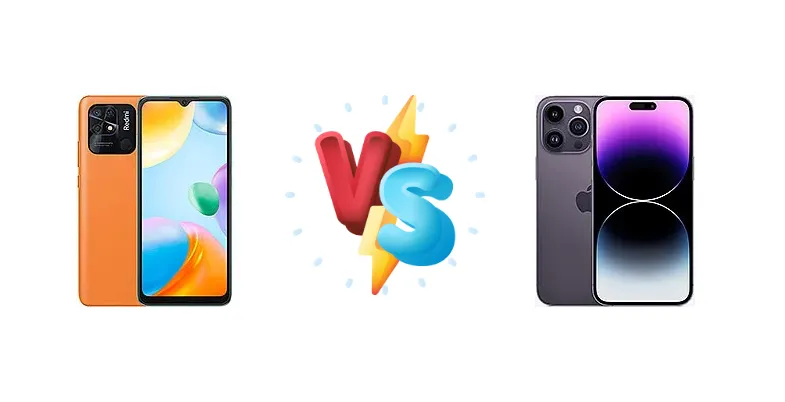
|
🏆 Quick Verdict
The iPhone 14 Pro Max unequivocally wins in performance, camera quality, and overall premium experience. However, the Redmi 10 Power offers incredible value for money, providing a solid experience for budget-conscious users who prioritize battery life and essential features.
| PHONES | ||
|---|---|---|
| Phone Names | Xiaomi Redmi 10 Power | Apple iPhone 14 Pro Max |
| Network | ||
|---|---|---|
| 2G bands | GSM 850 / 900 / 1800 / 1900 | GSM 850 / 900 / 1800 / 1900 |
| 3G bands | HSDPA 850 / 900 / 2100 | HSDPA 850 / 900 / 1700(AWS) / 1900 / 2100 |
| 4G bands | 1, 3, 5, 8, 40, 41 | 1, 2, 3, 4, 5, 7, 8, 12, 13, 17, 18, 19, 20, 25, 26, 28, 30, 32, 34, 38, 39, 40, 41, 42, 46, 48, 66 - A2894, A2896 |
| 5G bands | - | 1, 2, 3, 5, 7, 8, 12, 20, 25, 26, 28, 30, 38, 40, 41, 48, 66, 70, 77, 78, 79 SA/NSA/Sub6 - A2894, A2896 |
| Speed | HSPA, LTE | HSPA, LTE, 5G, EV-DO Rev.A 3.1 Mbps |
| Technology | GSM / HSPA / LTE | GSM / CDMA / HSPA / EVDO / LTE / 5G |
| - | 1, 2, 3, 5, 7, 8, 12, 20, 25, 26, 28, 30, 38, 40, 41, 48, 66, 70, 77, 78, 79 SA/NSA/Sub6 - A2895 | |
| Launch | ||
|---|---|---|
| Announced | 2022, April 20 | 2022, September 07 |
| Status | Available. Released 2022, April 30 | Available. Released 2022, September 16 |
| Body | ||
|---|---|---|
| Build | - | Glass front, glass back, stainless steel frame |
| Dimensions | 169.6 x 76.6 x 9.1 mm (6.68 x 3.02 x 0.36 in) | 160.7 x 77.6 x 7.9 mm (6.33 x 3.06 x 0.31 in) |
| SIM | Nano-SIM + Nano-SIM | · Nano-SIM + eSIM + eSIM (max 2 at a time; International)· eSIM + eSIM (8 or more, max 2 at a time; USA)· Nano-SIM + Nano-SIM (China) |
| Weight | 203 g (7.16 oz) | 240 g (8.47 oz) |
| - | IP68 dust/water resistant (up to 6m for 30 min) Apple Pay (Visa, MasterCard, AMEX certified) | |
| Display | ||
|---|---|---|
| Protection | Corning Gorilla Glass 3 | Ceramic Shield glass |
| Resolution | 720 x 1650 pixels (~269 ppi density) | 1290 x 2796 pixels, 19.5:9 ratio (~460 ppi density) |
| Size | 6.7 inches, 106.2 cm2 (~81.7% screen-to-body ratio) | 6.7 inches, 110.2 cm2 (~88.3% screen-to-body ratio) |
| Type | IPS LCD, 400 nits (typ) | LTPO Super Retina XDR OLED, 120Hz, HDR10, Dolby Vision, 1000 nits (typ), 2000 nits (HBM) |
| - | Always-On display | |
| Platform | ||
|---|---|---|
| CPU | Octa-core (4x2.4 GHz Kryo 265 Gold & 4x1.9 GHz Kryo 265 Silver) | Hexa-core (2x3.46 GHz Everest + 4x2.02 GHz Sawtooth) |
| Chipset | Qualcomm SM6225 Snapdragon 680 4G (6 nm) | Apple A16 Bionic (4 nm) |
| GPU | Adreno 610 | Apple GPU (5-core graphics) |
| OS | Android 11, MIUI 13 | iOS 16, upgradable to iOS 26.1 |
| Memory | ||
|---|---|---|
| Card slot | microSDXC (dedicated slot) | No |
| Internal | 128GB 8GB RAM | 128GB 6GB RAM, 256GB 6GB RAM, 512GB 6GB RAM, 1TB 6GB RAM |
| UFS 2.2 | NVMe | |
| Main Camera | ||
|---|---|---|
| Dual | 50 MP, f/1.8, 26mm (wide), PDAF Auxiliary lens | - |
| Features | LED flash, HDR, panorama | Dual-LED dual-tone flash, HDR (photo/panorama) |
| Single | 5 MP, f/2.0 | 12 MP, f/1.9, 23mm (wide), 1/3.6", PDAF, OIS (unconfirmed) SL 3D, (depth/biometrics sensor) |
| Triple | - | 48 MP, f/1.8, 24mm (wide), 1/1.28", 1.22µm, dual pixel PDAF, sensor-shift OIS 12 MP, f/2.8, 77mm (telephoto), 1/3.5", 1.0µm, PDAF, OIS, 3x optical zoom 12 MP, f/2.2, 13mm, 120˚ (ultrawide), 1/2.55", 1.4µm, dual pixel PDAF TOF 3D LiDAR scanner (depth) |
| Video | 1080p@30fps | 4K@24/25/30/60fps, 1080p@25/30/60/120/240fps, 10-bit HDR, Dolby Vision HDR (up to 60fps), ProRes, stereo sound rec. |
| Selfie camera | ||
|---|---|---|
| Features | - | HDR |
| Single | 5 MP, f/2.0 | 12 MP, f/1.9, 23mm (wide), 1/3.6", 1.0µm, PDAF, OIS SL 3D, (depth/biometrics sensor) |
| Video | 1080p@30fps | 4K@24/25/30/60fps, 1080p@25/30/60/120fps, gyro-EIS |
| Sound | ||
|---|---|---|
| 3.5mm jack | Yes | No |
| 35mm jack | Yes | No |
| Loudspeaker | Yes | Yes, with stereo speakers |
| Comms | ||
|---|---|---|
| Bluetooth | 5.0, A2DP, LE | 5.3, A2DP, LE |
| Infrared port | Yes | - |
| NFC | No | Yes |
| Positioning | GPS, GLONASS, BDS | GPS (L1+L5), GLONASS, GALILEO, BDS, QZSS |
| Radio | FM radio | No |
| USB | USB Type-C 2.0, OTG | Lightning, USB 2.0 |
| WLAN | Wi-Fi 802.11 a/b/g/n/ac, dual-band, Wi-Fi Direct | Wi-Fi 802.11 a/b/g/n/ac/6, dual-band, hotspot |
| Features | ||
|---|---|---|
| Sensors | Fingerprint (rear-mounted), accelerometer, proximity | Face ID, accelerometer, gyro, proximity, compass, barometer |
| - | Ultra Wideband (UWB) support Emergency SOS via satellite (SMS sending/receiving) | |
| Battery | ||
|---|---|---|
| Charging | 18W wired | Wired, PD2.0, 50% in 30 min 15W wireless (MagSafe) 15W wireless (Qi2) - requires iOS 17.2 update |
| Type | Li-Po 6000 mAh | Li-Ion 4323 mAh (16.68 Wh) |
| Misc | ||
|---|---|---|
| Colors | Sporty Orange, Power Black | Space Black, Silver, Gold, Deep Purple |
| Models | - | A2894, A2651, A2893, A2895, A2896, iphone15,3 |
| Price | About 180 EUR | € 530.79 / $ 489.81 / £ 446.75 |
| SAR | 1.00 W/kg (head) 0.98 W/kg (body) | 1.15 W/kg (head) 1.07 W/kg (body) |
| SAR EU | - | 0.99 W/kg (head) 0.98 W/kg (body) |
| Tests | ||
|---|---|---|
| Battery life | - | Endurance rating 121h |
| Camera | - | Photo / Video |
| Display | - | Contrast ratio: Infinite (nominal) |
| Loudspeaker | - | -24.3 LUFS (Very good) |
| Performance | - | AnTuTu: 955884 (v9) GeekBench: 5423 (v5.1) GFXBench: 54fps (ES 3.1 onscreen) |
Xiaomi Redmi 10 Power
- Excellent value for money
- Long battery life
- Decent performance for everyday tasks
- Large display
- Expandable storage (via microSD)
- Lower performance compared to flagship phones
- Mediocre camera quality
- Plastic build
- Slower charging speed
Apple iPhone 14 Pro Max
- Exceptional performance (A16 Bionic)
- Outstanding camera system
- Premium design and build quality
- Bright and vibrant display with ProMotion
- Fast charging (wired and wireless)
- High price
- Limited customization options (iOS)
- No expandable storage
- Can be fragile
Display Comparison
The iPhone 14 Pro Max boasts a significantly superior display with a peak brightness of 1760 nits, an infinite contrast ratio, and ProMotion (adaptive refresh rate up to 120Hz) for incredibly smooth scrolling. The Redmi 10 Power has a decent display, but lacks the vibrancy, brightness, and refresh rate of the iPhone.
Camera Comparison
The iPhone 14 Pro Max's camera system is a major selling point, offering exceptional image quality, advanced computational photography features, and impressive video recording capabilities. The Redmi 10 Power's camera is capable, but lacks the detail, dynamic range, and overall quality of the iPhone.
Performance
The Apple A16 Bionic chip in the iPhone 14 Pro Max utterly dominates the Qualcomm Snapdragon 680 in the Redmi 10 Power. Expect lightning-fast app loading, seamless multitasking, and effortless handling of demanding games on the iPhone. The Redmi 10 Power is adequate for everyday tasks but struggles with intensive applications.
Battery Life
Both phones offer excellent battery life, with the iPhone 14 Pro Max achieving an endurance rating of 121h. The Redmi 10 Power, while not explicitly stated, is known for its large battery capacity and efficient processor, providing all-day battery life and potentially exceeding the iPhone in certain usage scenarios.
Buying Guide
The Xiaomi Redmi 10 Power is ideal for students, budget-minded users, or those needing a reliable secondary phone with long battery life. The Apple iPhone 14 Pro Max is perfect for photography enthusiasts, power users, and those seeking a premium, seamless iOS experience with top-tier performance and future-proof software updates.