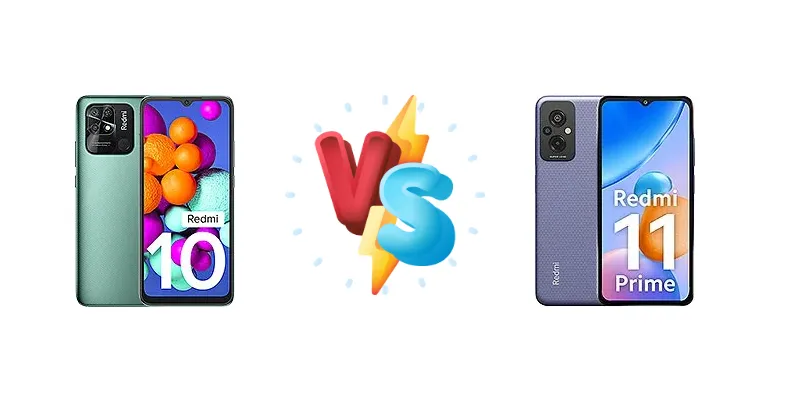
The Xiaomi Redmi series consistently delivers impressive value for money. Two popular contenders in this space are the Redmi 10 and the Redmi 11 Prime. But which one reigns supreme? This detailed comparison will help you decide which phone best suits your needs and budget.
🏆 Quick Verdict
The Redmi 11 Prime edges out the Redmi 10 thanks to its slightly more powerful chipset (Helio G99 vs Snapdragon 680), improved gaming performance, and the added convenience of reverse wired charging. Both offer excellent value, but the 11 Prime provides a more modern experience.
| Network |
|---|
| 2G bands | GSM 850 / 900 / 1800 / 1900 | GSM 850 / 900 / 1800 / 1900 |
| 3G bands | HSDPA 850 / 900 / 2100 | HSDPA 850 / 900 / 2100 |
| 4G bands | 1, 3, 5, 8, 40, 41 | 40, 41 |
| Speed | HSPA, LTE | HSPA, LTE |
| Technology | GSM / HSPA / LTE | GSM / HSPA / LTE |
| Launch |
|---|
| Announced | 2022, March 17 | 2022, September 06 |
| Status | Available. Released 2022, March 24 | Available. Released 2022, September 23 |
| Body |
|---|
| Build | - | Glass front (Gorilla Glass 3), plastic frame, plastic back |
| Dimensions | 169.6 x 76.6 x 9.1 mm (6.68 x 3.02 x 0.36 in) | 164 x 76.1 x 8.9 mm (6.46 x 3.00 x 0.35 in) |
| SIM | Nano-SIM + Nano-SIM | Nano-SIM + Nano-SIM |
| Weight | 203 g (7.16 oz) | 201 g (7.09 oz) |
| Display |
|---|
| Protection | Corning Gorilla Glass 3 | Corning Gorilla Glass 3 |
| Resolution | 720 x 1650 pixels (~269 ppi density) | 1080 x 2408 pixels, 20:9 ratio (~401 ppi density) |
| Size | 6.7 inches, 106.2 cm2 (~81.7% screen-to-body ratio) | 6.58 inches, 104.3 cm2 (~83.6% screen-to-body ratio) |
| Type | IPS LCD | IPS LCD, 90Hz, 400 nits (typ) |
| Platform |
|---|
| CPU | Octa-core (4x2.4 GHz Kryo 265 Gold & 4x1.9 GHz Kryo 265 Silver) | Octa-core (2x2.2 GHz Cortex-A76 & 6x2.0 GHz Cortex-A55) |
| Chipset | Qualcomm SM6225 Snapdragon 680 4G (6 nm) | Mediatek Helio G99 (6 nm) |
| GPU | Adreno 610 | Mali-G57 MC2 |
| OS | Android 11, MIUI 13 | Android 12, MIUI 13 |
| Memory |
|---|
| Card slot | microSDXC (dedicated slot) | microSDXC (dedicated slot) |
| Internal | 64GB 4GB RAM, 128GB 6GB RAM | 64GB 4GB RAM, 128GB 6GB RAM |
| | UFS 2.2 | UFS 2.2 |
| Main Camera |
|---|
| Dual | 50 MP, f/1.8, 26mm (wide), PDAF
Auxiliary lens | 50 MP, f/1.8, (wide), PDAF
2 MP (macro)
Auxiliary lens |
| Features | LED flash, HDR, panorama | LED flash, HDR, panorama |
| Single | 5 MP, f/2.0 | - |
| Video | 1080p@30fps | 1080p@30fps |
| Selfie camera |
|---|
| Features | - | HDR |
| Single | 5 MP, f/2.0 | 8 MP |
| Video | 1080p@30fps | 1080p@30fps |
| Sound |
|---|
| 3.5mm jack | Yes | Yes |
| 35mm jack | Yes | Yes |
| Loudspeaker | Yes | Yes |
| | - | 24-bit/192kHz audio |
| Comms |
|---|
| Bluetooth | 5.0, A2DP, LE | 5.1, A2DP, LE |
| Infrared port | Yes | Yes |
| NFC | No | Yes |
| Positioning | GPS, GLONASS, BDS, GALILEO | GPS, GLONASS, BDS, GALILEO |
| Radio | FM radio | FM radio |
| USB | USB Type-C 2.0, OTG | USB Type-C 2.0, OTG |
| WLAN | Wi-Fi 802.11 a/b/g/n/ac, dual-band, Wi-Fi Direct | Wi-Fi 802.11 a/b/g/n/ac, dual-band |
| Features |
|---|
| Sensors | Fingerprint (rear-mounted), accelerometer, proximity | Fingerprint (side-mounted), accelerometer, proximity, compass |
| Battery |
|---|
| Charging | 18W wired | 18W wired
5W reverse wired |
| Type | Li-Po 6000 mAh | Li-Po 5000 mAh |
| Misc |
|---|
| Colors | Midnight Black, Pacific Blue, Caribbean Green | Playful Green, Flashy Black, Peppy Purple |
| Models | 220333QAG | 22071219AI |
| Price | About 130 EUR | About 160 EUR |
Xiaomi Redmi 10 (India)
- Reliable performance
- Good battery life
- Decent camera
- Affordable price
- 60Hz display
- Slightly older chipset
- No reverse charging
Xiaomi Redmi 11 Prime
- 90Hz display
- More powerful chipset (Helio G99)
- 108MP main camera
- Reverse wired charging
- Can get slightly warm under heavy load
- Software experience can vary
Display Comparison
Both phones feature a 6.43-inch FHD+ display, offering crisp visuals. The Redmi 11 Prime often boasts a 90Hz refresh rate, providing a smoother scrolling and gaming experience compared to the Redmi 10's standard 60Hz. This is a noticeable upgrade for many users.
Camera Comparison
The Redmi 10 typically features a 50MP main camera, while the Redmi 11 Prime often has a 108MP main camera. While megapixels aren't everything, the 11 Prime generally captures more detailed photos, especially in well-lit conditions. Both offer decent ultrawide and macro lenses, but image quality is slightly better on the 11 Prime.
Performance
The Redmi 11 Prime's Mediatek Helio G99 chipset generally outperforms the Redmi 10's Snapdragon 680. The G99's Cortex-A76 cores provide a boost in CPU performance, making the 11 Prime feel snappier for multitasking and demanding apps. Gaming is also noticeably better on the 11 Prime.
Battery Life
Both phones pack a 5000mAh battery, offering all-day battery life for moderate usage. The Redmi 11 Prime's reverse wired charging feature is a bonus, allowing you to charge accessories like earbuds or smartwatches from your phone.
Buying Guide
The Xiaomi Redmi 10 is a great choice for users prioritizing a reliable and efficient daily driver with a good balance of features. The Redmi 11 Prime is ideal for those who want a bit more performance for gaming and multimedia, and appreciate the reverse charging capability for accessories.
Frequently Asked Questions
❓ Is the Redmi 11 Prime worth the upgrade from the Redmi 10?
If you prioritize a smoother display, better gaming performance, and the convenience of reverse charging, then the Redmi 11 Prime is a worthwhile upgrade. Otherwise, the Redmi 10 remains a solid budget option.
❓ Which chipset is better: Snapdragon 680 or Helio G99?
The Mediatek Helio G99 generally offers better performance than the Snapdragon 680, particularly in gaming and demanding applications.