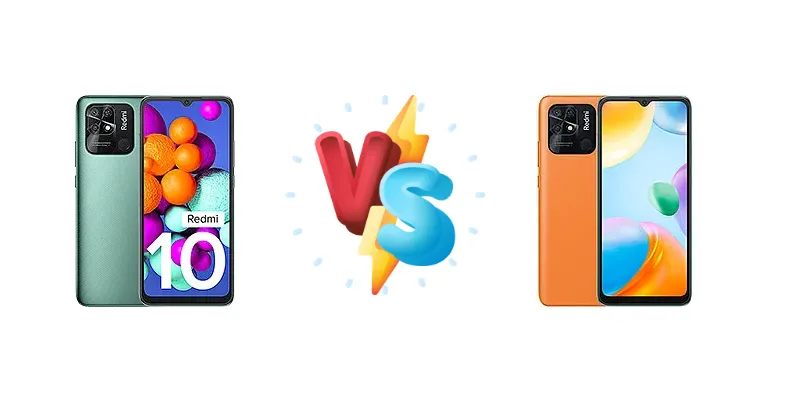
The Xiaomi Redmi series consistently delivers excellent value for money, and the Redmi 10 and Redmi 10 Power are no exception. But with seemingly identical specs, choosing between these two budget-friendly smartphones can be tricky. This comprehensive comparison will break down the differences to help you make the right decision.
🏆 Quick Verdict
Despite sharing the same core chipset and charging speed, the Redmi 10 Power typically offers a larger battery and potentially slightly improved software optimization for longer battery life. If battery endurance is your top priority, the Power is the better choice; otherwise, the standard Redmi 10 is a solid all-rounder.
| Network |
|---|
| 2G bands | GSM 850 / 900 / 1800 / 1900 | GSM 850 / 900 / 1800 / 1900 |
| 3G bands | HSDPA 850 / 900 / 2100 | HSDPA 850 / 900 / 2100 |
| 4G bands | 1, 3, 5, 8, 40, 41 | 1, 3, 5, 8, 40, 41 |
| Speed | HSPA, LTE | HSPA, LTE |
| Technology | GSM / HSPA / LTE | GSM / HSPA / LTE |
| Launch |
|---|
| Announced | 2022, March 17 | 2022, April 20 |
| Status | Available. Released 2022, March 24 | Available. Released 2022, April 30 |
| Body |
|---|
| Dimensions | 169.6 x 76.6 x 9.1 mm (6.68 x 3.02 x 0.36 in) | 169.6 x 76.6 x 9.1 mm (6.68 x 3.02 x 0.36 in) |
| SIM | Nano-SIM + Nano-SIM | Nano-SIM + Nano-SIM |
| Weight | 203 g (7.16 oz) | 203 g (7.16 oz) |
| Display |
|---|
| Protection | Corning Gorilla Glass 3 | Corning Gorilla Glass 3 |
| Resolution | 720 x 1650 pixels (~269 ppi density) | 720 x 1650 pixels (~269 ppi density) |
| Size | 6.7 inches, 106.2 cm2 (~81.7% screen-to-body ratio) | 6.7 inches, 106.2 cm2 (~81.7% screen-to-body ratio) |
| Type | IPS LCD | IPS LCD, 400 nits (typ) |
| Platform |
|---|
| CPU | Octa-core (4x2.4 GHz Kryo 265 Gold & 4x1.9 GHz Kryo 265 Silver) | Octa-core (4x2.4 GHz Kryo 265 Gold & 4x1.9 GHz Kryo 265 Silver) |
| Chipset | Qualcomm SM6225 Snapdragon 680 4G (6 nm) | Qualcomm SM6225 Snapdragon 680 4G (6 nm) |
| GPU | Adreno 610 | Adreno 610 |
| OS | Android 11, MIUI 13 | Android 11, MIUI 13 |
| Memory |
|---|
| Card slot | microSDXC (dedicated slot) | microSDXC (dedicated slot) |
| Internal | 64GB 4GB RAM, 128GB 6GB RAM | 128GB 8GB RAM |
| | UFS 2.2 | UFS 2.2 |
| Main Camera |
|---|
| Dual | 50 MP, f/1.8, 26mm (wide), PDAF
Auxiliary lens | 50 MP, f/1.8, 26mm (wide), PDAF
Auxiliary lens |
| Features | LED flash, HDR, panorama | LED flash, HDR, panorama |
| Single | 5 MP, f/2.0 | 5 MP, f/2.0 |
| Video | 1080p@30fps | 1080p@30fps |
| Selfie camera |
|---|
| Single | 5 MP, f/2.0 | 5 MP, f/2.0 |
| Video | 1080p@30fps | 1080p@30fps |
| Sound |
|---|
| 3.5mm jack | Yes | Yes |
| 35mm jack | Yes | Yes |
| Loudspeaker | Yes | Yes |
| Comms |
|---|
| Bluetooth | 5.0, A2DP, LE | 5.0, A2DP, LE |
| Infrared port | Yes | Yes |
| NFC | No | No |
| Positioning | GPS, GLONASS, BDS, GALILEO | GPS, GLONASS, BDS |
| Radio | FM radio | FM radio |
| USB | USB Type-C 2.0, OTG | USB Type-C 2.0, OTG |
| WLAN | Wi-Fi 802.11 a/b/g/n/ac, dual-band, Wi-Fi Direct | Wi-Fi 802.11 a/b/g/n/ac, dual-band, Wi-Fi Direct |
| Features |
|---|
| Sensors | Fingerprint (rear-mounted), accelerometer, proximity | Fingerprint (rear-mounted), accelerometer, proximity |
| Battery |
|---|
| Charging | 18W wired | 18W wired |
| Type | Li-Po 6000 mAh | Li-Po 6000 mAh |
| Misc |
|---|
| Colors | Midnight Black, Pacific Blue, Caribbean Green | Sporty Orange, Power Black |
| Models | 220333QAG | - |
| Price | About 130 EUR | About 180 EUR |
| SAR | - | 1.00 W/kg (head) 0.98 W/kg (body) |
Xiaomi Redmi 10 (India)
- Slightly more compact design
- Potentially more refined software experience
- Good value for money
- Smaller battery compared to Power
- Charging speed could be faster
Xiaomi Redmi 10 Power
- Exceptional battery life
- Large display
- Good value for money
- Larger and potentially less comfortable to hold
- Performance might be slightly throttled for battery saving
Display Comparison
Both phones feature a 6.43-inch FHD+ AMOLED display with a 60Hz refresh rate. While the resolution and panel type are identical, slight variations in color calibration or brightness might exist, but these are generally negligible. The standard Redmi 10 might feel slightly more pocketable due to its marginally smaller dimensions.
Camera Comparison
Both devices typically feature a quad-camera setup with a 50MP main sensor, an 8MP ultrawide, a 2MP macro, and a 2MP depth sensor. Image quality should be comparable in most lighting conditions. Software processing and post-processing algorithms might differ slightly, resulting in subtle variations in color and dynamic range.
Performance
Powered by the same Snapdragon 680 chipset, performance is expected to be very similar on both devices. Day-to-day tasks, social media browsing, and light gaming should run smoothly on either phone. However, the Redmi 10 Power's software optimization might prioritize battery saving, potentially leading to slightly reduced performance in demanding scenarios.
Battery Life
This is where the Redmi 10 Power typically shines. While both phones support 18W charging, the Power usually boasts a larger battery capacity (typically 6000mAh vs. 5000mAh on the standard Redmi 10), translating to significantly longer battery life.
Buying Guide
Who should buy the Xiaomi Redmi 10 (India)? Users prioritizing a slightly more compact design and potentially a more refined software experience (depending on updates) will appreciate the standard Redmi 10. Who should buy the Xiaomi Redmi 10 Power? Those who demand maximum battery life and are willing to accept a potentially larger device will find the Redmi 10 Power more appealing.
Frequently Asked Questions
❓ Is the Redmi 10 Power worth the extra cost?
If battery life is your top priority, then yes, the Redmi 10 Power is worth the slight premium. Otherwise, the standard Redmi 10 offers a very similar experience at a potentially lower price.
❓ Do both phones support fast charging?
Both phones support 18W wired charging, although Xiaomi often includes a 10W charger in the box. You'll need to purchase a separate 18W charger for optimal charging speeds.