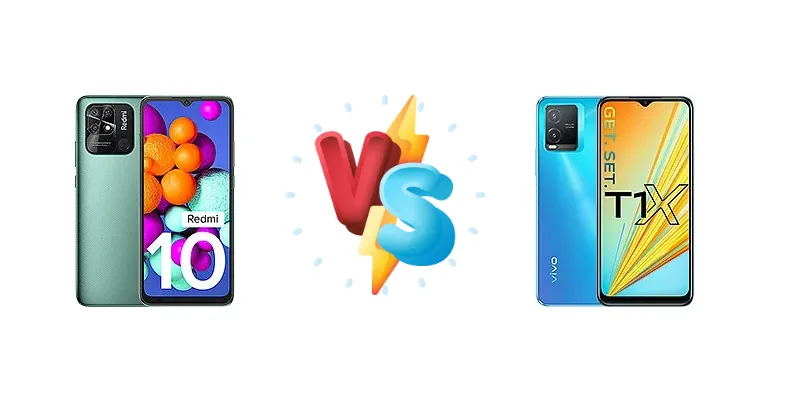
The Xiaomi Redmi 10 and vivo T1x represent a fiercely competitive segment of the Indian smartphone market – the sub-₹15,000 (approximately $180 USD) bracket. Both devices center around the Qualcomm Snapdragon 680, aiming to deliver a balance of performance and efficiency. This comparison dissects the nuances between these two phones, moving beyond the identical chipset to uncover where each excels.
🏆 Quick Verdict
For the average user prioritizing a potentially cleaner software experience and a slightly more streamlined design, the vivo T1x emerges as the better choice. However, the Redmi 10’s established brand recognition and wider availability shouldn’t be dismissed. The core performance is virtually identical.
| Network |
|---|
| 2G bands | GSM 850 / 900 / 1800 / 1900 | GSM 850 / 900 / 1800 / 1900 |
| 3G bands | HSDPA 850 / 900 / 2100 | HSDPA 850 / 900 / 2100 |
| 4G bands | 1, 3, 5, 8, 40, 41 | 1, 3, 5, 8, 38, 40, 41 |
| Speed | HSPA, LTE | HSPA, LTE |
| Technology | GSM / HSPA / LTE | GSM / HSPA / LTE |
| Launch |
|---|
| Announced | 2022, March 17 | 2022, July 20 |
| Status | Available. Released 2022, March 24 | Available. Released 2022, July 27 |
| Body |
|---|
| Build | - | Glass front, plastic frame, plastic back |
| Dimensions | 169.6 x 76.6 x 9.1 mm (6.68 x 3.02 x 0.36 in) | 164.3 x 76.1 x 8 mm (6.47 x 3.00 x 0.31 in) |
| SIM | Nano-SIM + Nano-SIM | Nano-SIM + Nano-SIM |
| Weight | 203 g (7.16 oz) | 182 g (6.42 oz) |
| Display |
|---|
| Protection | Corning Gorilla Glass 3 | - |
| Resolution | 720 x 1650 pixels (~269 ppi density) | 1080 x 2408 pixels, 20:9 ratio (~401 ppi density) |
| Size | 6.7 inches, 106.2 cm2 (~81.7% screen-to-body ratio) | 6.58 inches, 104.3 cm2 (~83.4% screen-to-body ratio) |
| Type | IPS LCD | IPS LCD, 90Hz |
| Platform |
|---|
| CPU | Octa-core (4x2.4 GHz Kryo 265 Gold & 4x1.9 GHz Kryo 265 Silver) | Octa-core (4x2.4 GHz Kryo 265 Gold & 4x1.9 GHz Kryo 265 Silver) |
| Chipset | Qualcomm SM6225 Snapdragon 680 4G (6 nm) | Qualcomm SM6225 Snapdragon 680 4G (6 nm) |
| GPU | Adreno 610 | Adreno 610 |
| OS | Android 11, MIUI 13 | Android, Funtouch 12 |
| Memory |
|---|
| Card slot | microSDXC (dedicated slot) | microSDXC (dedicated slot) |
| Internal | 64GB 4GB RAM, 128GB 6GB RAM | 64GB 4GB RAM, 128GB 4GB RAM, 128GB 6GB RAM |
| | UFS 2.2 | UFS 2.2 |
| Main Camera |
|---|
| Dual | 50 MP, f/1.8, 26mm (wide), PDAF
Auxiliary lens | 50 MP, f/1.8, (wide), PDAF
Auxiliary lens |
| Features | LED flash, HDR, panorama | LED flash, HDR |
| Single | 5 MP, f/2.0 | 8 MP, f/1.8, (wide) |
| Video | 1080p@30fps | 1080p@30fps |
| Selfie camera |
|---|
| Single | 5 MP, f/2.0 | 8 MP, f/1.8, (wide) |
| Video | 1080p@30fps | 1080p@30fps |
| Sound |
|---|
| 3.5mm jack | Yes | Yes |
| 35mm jack | Yes | Yes |
| Loudspeaker | Yes | Yes |
| Comms |
|---|
| Bluetooth | 5.0, A2DP, LE | 5.0, A2DP, LE |
| Infrared port | Yes | - |
| NFC | No | No |
| Positioning | GPS, GLONASS, BDS, GALILEO | GPS, GLONASS, GALILEO, BDS, QZSS |
| Radio | FM radio | FM radio |
| USB | USB Type-C 2.0, OTG | USB Type-C, OTG |
| WLAN | Wi-Fi 802.11 a/b/g/n/ac, dual-band, Wi-Fi Direct | Wi-Fi 802.11 a/b/g/n/ac, dual-band, Wi-Fi Direct, hotspot |
| Features |
|---|
| Sensors | Fingerprint (rear-mounted), accelerometer, proximity | Fingerprint (side-mounted), accelerometer, proximity, compass |
| Battery |
|---|
| Charging | 18W wired | 18W wired |
| Type | Li-Po 6000 mAh | 5000 mAh |
| Misc |
|---|
| Colors | Midnight Black, Pacific Blue, Caribbean Green | Gravity Black, Space Blue |
| Models | 220333QAG | V2143 |
| Price | About 130 EUR | About 150 EUR |
Xiaomi Redmi 10 (India)
- Established brand reputation
- Wider availability of accessories
- Strong resale value
- Potential for MIUI bloatware
- Software updates may be slower
vivo T1x (India)
- Potentially cleaner software experience (Funtouch OS)
- Modern design aesthetic
- Rapidly growing brand presence
- Less established ecosystem
- Resale value may be lower
Display Comparison
Both the Redmi 10 and T1x are expected to feature LCD panels, typical for this price point. While specific details like peak brightness and color gamut coverage aren't provided, the focus will likely be on maximizing battery life rather than delivering a vibrant visual experience. Bezels are likely to be similar, and neither device is expected to offer high refresh rate displays. The user experience will be functional, prioritizing readability over immersive visuals.
Camera Comparison
Without detailed camera specifications, it’s difficult to draw firm conclusions. Both phones likely feature a multi-camera setup, but the quality will heavily depend on the primary sensor and image processing algorithms. Given the price bracket, expect a focus on computational photography to enhance image quality. The presence of a 2MP macro camera on both is likely a marketing feature with limited practical utility. Image processing style will be a key differentiator – Xiaomi typically leans towards more saturated colors, while vivo often aims for a more natural look.
Performance
The heart of both devices is the Qualcomm Snapdragon 680 4G (6 nm) chipset, featuring an octa-core CPU configuration with 4x2.4 GHz Kryo 265 Gold and 4x1.9 GHz Kryo 265 Silver cores. This means CPU performance will be nearly indistinguishable between the two. The 6nm process node contributes to good power efficiency, but sustained performance under heavy load will depend on thermal management, a detail not specified. RAM configurations are likely similar, impacting multitasking capabilities. The identical chipset suggests similar gaming performance, capable of handling popular titles at medium settings.
Battery Life
Both the Redmi 10 and T1x support 18W wired charging. While the battery capacity isn't specified, it's reasonable to assume they are similarly sized (around 5000mAh). 18W charging isn't particularly fast by today's standards, meaning a full 0-100% charge will likely take around 2 hours. The Snapdragon 680’s efficiency will contribute to all-day battery life for moderate users. The real-world impact will depend on software optimization and usage patterns.
Buying Guide
Buy the Xiaomi Redmi 10 (India) if you need a phone with a well-established ecosystem, readily available accessories, and a strong resale value. Buy the vivo T1x (India) if you prefer a potentially less cluttered software experience, a more modern aesthetic, and are comfortable with a brand that’s rapidly gaining traction in India.
Frequently Asked Questions
❓ Will the Snapdragon 680 in either phone struggle with demanding games like Genshin Impact?
The Snapdragon 680 is a capable processor for casual gaming, but demanding titles like Genshin Impact will likely require significant graphics settings reductions and may still experience occasional frame drops. Expect playable performance at lower settings.
❓ How does the software experience differ between Xiaomi's MIUI and vivo's Funtouch OS?
MIUI is known for its extensive customization options and feature set, but it often comes with pre-installed bloatware. Funtouch OS generally offers a cleaner, more streamlined experience, but may lack some of the advanced features found in MIUI. User preference plays a significant role here.
❓ Is the 18W charging speed sufficient for daily use?
While 18W charging isn't the fastest available, it's adequate for overnight charging or topping up the battery during downtime. Expect a full charge to take around 2 hours. The Snapdragon 680's efficiency helps mitigate the slower charging speed.