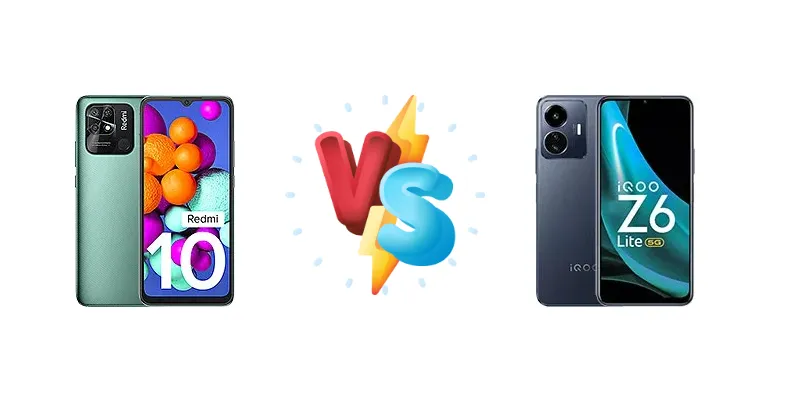
The sub-₹15,000 (approximately $180 USD) smartphone segment in India is fiercely competitive. The Xiaomi Redmi 10 and vivo iQOO Z6 Lite both aim to deliver a solid experience without breaking the bank, but they take different approaches, primarily revolving around their respective Qualcomm Snapdragon chipsets. This comparison dissects the key differences to help you choose the right device.
🏆 Quick Verdict
For the average user prioritizing sustained performance and a slightly more mature software ecosystem, the Xiaomi Redmi 10 (India) emerges as the better choice. Its Snapdragon 680, while older, offers a more balanced CPU/GPU combination and benefits from a 6nm process, potentially leading to better thermal management during extended use. However, the iQOO Z6 Lite isn't far behind and offers a compelling alternative.
| Network |
|---|
| 2G bands | GSM 850 / 900 / 1800 / 1900 | GSM 850 / 900 / 1800 / 1900 |
| 3G bands | HSDPA 850 / 900 / 2100 | HSDPA 850 / 900 / 2100 |
| 4G bands | 1, 3, 5, 8, 40, 41 | 1, 3, 5, 8, 38, 40, 41 |
| 5G bands | - | 77, 78 SA/NSA |
| Speed | HSPA, LTE | HSPA, LTE, 5G |
| Technology | GSM / HSPA / LTE | GSM / HSPA / LTE / 5G |
| Launch |
|---|
| Announced | 2022, March 17 | 2022, September 14 |
| Status | Available. Released 2022, March 24 | Available. Released 2022, September 14 |
| Body |
|---|
| Build | - | Glass front, plastic frame, plastic back |
| Dimensions | 169.6 x 76.6 x 9.1 mm (6.68 x 3.02 x 0.36 in) | 164 x 75.8 x 8.3 mm (6.46 x 2.98 x 0.33 in) |
| SIM | Nano-SIM + Nano-SIM | Nano-SIM + Nano-SIM |
| Weight | 203 g (7.16 oz) | 194 g (6.84 oz) |
| Display |
|---|
| Protection | Corning Gorilla Glass 3 | - |
| Resolution | 720 x 1650 pixels (~269 ppi density) | 1080 x 2408 pixels, 20:9 ratio (~401 ppi density) |
| Size | 6.7 inches, 106.2 cm2 (~81.7% screen-to-body ratio) | 6.58 inches, 104.3 cm2 (~83.9% screen-to-body ratio) |
| Type | IPS LCD | IPS LCD, 120Hz |
| Platform |
|---|
| CPU | Octa-core (4x2.4 GHz Kryo 265 Gold & 4x1.9 GHz Kryo 265 Silver) | Octa-core (2x2.0 GHz Cortex-A78 & 6x1.8 GHz Cortex-A55) |
| Chipset | Qualcomm SM6225 Snapdragon 680 4G (6 nm) | Qualcomm SM4375 Snapdragon 4 Gen 1 (6 nm) |
| GPU | Adreno 610 | Adreno 619 |
| OS | Android 11, MIUI 13 | Android 12, Funtouch 12 |
| Memory |
|---|
| Card slot | microSDXC (dedicated slot) | microSDXC (uses shared SIM slot) |
| Internal | 64GB 4GB RAM, 128GB 6GB RAM | 64GB 4GB RAM, 128GB 6GB RAM |
| | UFS 2.2 | - |
| Main Camera |
|---|
| Dual | 50 MP, f/1.8, 26mm (wide), PDAF
Auxiliary lens | 50 MP, f/1.8, (wide), PDAF
2 MP (macro) |
| Features | LED flash, HDR, panorama | Dual-LED dual-tone flash, HDR, panorama |
| Single | 5 MP, f/2.0 | 8 MP, f/2.0, (wide) |
| Video | 1080p@30fps | 1080p@30fps |
| Selfie camera |
|---|
| Single | 5 MP, f/2.0 | 8 MP, f/2.0, (wide) |
| Video | 1080p@30fps | 1080p@30fps |
| Sound |
|---|
| 3.5mm jack | Yes | Yes |
| 35mm jack | Yes | Yes |
| Loudspeaker | Yes | Yes |
| Comms |
|---|
| Bluetooth | 5.0, A2DP, LE | 5.1, A2DP, LE |
| Infrared port | Yes | - |
| NFC | No | No |
| Positioning | GPS, GLONASS, BDS, GALILEO | GPS, GLONASS, GALILEO, BDS, QZSS |
| Radio | FM radio | FM radio |
| USB | USB Type-C 2.0, OTG | USB Type-C 2.0, OTG |
| WLAN | Wi-Fi 802.11 a/b/g/n/ac, dual-band, Wi-Fi Direct | Wi-Fi 802.11 a/b/g/n/ac, dual-band, Wi-Fi Direct |
| Features |
|---|
| Sensors | Fingerprint (rear-mounted), accelerometer, proximity | Fingerprint (side-mounted), accelerometer, proximity, compass |
| Battery |
|---|
| Charging | 18W wired | 18W wired |
| Type | Li-Po 6000 mAh | 5000 mAh |
| Misc |
|---|
| Colors | Midnight Black, Pacific Blue, Caribbean Green | Mystic Night, Stellar Green |
| Models | 220333QAG | I2208 |
| Price | About 130 EUR | About 180 EUR |
Xiaomi Redmi 10 (India)
- Snapdragon 680 offers balanced performance.
- Potentially better thermal management due to 6nm and architecture.
- Mature software ecosystem from Xiaomi.
- Older chipset compared to the Snapdragon 4 Gen 1.
- Display specs are unknown, potentially limiting visual experience.
vivo iQOO Z6 Lite
- Newer Snapdragon 4 Gen 1 chipset.
- Cortex-A78 cores provide strong single-core performance.
- Potentially more responsive for quick tasks.
- Snapdragon 4 Gen 1 may throttle more under sustained load.
- Software optimization may be less refined than Xiaomi's MIUI.
Display Comparison
Both devices are expected to feature LCD panels, a common trait in this price bracket. However, detailed display specs (resolution, brightness, color gamut) are missing. The focus here is on the chipset's ability to drive the display smoothly. While neither is expected to offer high refresh rates, the Snapdragon 680's slightly more powerful GPU could translate to a more fluid user interface, especially when scrolling through content. The absence of detailed display specs makes a definitive comparison impossible, but the Redmi 10's GPU advantage is a potential differentiator.
Camera Comparison
Without detailed camera sensor information, a direct comparison is limited. Both phones likely feature a primary camera alongside auxiliary lenses (potentially including a depth or macro sensor). The image signal processor (ISP) within the Snapdragon 680 has a longer track record and potentially more optimized image processing algorithms. While the iQOO Z6 Lite’s newer chipset *could* offer improvements, the Redmi 10’s ISP maturity is a significant advantage. The absence of OIS (Optical Image Stabilization) on either device suggests reliance on software stabilization, where the Snapdragon 680’s processing capabilities could again provide an edge.
Performance
The core of the difference lies in the chipsets. The Redmi 10 utilizes the Qualcomm SM6225 Snapdragon 680, built on a 6nm process, featuring an octa-core configuration with 4x2.4 GHz Kryo 265 Gold and 4x1.9 GHz Kryo 265 Silver cores. The iQOO Z6 Lite employs the Snapdragon 4 Gen 1 (SM4375), also 6nm, but with a different core arrangement: 2x2.0 GHz Cortex-A78 and 6x1.8 GHz Cortex-A55. The Cortex-A78 cores in the Z6 Lite offer higher single-core performance, potentially benefiting short bursts of tasks and app launches. However, the Snapdragon 680’s Kryo Gold cores, combined with a more balanced core count, are likely to provide superior sustained multi-core performance, crucial for gaming and multitasking. The 6nm process on both chips contributes to improved efficiency, but the Snapdragon 680’s architecture is generally considered more refined.
Battery Life
Both devices are equipped with 18W wired charging, suggesting similar charging speeds (approximately 2-3 hours for a full charge). Battery capacity is not specified, but typical capacities in this segment range from 5000mAh to 5500mAh. The Snapdragon 680’s 6nm efficiency could translate to slightly better battery life, especially during demanding tasks. However, real-world battery performance is heavily influenced by software optimization and user habits. The similar charging wattage means the difference in 0-100% times will likely be negligible.
Buying Guide
Buy the Xiaomi Redmi 10 (India) if you need a phone for consistent everyday tasks, moderate gaming, and value a brand with a well-established track record in India. Buy the vivo iQOO Z6 Lite if you prioritize a slightly newer chipset and are looking for a device that might offer marginally better responsiveness in quick app switching, though at the potential cost of sustained performance under load.
Frequently Asked Questions
❓ Will the iQOO Z6 Lite overheat during prolonged gaming sessions like PUBG or Call of Duty?
The Snapdragon 4 Gen 1 is a capable chip, but its thermal performance under sustained load is a potential concern. While the 6nm process helps, the core configuration and cooling solution (which is unspecified) may lead to throttling, reducing frame rates after extended gaming. The Redmi 10's Snapdragon 680, with its more balanced architecture, is likely to handle prolonged gaming slightly better.
❓ Does either phone support VoWiFi (Wi-Fi Calling) and VoLTE (Voice over LTE) for improved call quality in areas with poor cellular reception?
Support for VoWiFi and VoLTE is highly dependent on carrier compatibility and software implementation. Both Xiaomi and vivo typically include these features in their devices targeting the Indian market, but it's crucial to verify compatibility with your specific carrier before purchasing. Check the official specifications or contact your carrier for confirmation.
❓ How does the software experience differ between Xiaomi's MIUI and vivo's Funtouch OS?
MIUI is known for its extensive customization options and feature set, but it can also be perceived as bloated with pre-installed apps. Funtouch OS, on the other hand, generally offers a cleaner and more streamlined experience, but with fewer customization options. The choice depends on your preference: MIUI for power users who enjoy tweaking settings, or Funtouch OS for a simpler, more straightforward interface.