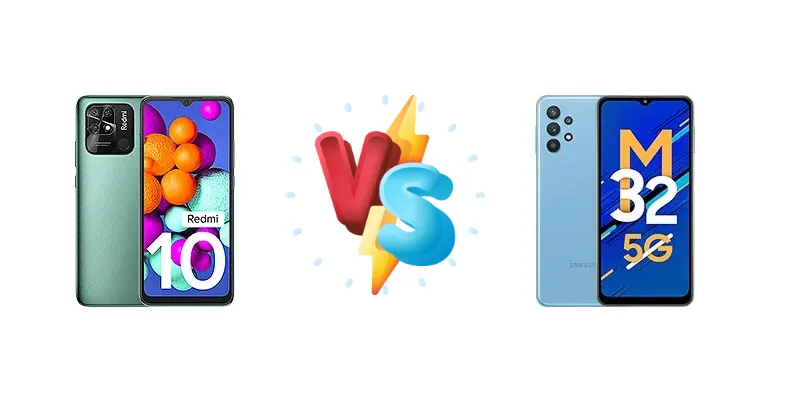
Both the Xiaomi Redmi 10 (India) and the Samsung Galaxy M32 5G target the competitive sub-₹15,000 Indian market, offering 5G connectivity at an accessible price point. However, they diverge significantly in their core hardware, particularly in their chipsets. This comparison dissects those differences to determine which phone delivers the best overall experience.
🏆 Quick Verdict
For the average user prioritizing efficiency and sustained performance, the Xiaomi Redmi 10 (India) is the better choice. Its Snapdragon 680, built on a 6nm process, offers superior power efficiency and potentially less thermal throttling compared to the Galaxy M32 5G’s Dimensity 720. While the M32 5G boasts 5G, the Redmi 10’s optimized chipset provides a smoother daily experience.
| Network |
|---|
| 2G bands | GSM 850 / 900 / 1800 / 1900 | GSM 850 / 900 / 1800 / 1900 |
| 3G bands | HSDPA 850 / 900 / 2100 | HSDPA 850 / 900 / 1700(AWS) / 1900 / 2100 |
| 4G bands | 1, 3, 5, 8, 40, 41 | 1, 2, 3, 4, 5, 7, 8, 12, 17, 20, 26, 28, 38, 40, 41, 66 |
| 5G bands | - | 1, 3, 5, 7, 8, 20, 28, 38, 40, 41, 66, 78 SA/NSA/Sub6 |
| Speed | HSPA, LTE | HSPA, LTE, 5G |
| Technology | GSM / HSPA / LTE | GSM / HSPA / LTE / 5G |
| Launch |
|---|
| Announced | 2022, March 17 | 2021, August 25 |
| Status | Available. Released 2022, March 24 | Available. Released 2021, September 02 |
| Body |
|---|
| Dimensions | 169.6 x 76.6 x 9.1 mm (6.68 x 3.02 x 0.36 in) | 164.2 x 76.1 x 9.1 mm (6.46 x 3.00 x 0.36 in) |
| SIM | Nano-SIM + Nano-SIM | Nano-SIM + Nano-SIM |
| Weight | 203 g (7.16 oz) | 205 g (7.23 oz) |
| Display |
|---|
| Protection | Corning Gorilla Glass 3 | - |
| Resolution | 720 x 1650 pixels (~269 ppi density) | 720 x 1600 pixels, 20:9 ratio (~270 ppi density) |
| Size | 6.7 inches, 106.2 cm2 (~81.7% screen-to-body ratio) | 6.5 inches, 102.0 cm2 (~81.6% screen-to-body ratio) |
| Type | IPS LCD | TFT LCD |
| Platform |
|---|
| CPU | Octa-core (4x2.4 GHz Kryo 265 Gold & 4x1.9 GHz Kryo 265 Silver) | Octa-core (2x2.0 GHz Cortex-A76 & 6x2.0 GHz Cortex-A55) |
| Chipset | Qualcomm SM6225 Snapdragon 680 4G (6 nm) | Mediatek Dimensity 720 (7 nm) |
| GPU | Adreno 610 | Mali-G57 MC3 |
| OS | Android 11, MIUI 13 | Android 11, upgradable to Android 13, One UI 5 |
| Memory |
|---|
| Card slot | microSDXC (dedicated slot) | microSDXC (uses shared SIM slot) |
| Internal | 64GB 4GB RAM, 128GB 6GB RAM | 128GB 6GB RAM, 128GB 8GB RAM |
| | UFS 2.2 | eMMC 5.1 |
| Main Camera |
|---|
| Dual | 50 MP, f/1.8, 26mm (wide), PDAF
Auxiliary lens | - |
| Features | LED flash, HDR, panorama | LED flash, panorama, HDR |
| Quad | - | 48 MP, f/1.8, 26mm (wide), PDAF
8 MP, f/2.2, 123˚ (ultrawide)
5 MP (macro)
Auxiliary lens |
| Single | 5 MP, f/2.0 | - |
| Video | 1080p@30fps | 4K@30fps, 1080p@30fps |
| Selfie camera |
|---|
| Single | 5 MP, f/2.0 | 13 MP, f/2.2, (wide) |
| Video | 1080p@30fps | 1080p@30fps |
| Sound |
|---|
| 3.5mm jack | Yes | Yes |
| 35mm jack | Yes | Yes |
| Loudspeaker | Yes | Yes |
| Comms |
|---|
| Bluetooth | 5.0, A2DP, LE | 5.0, A2DP, LE, aptX |
| Infrared port | Yes | - |
| NFC | No | Yes |
| Positioning | GPS, GLONASS, BDS, GALILEO | GPS, GLONASS, BDS, GALILEO |
| Radio | FM radio | Unspecified |
| USB | USB Type-C 2.0, OTG | USB Type-C 2.0, OTG |
| WLAN | Wi-Fi 802.11 a/b/g/n/ac, dual-band, Wi-Fi Direct | Wi-Fi 802.11 a/b/g/n/ac, dual-band, Wi-Fi Direct |
| Features |
|---|
| Sensors | Fingerprint (rear-mounted), accelerometer, proximity | Fingerprint (side-mounted), accelerometer, gyro, compass |
| | - | Virtual proximity sensing |
| Battery |
|---|
| Charging | 18W wired | 15W wired |
| Type | Li-Po 6000 mAh | Li-Ion 5000 mAh |
| Misc |
|---|
| Colors | Midnight Black, Pacific Blue, Caribbean Green | Slate Black, Sky Blue |
| Models | 220333QAG | SM-M326B, SM-M326B/DS |
| Price | About 130 EUR | About 220 EUR |
| SAR | - | 0.48 W/kg (head) |
Xiaomi Redmi 10 (India)
- More power-efficient Snapdragon 680 chipset
- Faster 18W charging
- Potentially better image processing
- Lacks 5G connectivity
- Display details are unknown
Samsung Galaxy M32 5G
- 5G connectivity for future-proofing
- Potentially wider 5G network compatibility
- Samsung’s One UI software experience
- Less efficient Dimensity 720 chipset
- Slower 15W charging
- Potential for thermal throttling under load
Display Comparison
Neither device boasts a standout display. Both likely utilize LCD panels, a common trait in this price bracket. The key difference lies under the hood; details on panel quality (peak brightness, color gamut coverage) are absent. However, the Redmi 10’s potential for better image processing due to its more efficient chipset *could* translate to slightly improved visual clarity. Bezels are expected to be comparable, typical of budget devices.
Camera Comparison
Without detailed sensor information beyond the presence of a main camera, a direct comparison is difficult. However, the Redmi 10’s image signal processor (ISP), integrated within the Snapdragon 680, benefits from Qualcomm’s image processing algorithms. This *could* result in better dynamic range and noise reduction, particularly in challenging lighting conditions. The Galaxy M32 5G’s Dimensity 720 also has an ISP, but it’s likely less refined. The prevalence of 2MP macro/depth sensors on both devices suggests limited utility; focusing on the main sensor’s quality is crucial.
Performance
The core battleground is the chipset. The Xiaomi Redmi 10’s Qualcomm Snapdragon 680 (6nm) is a significant advantage over the Samsung Galaxy M32 5G’s MediaTek Dimensity 720 (7nm). The 6nm node generally translates to better power efficiency, meaning the Redmi 10 should deliver longer battery life and run cooler under load. While the Dimensity 720 features Cortex-A76 cores for peak performance, the Snapdragon 680’s Kryo cores, coupled with the process node advantage, are likely to provide more consistent performance during extended gaming or multitasking. The CPU configuration (Octa-core 2.4GHz vs Octa-core 2.0GHz) further favors the Redmi 10 in raw processing power.
Battery Life
The Redmi 10’s 18W charging is slightly faster than the Galaxy M32 5G’s 15W charging. However, the real advantage lies in the Snapdragon 680’s power efficiency. This means the Redmi 10 will likely achieve a similar or longer battery life with a comparable battery capacity (spec not provided) and charge slightly faster. The Dimensity 720, while capable, is less efficient, potentially leading to more frequent charging needs.
Buying Guide
Buy the Xiaomi Redmi 10 (India) if you need a phone that balances performance with excellent battery life and consistent responsiveness for everyday tasks. Buy the Samsung Galaxy M32 5G if 5G connectivity is your absolute priority and you frequently engage in tasks that benefit from a slightly wider bandwidth, understanding there may be trade-offs in sustained performance and thermal management.
Frequently Asked Questions
❓ Will the Dimensity 720 in the Galaxy M32 5G overheat during prolonged gaming sessions?
The Dimensity 720 is a capable chipset, but its 7nm process is less efficient than the Snapdragon 680’s 6nm process. This means the Galaxy M32 5G is more likely to experience thermal throttling during extended gaming, potentially leading to reduced frame rates and performance dips. The Redmi 10 should maintain more consistent performance.
❓ Is the 5G connectivity on the Galaxy M32 5G actually useful in India right now?
While 5G networks are expanding in India, coverage remains limited. The practical benefits of 5G on the Galaxy M32 5G are currently minimal for most users. The Redmi 10’s focus on 4G optimization and efficiency provides a more consistently reliable connection in the current Indian network landscape.
❓ How much faster is the 18W charging on the Redmi 10 compared to the 15W charging on the Galaxy M32 5G?
While a 3W difference may not seem significant, it translates to a noticeable reduction in charging time. Expect the Redmi 10 to reach a full charge approximately 20-30 minutes faster than the Galaxy M32 5G, assuming similar battery capacities. However, the Snapdragon 680’s efficiency also means the Redmi 10 may require less frequent charging overall.