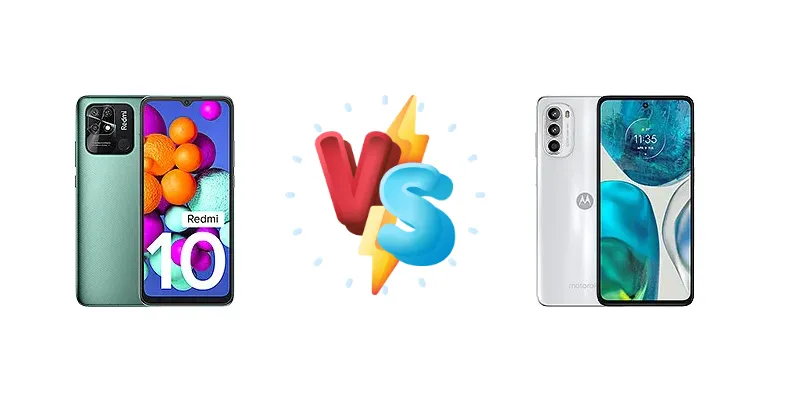
Both the Xiaomi Redmi 10 (India) and Motorola Moto G52 target the competitive budget smartphone market, relying on the Qualcomm Snapdragon 680 to deliver a smooth experience. However, despite sharing the same core processor, these devices diverge significantly in their charging capabilities and overall feature set, making a direct comparison crucial for discerning buyers.
🏆 Quick Verdict
For the average user prioritizing convenience and faster power-ups, the Motorola Moto G52 is the clear winner. Its 30W charging significantly reduces downtime compared to the Redmi 10’s 18W, offsetting any other minor differences. However, the Redmi 10 may appeal to those seeking the absolute lowest price point.
| Network |
|---|
| 2G bands | GSM 850 / 900 / 1800 / 1900 | GSM 850 / 900 / 1800 / 1900 |
| 3G bands | HSDPA 850 / 900 / 2100 | HSDPA 850 / 900 / 1700(AWS) / 1900 / 2100 |
| 4G bands | 1, 3, 5, 8, 40, 41 | LTE |
| Speed | HSPA, LTE | HSPA, LTE |
| Technology | GSM / HSPA / LTE | GSM / HSPA / LTE |
| Launch |
|---|
| Announced | 2022, March 17 | 2022, April 12 |
| Status | Available. Released 2022, March 24 | Available. Released 2022, April 20 |
| Body |
|---|
| Dimensions | 169.6 x 76.6 x 9.1 mm (6.68 x 3.02 x 0.36 in) | 160.1 x 74.5 x 8 mm (6.30 x 2.93 x 0.31 in) |
| SIM | Nano-SIM + Nano-SIM | Nano-SIM + Nano-SIM |
| Weight | 203 g (7.16 oz) | 169 g (5.96 oz) |
| | - | Water-repellent design |
| Display |
|---|
| Protection | Corning Gorilla Glass 3 | - |
| Resolution | 720 x 1650 pixels (~269 ppi density) | 1080 x 2400 pixels, 20:9 ratio (~402 ppi density) |
| Size | 6.7 inches, 106.2 cm2 (~81.7% screen-to-body ratio) | 6.6 inches, 103.6 cm2 (~86.9% screen-to-body ratio) |
| Type | IPS LCD | AMOLED, 90Hz |
| Platform |
|---|
| CPU | Octa-core (4x2.4 GHz Kryo 265 Gold & 4x1.9 GHz Kryo 265 Silver) | Octa-core (4x2.4 GHz Kryo 265 Gold & 4x1.9 GHz Kryo 265 Silver) |
| Chipset | Qualcomm SM6225 Snapdragon 680 4G (6 nm) | Qualcomm SM6225 Snapdragon 680 4G (6 nm) |
| GPU | Adreno 610 | Adreno 610 |
| OS | Android 11, MIUI 13 | Android 12, planned upgrade to Android 13 |
| Memory |
|---|
| Card slot | microSDXC (dedicated slot) | microSDXC (uses shared SIM slot) |
| Internal | 64GB 4GB RAM, 128GB 6GB RAM | 64GB 4GB RAM, 128GB 4GB RAM, 128GB 6GB RAM, 256GB 6GB RAM |
| | UFS 2.2 | - |
| Main Camera |
|---|
| Dual | 50 MP, f/1.8, 26mm (wide), PDAF
Auxiliary lens | - |
| Features | LED flash, HDR, panorama | LED flash, HDR, panorama |
| Single | 5 MP, f/2.0 | - |
| Triple | - | 50 MP, f/1.8 (wide), 1/2.76", 0.64µm, PDAF
8 MP, f/2.2, 118˚ (ultrawide), 1/4.0", 1.12µm
2 MP (macro) |
| Video | 1080p@30fps | 1080p@30fps |
| Selfie camera |
|---|
| Single | 5 MP, f/2.0 | 16 MP, f/2.5, (wide), 1.0µm |
| Video | 1080p@30fps | 1080p@30fps |
| Sound |
|---|
| 3.5mm jack | Yes | Yes |
| 35mm jack | Yes | Yes |
| Loudspeaker | Yes | Yes, with stereo speakers |
| Comms |
|---|
| Bluetooth | 5.0, A2DP, LE | 5.0, A2DP, LE |
| Infrared port | Yes | - |
| NFC | No | Yes (market/region dependent) |
| Positioning | GPS, GLONASS, BDS, GALILEO | GPS, GLONASS, GALILEO |
| Radio | FM radio | Unspecified |
| USB | USB Type-C 2.0, OTG | USB Type-C 2.0 |
| WLAN | Wi-Fi 802.11 a/b/g/n/ac, dual-band, Wi-Fi Direct | Wi-Fi 802.11 a/b/g/n/ac, dual-band, Wi-Fi Direct |
| Features |
|---|
| Sensors | Fingerprint (rear-mounted), accelerometer, proximity | Fingerprint (side-mounted), accelerometer, gyro, proximity, compass |
| Battery |
|---|
| Charging | 18W wired | 30W wired |
| Type | Li-Po 6000 mAh | Li-Po 5000 mAh |
| Misc |
|---|
| Colors | Midnight Black, Pacific Blue, Caribbean Green | Charcoal Gray, Porcelain White |
| Models | 220333QAG | XT2221-1, XT2221-2 |
| Price | About 130 EUR | About 470 EUR |
Xiaomi Redmi 10 (India)
- Potentially lower price point
- Xiaomi's MIUI offers extensive customization options
- Likely wider availability in India
- Slower 18W charging
- MIUI can be resource-intensive
- Potential for more pre-installed bloatware
Motorola Moto G52
- Faster 30W charging
- Near-stock Android experience with Motorola's My UX
- Generally cleaner software experience
- May be slightly more expensive
- Motorola's software update support is less consistent than Xiaomi's
- Potentially less brand recognition in some regions
Display Comparison
Both devices are likely to feature LCD panels, typical for this price segment. While specific details like peak brightness and color gamut coverage are unavailable, the focus here isn't display quality. The absence of high refresh rate panels on either device suggests a prioritization of battery life over visual fluidity. Bezels are expected to be comparable, contributing minimally to differentiating the user experience.
Camera Comparison
Without detailed sensor information, a direct camera comparison is difficult. Both phones likely employ a multi-camera setup, but the quality will heavily depend on the primary sensor and image processing algorithms. The inclusion of a 2MP macro camera on either device is largely a marketing tactic, offering limited practical benefit due to the low resolution and lack of optical image stabilization (OIS). Image processing style will likely differ, with Xiaomi typically favoring more saturated colors and Motorola aiming for a more natural look.
Performance
The core of both phones is the Qualcomm SM6225 Snapdragon 680 4G (6 nm) chipset, featuring an octa-core CPU configuration with 4x2.4 GHz Kryo 265 Gold and 4x1.9 GHz Kryo 265 Silver cores. This means performance will be virtually identical for everyday tasks like browsing, social media, and light gaming. The 6nm process node contributes to reasonable power efficiency, but sustained gaming will likely result in some thermal throttling. RAM configurations are a key differentiator, but not provided in the context data; however, the Snapdragon 680 benefits from efficient memory management, mitigating the impact of lower RAM amounts.
Battery Life
The battery capacity isn't specified, but both phones likely house batteries in the 5000mAh range, common for this segment. The critical difference lies in charging speed. The Motorola Moto G52’s 30W wired charging offers a significant advantage over the Redmi 10’s 18W. This translates to a substantially faster 0-100% charge time, potentially reducing charging from over 2 hours on the Redmi 10 to around 1 hour 20 minutes on the Moto G52. This difference is particularly impactful for users who frequently find themselves needing to quickly top up their battery.
Buying Guide
Buy the Xiaomi Redmi 10 (India) if you need a highly affordable smartphone and are willing to trade charging speed for a lower upfront cost. Buy the Motorola Moto G52 if you prefer a faster charging experience, minimizing the time spent tethered to a wall outlet, and appreciate a slightly more refined software experience.
Frequently Asked Questions
❓ Will I notice a significant difference in performance between the Redmi 10 and Moto G52 when playing games like PUBG Mobile?
No, you likely won't notice a significant difference. Both phones utilize the same Snapdragon 680 chipset and CPU configuration. Performance will be largely identical, though thermal throttling might become a factor during extended gaming sessions, potentially leading to slight frame rate drops on both devices.
❓ How much faster is the 30W charging on the Moto G52 compared to the 18W charging on the Redmi 10 in real-world usage?
The 30W charging on the Moto G52 can reduce charging time by approximately 30-45 minutes for a full 0-100% charge. While the exact time depends on usage and battery health, expect the Moto G52 to fully charge in around 1 hour 20 minutes, compared to over 2 hours for the Redmi 10.
❓ Does the Motorola Moto G52 offer a cleaner software experience than the Xiaomi Redmi 10?
Yes, the Moto G52 generally provides a cleaner, near-stock Android experience with Motorola's My UX. This means fewer pre-installed apps (bloatware) and a more streamlined interface compared to Xiaomi's MIUI, which is known for its extensive customization options but can also be more resource-intensive.