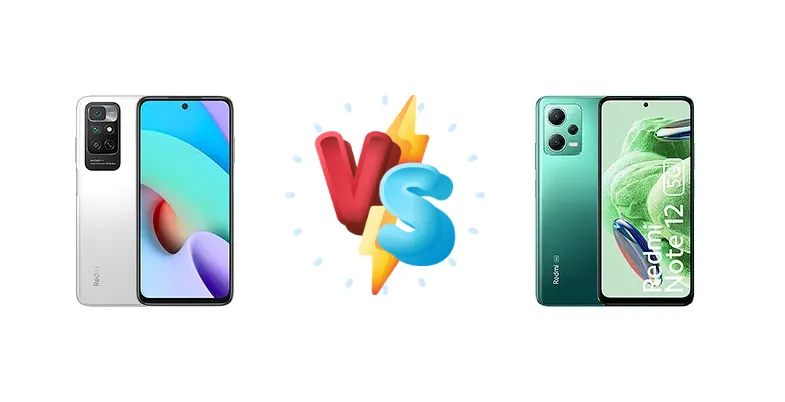
Xiaomi's Redmi series consistently delivers impressive value, but choosing between models can be tricky. The Redmi 10 2022 and Redmi Note 12 both offer compelling features for budget-conscious buyers. Let's dive into a detailed comparison to help you pick the perfect phone.
🏆 Quick Verdict
The Redmi Note 12 emerges as the clear winner thanks to its faster Snapdragon 4 Gen 1 chipset, significantly quicker charging, and brighter display. While the Redmi 10 2022 remains a solid option, the Note 12's upgrades make it the more appealing choice for most users.
| Network |
|---|
| 2G bands | GSM 850 / 900 / 1800 / 1900 | GSM 850 / 900 / 1800 / 1900 |
| 3G bands | HSDPA 850 / 900 / 1700(AWS) / 1900 / 2100 | HSDPA 850 / 900 / 2100 |
| 4G bands | 1, 2, 3, 4, 5, 7, 8, 20, 28, 38, 40, 41 | 1, 3, 5, 8, 40, 41 |
| 5G bands | - | 1, 3, 5, 8, 28, 40, 78 SA/NSA |
| Speed | HSPA, LTE | HSPA, LTE, 5G |
| Technology | GSM / HSPA / LTE | GSM / HSPA / LTE / 5G |
| Launch |
|---|
| Announced | 2022, February 15 | 2022, October 27 |
| Status | Available. Released 2022, May 11 | Available. Released 2023, January 11 |
| Body |
|---|
| Dimensions | 162 x 75.5 x 8.9 mm (6.38 x 2.97 x 0.35 in) | 165.9 x 76.2 x 8 mm (6.53 x 3.00 x 0.31 in) |
| SIM | Nano-SIM + Nano-SIM | Nano-SIM + Nano-SIM |
| Weight | 181 g (6.38 oz) | 188 g (6.63 oz) |
| | - | IP53, dust and splash resistant |
| Display |
|---|
| Protection | Corning Gorilla Glass 3 | Corning Gorilla Glass 3 |
| Resolution | 1080 x 2400 pixels, 20:9 ratio (~405 ppi density) | 1080 x 2400 pixels, 20:9 ratio (~395 ppi density) |
| Size | 6.5 inches, 102.0 cm2 (~83.4% screen-to-body ratio) | 6.67 inches, 107.4 cm2 (~85.0% screen-to-body ratio) |
| Type | LCD, 90Hz | AMOLED, 120Hz, 1200 nits (peak) |
| Platform |
|---|
| CPU | Octa-core (2x2.0 GHz Cortex-A75 & 6x1.8 GHz Cortex-A55) | Octa-core (2x2.0 GHz Cortex-A78 & 6x1.8 GHz Cortex-A55) |
| Chipset | Mediatek MT6769H Helio G88 (12 nm) | Qualcomm SM4375 Snapdragon 4 Gen 1 (6 nm) |
| GPU | Mali-G52 MC2 | Adreno 619 |
| OS | Android 11, MIUI 12.5 | Android 12, MIUI 14 (International), MIUI 13 (India) |
| Memory |
|---|
| Card slot | microSDXC (uses shared SIM slot) | microSDXC (uses shared SIM slot) |
| Internal | 64GB 4GB RAM, 128GB 4GB RAM, 128GB 6GB RAM | 128GB 4GB RAM, 128GB 6GB RAM, 256GB 8GB RAM |
| | eMMC 5.1 | UFS 2.2 |
| Main Camera |
|---|
| Features | LED flash, HDR, panorama | Dual-LED dual-tone flash, HDR, panorama |
| Quad | 50 MP, f/1.8, (wide), PDAF
8 MP, f/2.2, 120˚ (ultrawide)
2 MP (macro)
Auxiliary lens | - |
| Single | 8 MP, f/2.0, (wide), 1/4.0”, 1.12µm | - |
| Triple | - | 48 MP, f/1.8, (wide), PDAF
8 MP, f/2.2, 120˚ (ultrawide), 1/4.0", 1.12µm
2 MP (macro) |
| Video | 1080p@30fps | 1080p@30fps |
| Selfie camera |
|---|
| Features | HDR, panorama | HDR |
| Single | 8 MP, f/2.0, (wide), 1/4.0”, 1.12µm | 13 MP, f/2.5, (wide), 1/3.0" |
| Video | 1080p@30fps | 1080p@30fps |
| Sound |
|---|
| 3.5mm jack | Yes | Yes |
| 35mm jack | Yes | Yes |
| Loudspeaker | Yes, with stereo speakers | Yes |
| | - | 24-bit/192kHz audio |
| Comms |
|---|
| Bluetooth | 5.1, A2DP, LE | 5.1, A2DP, LE |
| Infrared port | Yes | Yes |
| NFC | Yes (market/region dependent) | Yes (market/region dependent) |
| Positioning | GPS, GLONASS, GALILEO, BDS | GPS, GLONASS |
| Radio | FM radio | Unspecified |
| USB | USB Type-C 2.0 | USB Type-C 2.0, OTG |
| WLAN | Wi-Fi 802.11 a/b/g/n/ac, dual-band, Wi-Fi Direct | Wi-Fi 802.11 a/b/g/n/ac, dual-band |
| Features |
|---|
| Sensors | Fingerprint (side-mounted), accelerometer, proximity, compass | Fingerprint (side-mounted), accelerometer, gyro, proximity, compass |
| Battery |
|---|
| Charging | 18W wired
9W reverse wired | 33W wired, 50% in 22 min |
| Type | Li-Po 5000 mAh | Li-Po 5000 mAh |
| Misc |
|---|
| Colors | Carbon Gray, Pebble White, Sea Blue | Frosted Green, Matte Black, Mystique Blue |
| Models | 21121119SG, 22011119UY, 21121119VL | 22111317I, 22111317G |
| Price | About 100 EUR | € 151.99 / $ 219.99 / ₹ 11,999 |
| SAR | 0.77 W/kg (head) 0.74 W/kg (body) | 1.09 W/kg (head) 1.05 W/kg (body) |
| SAR EU | - | 0.68 W/kg (head) 0.91 W/kg (body) |
| Tests |
|---|
| Battery life | - |
Endurance rating 101h
|
| Camera | - |
Photo / Video |
| Display | - |
Contrast ratio: Infinite (nominal) |
| Loudspeaker | - |
-28.0 LUFS (Good)
|
| Performance | - |
AnTuTu: 360745 (v9)
GeekBench: 1998 (v5.1), 2017 (v6) |
Xiaomi Redmi 10 2022
- Large Display
- Affordable Price
- Reverse Wired Charging
- Slower Performance
- Less Bright Display
- Slower Charging
Xiaomi Redmi Note 12
- Faster Performance (Snapdragon 4 Gen 1)
- Brighter Display
- Faster Charging (33W)
- Excellent Battery Life
- Slightly Higher Price
- Camera details are unclear
Display Comparison
The Redmi Note 12 boasts a significant advantage with its 706 nits max brightness, offering better visibility in sunlight. While both phones likely feature similar LCD panels, the Note 12's contrast ratio (reported as infinite, though nominal) suggests improved image quality. The Redmi 10 2022's display is adequate but lacks the punch of the Note 12.
Camera Comparison
Both phones feature 'Photo / Video' capabilities, suggesting standard camera setups. However, detailed camera specs are missing. Based on general Redmi trends, the Note 12 likely offers slightly improved image processing and potentially better low-light performance due to the newer chipset and potentially updated software algorithms. Further testing would be needed for a definitive comparison.
Performance
The Snapdragon 4 Gen 1 in the Redmi Note 12 is a substantial upgrade over the Helio G88 in the Redmi 10 2022. Expect noticeably smoother multitasking, faster app loading times, and improved gaming performance on the Note 12. The Note 12's 6nm process also contributes to better power efficiency.
Battery Life
The Redmi Note 12 shines here with an impressive endurance rating of 101h and active use score of 10:58h. The Redmi 10 2022's battery life is likely good, but not as exceptional as the Note 12. The Note 12's 33W charging is also a major advantage over the Redmi 10 2022's 18W wired charging and 9W reverse wired charging.
Buying Guide
The Xiaomi Redmi 10 2022 is ideal for users prioritizing a large display and a slightly more affordable price point, who aren't overly concerned with raw performance. The Xiaomi Redmi Note 12 is best suited for those seeking a smoother experience, faster charging, and a brighter, more vibrant display, even if it means spending a bit more.
Frequently Asked Questions
❓ Is the Redmi Note 12 worth the extra money compared to the Redmi 10 2022?
Yes, the Redmi Note 12's performance and charging improvements generally justify the price difference, especially if you value a smoother experience and faster top-ups.
❓ What kind of games can I play on these phones?
The Redmi Note 12 will handle more demanding games better than the Redmi 10 2022. Both are suitable for casual gaming, but the Note 12 offers a more enjoyable experience for more graphically intensive titles.