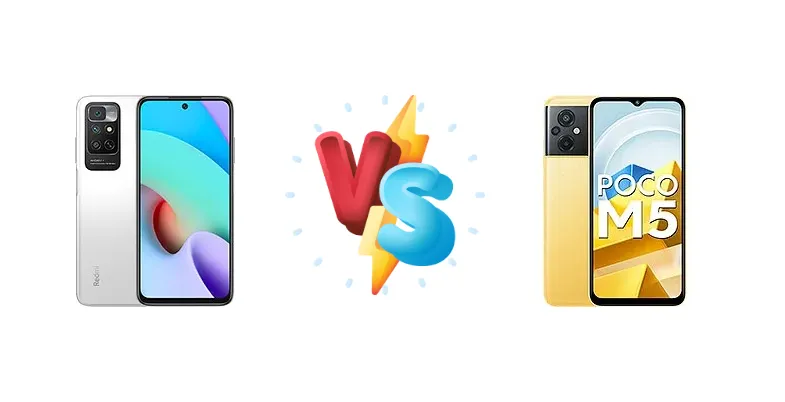
Xiaomi consistently delivers impressive value in the budget phone market. The Redmi 10 2022 and Poco M5 are two strong contenders, offering compelling features at affordable prices. But which one reigns supreme? Let's dive into a detailed comparison to help you make the right choice.
🏆 Quick Verdict
The Poco M5 edges out the Redmi 10 2022 thanks to its more powerful Helio G99 chipset and slightly improved display. While both offer excellent battery life, the Poco M5's performance advantage makes it the better overall pick for most users.
| Network |
|---|
| 2G bands | GSM 850 / 900 / 1800 / 1900 | GSM 850 / 900 / 1800 / 1900 |
| 3G bands | HSDPA 850 / 900 / 1700(AWS) / 1900 / 2100 | HSDPA 850 / 900 / 1700(AWS) / 1900 / 2100 |
| 4G bands | 1, 2, 3, 4, 5, 7, 8, 20, 28, 38, 40, 41 | 1, 2, 3, 4, 5, 7, 8, 20, 28, 38, 40, 41 |
| Speed | HSPA, LTE | HSPA, LTE |
| Technology | GSM / HSPA / LTE | GSM / HSPA / LTE |
| Launch |
|---|
| Announced | 2022, February 15 | 2022, September 05 |
| Status | Available. Released 2022, May 11 | Available. Released 2022, September 13 |
| Body |
|---|
| Build | - | Glass front (Gorilla Glass 3), plastic frame, plastic back |
| Dimensions | 162 x 75.5 x 8.9 mm (6.38 x 2.97 x 0.35 in) | 164 x 76.1 x 8.9 mm (6.46 x 3.00 x 0.35 in) |
| SIM | Nano-SIM + Nano-SIM | Nano-SIM + Nano-SIM |
| Weight | 181 g (6.38 oz) | 201 g (7.09 oz) |
| Display |
|---|
| Protection | Corning Gorilla Glass 3 | Corning Gorilla Glass 3 |
| Resolution | 1080 x 2400 pixels, 20:9 ratio (~405 ppi density) | 1080 x 2408 pixels, 20:9 ratio (~401 ppi density) |
| Size | 6.5 inches, 102.0 cm2 (~83.4% screen-to-body ratio) | 6.58 inches, 104.3 cm2 (~83.6% screen-to-body ratio) |
| Type | LCD, 90Hz | IPS LCD, 90Hz, 500 nits (HBM) |
| Platform |
|---|
| CPU | Octa-core (2x2.0 GHz Cortex-A75 & 6x1.8 GHz Cortex-A55) | Octa-core (2x2.2 GHz Cortex-A76 & 6x2.0 GHz Cortex-A55) |
| Chipset | Mediatek MT6769H Helio G88 (12 nm) | Mediatek Helio G99 (6 nm) |
| GPU | Mali-G52 MC2 | Mali-G57 MC2 |
| OS | Android 11, MIUI 12.5 | Android 12, upgradable to Android 14, HyperOS |
| Memory |
|---|
| Card slot | microSDXC (uses shared SIM slot) | microSDXC (dedicated slot) |
| Internal | 64GB 4GB RAM, 128GB 4GB RAM, 128GB 6GB RAM | 64GB 4GB RAM, 128GB 4GB RAM, 128GB 6GB RAM |
| | eMMC 5.1 | UFS 2.2 |
| Main Camera |
|---|
| Features | LED flash, HDR, panorama | LED flash, HDR, panorama |
| Quad | 50 MP, f/1.8, (wide), PDAF
8 MP, f/2.2, 120˚ (ultrawide)
2 MP (macro)
Auxiliary lens | - |
| Single | 8 MP, f/2.0, (wide), 1/4.0”, 1.12µm | - |
| Triple | - | 50 MP, f/1.8, (wide), PDAF
2 MP (macro)
Auxiliary lens |
| Video | 1080p@30fps | 1080p@30fps |
| Selfie camera |
|---|
| Features | HDR, panorama | - |
| Single | 8 MP, f/2.0, (wide), 1/4.0”, 1.12µm | 5 MP, f/2.2, (wide), 1/5.0", 1.12µm |
| Video | 1080p@30fps | 1080p@30fps |
| Sound |
|---|
| 3.5mm jack | Yes | Yes |
| 35mm jack | Yes | Yes |
| Loudspeaker | Yes, with stereo speakers | Yes |
| Comms |
|---|
| Bluetooth | 5.1, A2DP, LE | 5.3, A2DP, LE |
| Infrared port | Yes | Yes |
| NFC | Yes (market/region dependent) | Yes |
| Positioning | GPS, GLONASS, GALILEO, BDS | GPS, GLONASS, GALILEO, BDS |
| Radio | FM radio | FM radio |
| USB | USB Type-C 2.0 | USB Type-C 2.0, OTG |
| WLAN | Wi-Fi 802.11 a/b/g/n/ac, dual-band, Wi-Fi Direct | Wi-Fi 802.11 a/b/g/n/ac, dual-band, Wi-Fi Direct |
| Features |
|---|
| Sensors | Fingerprint (side-mounted), accelerometer, proximity, compass | Fingerprint (side-mounted), accelerometer, proximity, compass |
| Battery |
|---|
| Charging | 18W wired
9W reverse wired | 18W wired |
| Type | Li-Po 5000 mAh | Li-Po 5000 mAh |
| Misc |
|---|
| Colors | Carbon Gray, Pebble White, Sea Blue | Black, Green, Yellow |
| Models | 21121119SG, 22011119UY, 21121119VL | 22071219CG |
| Price | About 100 EUR | About 100 EUR |
| SAR | 0.77 W/kg (head) 0.74 W/kg (body) | 1.04 W/kg (head) 0.83 W/kg (body) |
| SAR EU | - | 0.52 W/kg (head) 0.83 W/kg (body) |
| Tests |
|---|
| Battery life | - |
Endurance rating 121h
|
| Camera | - |
Photo / Video |
| Display | - |
Contrast ratio: 1363:1 |
| Loudspeaker | - |
-27.6 LUFS (Good)
|
| Performance | - |
AnTuTu: 386311 (v9)
GeekBench: 1896 (v5.1)
GFXBench: 12fps (ES 3.1 onscreen) |
Xiaomi Redmi 10 2022
- Slightly larger screen
- Stylish design
- Reliable performance for everyday tasks
- Good value for money
- Less powerful chipset than Poco M5
- Slower charging speeds compared to some competitors
- Display slightly less vibrant than Poco M5
Xiaomi Poco M5
- More powerful Helio G99 chipset
- Better gaming performance
- Slightly improved display
- Reverse wired charging
- Design less premium than Redmi 10 2022
- May lack some of the Redmi 10 2022's design refinements
Display Comparison
Both phones feature a 6.43-inch or 6.58-inch FHD+ display with a 90Hz refresh rate. The Poco M5 boasts a slightly higher measured brightness of 448 nits and a 1363:1 contrast ratio, offering marginally better visual clarity and vibrancy compared to the Redmi 10 2022. While the difference is subtle, the Poco M5 has a slight edge.
Camera Comparison
Both phones offer versatile camera setups. The Redmi 10 2022 typically features a 50MP main sensor, while the Poco M5 also has a 50MP main sensor. Image quality is generally comparable in good lighting conditions. Low-light performance is decent on both, but the Poco M5 might have a slight advantage due to its more powerful image processing capabilities. Video recording capabilities are similar on both devices.
Performance
This is where the Poco M5 truly shines. Its Mediatek Helio G99 chipset (6nm) significantly outperforms the Redmi 10 2022's Helio G88 (12nm). Expect smoother multitasking, faster app loading times, and a better gaming experience on the Poco M5. The G99's Cortex-A76 cores also contribute to improved overall responsiveness.
Battery Life
Both the Redmi 10 2022 and Poco M5 deliver exceptional battery life, with endurance ratings around 121 hours. Both support 18W wired charging, and the Poco M5 also includes 9W reverse wired charging, allowing it to act as a power bank for other devices.
Buying Guide
The Xiaomi Redmi 10 2022 is ideal for users prioritizing a reliable, well-rounded experience with a focus on design and a slightly larger screen. The Xiaomi Poco M5 is best suited for those who value performance and gaming capabilities, even at the expense of a slightly less premium feel.
Frequently Asked Questions
❓ Which phone is better for gaming?
The Poco M5 is significantly better for gaming due to its more powerful Helio G99 chipset.
❓ Does the Redmi 10 2022 have NFC?
Yes, the Redmi 10 2022 typically includes NFC for contactless payments.
❓ What is the storage and RAM configuration available for each phone?
Both phones are available in various configurations, typically ranging from 4GB/64GB to 6GB/128GB. Check retailer listings for specific options.