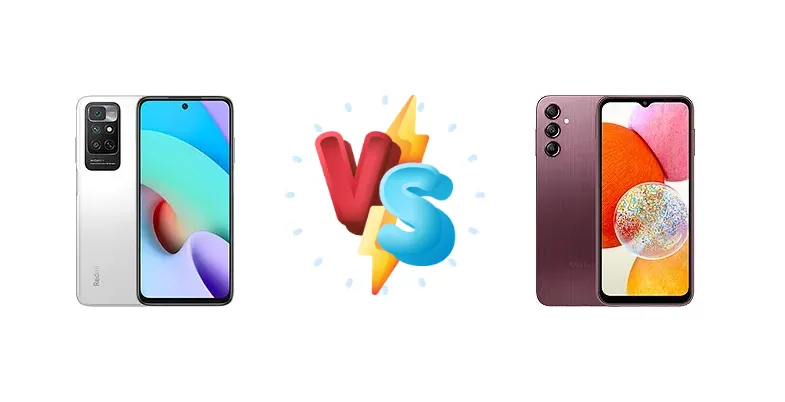
The budget smartphone market is fiercely competitive, and two contenders vying for your attention are the Xiaomi Redmi 10 2022 and the Samsung Galaxy A14. Both offer compelling features at affordable prices, but which one truly delivers the best value? Let's dive into a detailed comparison to help you decide.
🏆 Quick Verdict
The Samsung Galaxy A14 (Exynos version) edges out the Redmi 10 2022 thanks to its slightly more efficient chipset and potentially better software support. However, the Redmi 10 2022 offers reverse charging and a competitive camera system, making it a strong contender for those prioritizing those features.
| Network |
|---|
| 2G bands | GSM 850 / 900 / 1800 / 1900 | GSM 850 / 900 / 1800 / 1900 |
| 3G bands | HSDPA 850 / 900 / 1700(AWS) / 1900 / 2100 | HSDPA 850 / 900 / 2100 |
| 4G bands | 1, 2, 3, 4, 5, 7, 8, 20, 28, 38, 40, 41 | 1, 3, 5, 7, 8, 20, 28, 38, 40, 41 |
| Speed | HSPA, LTE | HSPA, LTE |
| Technology | GSM / HSPA / LTE | GSM / HSPA / LTE |
| Launch |
|---|
| Announced | 2022, February 15 | 2023, February 28 |
| Status | Available. Released 2022, May 11 | Available. Released 2023, March 27 |
| Body |
|---|
| Build | - | Glass front, plastic back, plastic frame |
| Dimensions | 162 x 75.5 x 8.9 mm (6.38 x 2.97 x 0.35 in) | 167.7 x 78 x 9.1 mm (6.60 x 3.07 x 0.36 in) |
| SIM | Nano-SIM + Nano-SIM | · Nano-SIM· Nano-SIM + Nano-SIM |
| Weight | 181 g (6.38 oz) | 201 g (7.09 oz) |
| Display |
|---|
| Protection | Corning Gorilla Glass 3 | - |
| Resolution | 1080 x 2400 pixels, 20:9 ratio (~405 ppi density) | 1080 x 2408 pixels, 20:9 ratio (~400 ppi density) |
| Size | 6.5 inches, 102.0 cm2 (~83.4% screen-to-body ratio) | 6.6 inches, 104.9 cm2 (~80.2% screen-to-body ratio) |
| Type | LCD, 90Hz | PLS LCD |
| Platform |
|---|
| CPU | Octa-core (2x2.0 GHz Cortex-A75 & 6x1.8 GHz Cortex-A55) | Octa-core (2x2.0 GHz Cortex-A75 & 6x1.8 GHz Cortex-A55) - Version AOcta-core (4x2.0 GHz Cortex-A55 & 4x2.0 GHz Cortex-A55) - Version B |
| Chipset | Mediatek MT6769H Helio G88 (12 nm) | Mediatek MT6769 Helio G80 (12 nm) - Version AExynos 850 (8 nm) - Version B |
| GPU | Mali-G52 MC2 | Mali-G52 MC2 |
| OS | Android 11, MIUI 12.5 | Android 13, upgradable to Android 15, One UI 7 |
| Memory |
|---|
| Card slot | microSDXC (uses shared SIM slot) | microSDXC (dedicated slot) |
| Internal | 64GB 4GB RAM, 128GB 4GB RAM, 128GB 6GB RAM | 64GB 4GB RAM, 128GB 4GB RAM, 128GB 6GB RAM |
| | eMMC 5.1 | - |
| Main Camera |
|---|
| Features | LED flash, HDR, panorama | LED flash, panorama, HDR |
| Quad | 50 MP, f/1.8, (wide), PDAF
8 MP, f/2.2, 120˚ (ultrawide)
2 MP (macro)
Auxiliary lens | - |
| Single | 8 MP, f/2.0, (wide), 1/4.0”, 1.12µm | 13 MP, f/2.0, (wide) |
| Triple | - | 50 MP, f/1.8, 26mm (wide), 1/2.75", 0.64µm, PDAF
5 MP, f/2.2, 17mm (ultrawide), 1/5.0", 1.12µm
2 MP (macro) |
| Video | 1080p@30fps | 1080p@30fps |
| Selfie camera |
|---|
| Features | HDR, panorama | - |
| Single | 8 MP, f/2.0, (wide), 1/4.0”, 1.12µm | 13 MP, f/2.0, 26mm (wide), 1/3.1", 1.12µm |
| Video | 1080p@30fps | 1080p@30fps |
| Sound |
|---|
| 3.5mm jack | Yes | Yes |
| 35mm jack | Yes | Yes |
| Loudspeaker | Yes, with stereo speakers | Yes |
| Comms |
|---|
| Bluetooth | 5.1, A2DP, LE | 5.1 or 5.3, A2DP, LE |
| Infrared port | Yes | - |
| NFC | Yes (market/region dependent) | Yes (market/region dependent) |
| Positioning | GPS, GLONASS, GALILEO, BDS | GPS, GALILEO, GLONASS, BDS, QZSS |
| Radio | FM radio | Unspecified |
| USB | USB Type-C 2.0 | USB Type-C 2.0 |
| WLAN | Wi-Fi 802.11 a/b/g/n/ac, dual-band, Wi-Fi Direct | Wi-Fi 802.11 a/b/g/n/ac, dual-band, Wi-Fi Direct |
| Features |
|---|
| Sensors | Fingerprint (side-mounted), accelerometer, proximity, compass | Fingerprint (side-mounted), accelerometer, proximity, compass |
| Battery |
|---|
| Charging | 18W wired
9W reverse wired | 15W wired |
| Type | Li-Po 5000 mAh | Li-Po 5000 mAh |
| Misc |
|---|
| Colors | Carbon Gray, Pebble White, Sea Blue | Black, Dark Red, Silver, Green |
| Models | 21121119SG, 22011119UY, 21121119VL | SM-A145F, SM-A145F/DSN, SM-A145M, SM-A145M/DS, SM-A145P, SM-A145R |
| Price | About 100 EUR | € 85.76 / $ 147.60 / £ 79.95 |
| SAR | 0.77 W/kg (head) 0.74 W/kg (body) | - |
| SAR EU | - | 0.46 W/kg (head) 1.37 W/kg (body) |
Xiaomi Redmi 10 2022
- Reverse wired charging
- Potentially better low-light camera performance
- Slightly higher refresh rate display (90Hz)
- Competitive price
- Less efficient chipset
- Potentially shorter software update support
- Display can be oversaturated
Samsung Galaxy A14
- More efficient chipset (Exynos version)
- Longer software update support (Samsung's promise)
- More color-accurate display
- Reliable brand reputation
- No reverse charging
- Potentially less vibrant display
- Performance can be limited in demanding games
Display Comparison
Both phones feature large 6.6-inch displays, but the Redmi 10 2022 often boasts a slightly higher refresh rate (90Hz vs 60Hz on the A14), leading to smoother scrolling. The A14's display is generally considered more color-accurate, while the Redmi 10 2022 can sometimes appear more vibrant. Resolution is typically FHD+ on both.
Camera Comparison
The Redmi 10 2022 typically features a 50MP main camera, often with improved low-light performance compared to the A14's 50MP main camera. The A14 often has a slightly wider ultrawide lens. Both offer decent image quality for the price, but the Redmi 10 2022's camera software is often more feature-rich.
Performance
The Galaxy A14 (Exynos version) with its 8nm Exynos 850 generally outperforms the Redmi 10 2022's Helio G88 in everyday tasks and gaming. The G88 is adequate for basic use, but the Exynos offers a noticeable boost in responsiveness. The A14's CPU architecture (4x2.0 GHz Cortex-A55 & 4x2.0 GHz Cortex-A55) is more efficient than the Redmi's (2x2.0 GHz Cortex-A75 & 6x1.8 GHz Cortex-A55).
Battery Life
Both phones pack large 5000mAh batteries, offering all-day battery life. The Galaxy A14 (Exynos version) generally exhibits slightly better battery efficiency due to its more efficient chipset. The Redmi 10 2022 has reverse charging, a useful feature for topping up accessories.
Buying Guide
The Xiaomi Redmi 10 2022 is ideal for users who want reverse charging, a slightly more vibrant display, and don't mind a Mediatek processor. The Samsung Galaxy A14 (Exynos version) is a better choice for those prioritizing smoother performance, longer software updates, and a more reliable brand reputation.
Frequently Asked Questions
❓ Which phone has better performance?
The Samsung Galaxy A14 (Exynos version) generally offers better performance due to its more efficient chipset and optimized software.
❓ Can the Redmi 10 2022 charge other devices?
Yes, the Redmi 10 2022 supports 9W reverse wired charging, allowing you to charge accessories like earbuds or smartwatches.