
Poco X7 Pro vs Nothing Phone (2): A Deep Dive into Performance, Battery, and Value
| Phones Images | |||||
|---|---|---|---|---|---|
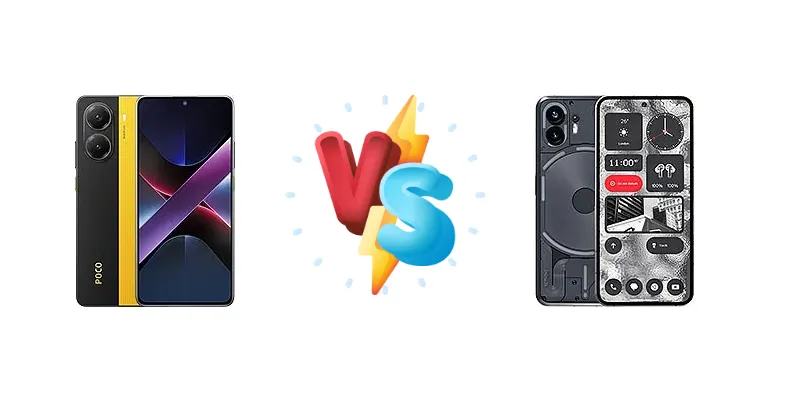
|
🏆 Quick Verdict
For users prioritizing raw performance and fast charging, the Poco X7 Pro is the clear winner. Its Dimensity 8400 Ultra chipset delivers superior processing power. However, the Nothing Phone (2) offers a more balanced package with longer battery life and a distinctive design, making it ideal for everyday users.
| PHONES | ||
|---|---|---|
| Phone Names | Xiaomi Poco X7 Pro | Nothing Phone (2) |
| Network | ||
|---|---|---|
| 2G bands | GSM 850 / 900 / 1800 / 1900 | GSM 850 / 900 / 1800 / 1900 |
| 3G bands | HSDPA 800 / 850 / 900 / 1700(AWS) / 1900 / 2100 | HSDPA 800 / 850 / 900 / 1700(AWS) / 1900 / 2100 |
| 4G bands | 1, 2, 3, 4, 5, 7, 8, 18, 19, 20, 26, 28, 38, 40, 41, 42, 48, 66 | 1, 2, 3, 4, 5, 7, 8, 12, 17, 18, 19, 20, 25, 26, 28, 30, 32, 34, 38, 39, 40, 41, 42, 48, 66, 71 |
| 5G bands | 1, 2, 3, 5, 7, 8, 20, 26, 28, 38, 40, 41, 48, 66, 77, 78 SA/NSA/Sub6 | 1, 2, 3, 5, 7, 8, 12, 20, 25, 28, 30, 38, 40, 41, 66, 71, 75, 77, 78 SA/NSA |
| Speed | HSPA, LTE, 5G | HSPA, LTE, 5G |
| Technology | GSM / HSPA / LTE / 5G | GSM / HSPA / LTE / 5G |
| Launch | ||
|---|---|---|
| Announced | 2025, January 09 | 2023, July 11 |
| Status | Available. Released 2025, January 09 | Available. Released 2023, July 17 |
| Body | ||
|---|---|---|
| Build | Glass front (Gorilla Glass 7i), plastic back, silicone polymer back (eco leather) | Glass front (Gorilla Glass 5), glass back (Gorilla Glass 5), aluminum frame |
| Dimensions | 160.8 x 75.2 x 8.3 mm (6.33 x 2.96 x 0.33 in) | 162.1 x 76.4 x 8.6 mm (6.38 x 3.01 x 0.34 in) |
| SIM | Nano-SIM + Nano-SIM | Nano-SIM + Nano-SIM |
| Weight | 195 g or 198 g (6.88 oz) | 201.2 g (7.09 oz) |
| Display | ||
|---|---|---|
| Protection | Corning Gorilla Glass 7i | Corning Gorilla Glass 5 |
| Resolution | 1220 x 2712 pixels, 20:9 ratio (~446 ppi density) | 1080 x 2412 pixels, 20:9 ratio (~394 ppi density) |
| Size | 6.67 inches, 107.4 cm2 (~88.8% screen-to-body ratio) | 6.7 inches, 108.0 cm2 (~87.2% screen-to-body ratio) |
| Type | AMOLED, 68B colors, 120Hz, 1920Hz PWM, Dolby Vision, HDR10+, 1400 nits (HBM), 3200 nits (peak) | LTPO OLED, 1B colors, 120Hz, 1920Hz PWM, HDR10+, 1600 nits (HBM), 1600 nits (peak) |
| Platform | ||
|---|---|---|
| CPU | Octa-core (1x3.25 GHz Cortex-A725 & 3x3.0 GHz Cortex-A725 & 4x2.1 GHz Cortex-A725) | Octa-core (1x3.0 GHz Cortex-X2 & 3x2.5 GHz Cortex-A710 & 4x1.80 GHz Cortex-A510) |
| Chipset | Mediatek Dimensity 8400 Ultra (4 nm) | Qualcomm SM8475 Snapdragon 8+ Gen 1 (4 nm) |
| GPU | Mali-G720 MC7 | Adreno 730 |
| OS | Android 15, HyperOS 2 | Android 13, upgradable to Android 15, up to 3 major Android upgrades, Nothing OS 3.0 |
| Memory | ||
|---|---|---|
| Card slot | No | No |
| Internal | 256GB 8GB RAM, 256GB 12GB RAM, 512GB 12GB RAM | 128GB 8GB RAM, 256GB 12GB RAM, 512GB 12GB RAM |
| Main Camera | ||
|---|---|---|
| Dual | 50 MP, f/1.5, 26mm (wide), 1/1.95", 0.8µm, PDAF, OIS 8 MP, f/2.2, 15mm (ultrawide), 1/4.0", 1.12µm | 50 MP, f/1.9, 24mm (wide), 1/1.56", 1.0µm, PDAF, OIS 50 MP, f/2.2, 114˚ (ultrawide), 1/2.76", 0.64µm, AF |
| Features | LED flash, HDR, panorama | LED flash, panorama, HDR |
| Video | 4K@24/30/60fps, 1080p@30/60/120/240/960fps, HDR10+, gyro-EIS, OIS | 4K@30/60fps, 1080p@30/60fps, gyro-EIS, live HDR, OIS |
| Selfie camera | ||
|---|---|---|
| Features | - | HDR |
| Single | 20 MP, f/2.2, 25mm (wide), 1/4.0", 0.7µm | 32 MP, f/2.5, (wide), 1/2.74", 0.8µm |
| Video | 1080p@30fps | 1080p@30fps |
| Sound | ||
|---|---|---|
| 35mm jack | No | No |
| Loudspeaker | Yes, with stereo speakers | Yes, with stereo speakers |
| Comms | ||
|---|---|---|
| Bluetooth | 5.4/6.0, A2DP, LE, aptX HD | 5.3, A2DP, LE, aptX HD, aptX Adaptive |
| Infrared port | Yes | - |
| NFC | Yes (market/region dependent) | Yes |
| Positioning | GPS (L1+L5), GLONASS (G1), BDS (B1I+B1c+B2a), GALILEO (E1+E5a), NavIC (L5) | GPS (L1+L5), GLONASS (L1), BDS (B1I+B1c), GALILEO (E1), QZSS (L1), NavIC |
| Radio | No | No |
| USB | USB Type-C 2.0, OTG | USB Type-C 2.0, OTG |
| WLAN | Wi-Fi 802.11 a/b/g/n/ac/6, dual-band, Wi-Fi Direct | Wi-Fi 802.11 a/b/g/n/ac/6, dual-band, Wi-Fi Direct |
| Features | ||
|---|---|---|
| Sensors | Fingerprint (under display, optical), accelerometer, gyro, proximity, compass | Fingerprint (under display, optical), accelerometer, proximity, gyro, compass |
| Battery | ||
|---|---|---|
| Charging | 90W wired, PD3.0, QC3+, 100% in 42 min Reverse wired | 45W wired, PD3.0, PPS, QC4, 100% in 55 min 15W wireless, 100% in 130 min 5W reverse wireless |
| Type | Market-dependent versions:· Si/C Li-Ion 6000 mAh (Global)· Si/C Li-Ion 6550 mAh (India only) | Li-Ion 4700 mAh |
| Misc | ||
|---|---|---|
| Colors | Black/Yellow, White, Green, Red (Iron Man Edition) | White, Dark Gray |
| Models | 2412DPC0AG, 2412DPC0AI | A065 |
| Price | $ 339.50 / £ 208.05 / € 235.00 / ₹ 21,850 | $ 379.99 / £ 370.00 |
| SAR | 1.09 W/kg (head) 1.08 W/kg (body) | - |
| SAR EU | 0.99 W/kg (head) 0.99 W/kg (body) | - |
Xiaomi Poco X7 Pro
- Significantly faster charging (90W)
- More powerful processor (Dimensity 8400 Ultra)
- Brighter display for outdoor visibility
- Shorter battery life in active use
- Lacks wireless charging
- Software experience may be less refined
Nothing Phone (2)
- Longer battery life
- Wireless and reverse wireless charging
- Unique and refined design
- Slower charging speed
- Less powerful processor
- Dimmer display
Display Comparison
The Poco X7 Pro boasts a brighter display, reaching a measured 1265 nits, compared to the Nothing Phone (2)'s 998 nits. This translates to better visibility under direct sunlight. While both utilize 4nm chipsets, the display brightness difference is significant for outdoor use. The Nothing Phone (2) doesn't specify PWM frequency, while the Poco X7 Pro's specifications are unavailable, making it difficult to assess flicker-related eye strain potential. Both displays are likely AMOLED, offering vibrant colors, but the Poco X7 Pro's higher peak brightness gives it an edge.
Camera Comparison
The context data for the Nothing Phone (2) only mentions 'Photo / Video' capabilities, lacking specific sensor details. However, Nothing typically focuses on image processing and software enhancements. The Poco X7 Pro's camera specifications are also missing, making a direct sensor comparison impossible. Without detailed information, it's difficult to assess camera quality beyond stating that the Nothing Phone (2) likely prioritizes computational photography, while the Poco X7 Pro's camera performance will depend heavily on its sensor size and lens quality. We can assume both phones will offer acceptable image quality for social media sharing.
Performance
The Poco X7 Pro's MediaTek Dimensity 8400 Ultra, with its octa-core configuration (1x3.25 GHz Cortex-A725, 3x3.0 GHz Cortex-A725, 4x2.1 GHz Cortex-A725), is architecturally more modern than the Nothing Phone (2)'s Qualcomm Snapdragon 8+ Gen 1 (1x3.0 GHz Cortex-X2, 3x2.5 GHz Cortex-A710, 4x1.80 GHz Cortex-A510). The Dimensity 8400 Ultra's newer Cortex-A725 cores offer improved efficiency and performance. While the Snapdragon 8+ Gen 1 remains a capable chip, the Dimensity 8400 Ultra is expected to deliver superior sustained performance and potentially better thermal management, despite both being fabricated on a 4nm process. The Poco X7 Pro will likely excel in demanding tasks like gaming and video editing.
Battery Life
The Nothing Phone (2) demonstrates superior battery endurance with an active use score of 14:21h, compared to the Poco X7 Pro's 12:43h. This suggests more efficient power management or a larger battery capacity (though the exact mAh isn't specified). However, the Poco X7 Pro compensates with significantly faster charging – 90W wired, achieving 100% in just 42 minutes – while the Nothing Phone (2) takes 55 minutes with 45W wired charging. The Nothing Phone (2) also offers 15W wireless and 5W reverse wireless charging, features absent on the Poco X7 Pro. The Poco X7 Pro prioritizes quick top-ups, while the Nothing Phone (2) focuses on overall longevity.
Buying Guide
Buy the Xiaomi Poco X7 Pro if you need uncompromising gaming performance, incredibly fast 90W charging, and don't mind a less polished software experience. Buy the Nothing Phone (2) if you prefer a unique, minimalist design, longer battery life, and a more refined software experience with a focus on usability and aesthetics.