
Poco X7 Pro vs Motorola Edge 40 Pro: A Deep Dive into Performance and Value
| Phones Images | |||||
|---|---|---|---|---|---|
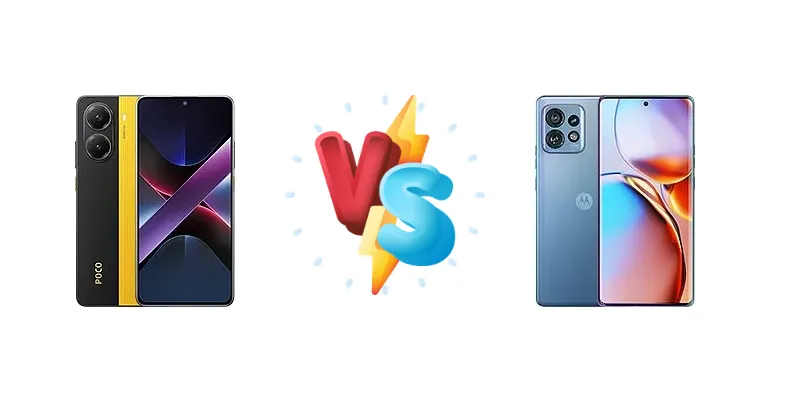
|
🏆 Quick Verdict
For the average user prioritizing raw performance and fast charging at an aggressive price point, the Poco X7 Pro emerges as the winner. While the Motorola Edge 40 Pro offers a more refined experience and potentially better thermal management, the X7 Pro’s Dimensity 8400 Ultra delivers comparable power for significantly less money.
| PHONES | ||
|---|---|---|
| Phone Names | Xiaomi Poco X7 Pro | Motorola Edge 40 Pro |
| Network | ||
|---|---|---|
| 2G bands | GSM 850 / 900 / 1800 / 1900 | GSM 850 / 900 / 1800 / 1900 |
| 3G bands | HSDPA 800 / 850 / 900 / 1700(AWS) / 1900 / 2100 | HSDPA 850 / 900 / 1700(AWS) / 1900 / 2100 |
| 4G bands | 1, 2, 3, 4, 5, 7, 8, 18, 19, 20, 26, 28, 38, 40, 41, 42, 48, 66 | 1, 2, 3, 4, 5, 7, 8, 12, 13, 17, 18, 19, 20, 25, 26, 28, 32, 38, 39, 40, 41, 42, 43, 48, 66 |
| 5G bands | 1, 2, 3, 5, 7, 8, 20, 26, 28, 38, 40, 41, 48, 66, 77, 78 SA/NSA/Sub6 | 1, 2, 3, 5, 7, 8, 20, 28, 38, 40, 41, 66, 77, 78 SA/NSA/Sub6 |
| Speed | HSPA, LTE, 5G | HSPA, LTE, 5G |
| Technology | GSM / HSPA / LTE / 5G | GSM / HSPA / LTE / 5G |
| Launch | ||
|---|---|---|
| Announced | 2025, January 09 | 2023, April 04 |
| Status | Available. Released 2025, January 09 | Available. Released 2023, April 04 |
| Body | ||
|---|---|---|
| Build | Glass front (Gorilla Glass 7i), plastic back, silicone polymer back (eco leather) | Glass front (Gorilla Glass Victus), glass back (Gorilla Glass Victus), aluminum frame |
| Dimensions | 160.8 x 75.2 x 8.3 mm (6.33 x 2.96 x 0.33 in) | 161.2 x 74 x 8.6 mm (6.35 x 2.91 x 0.34 in) |
| SIM | Nano-SIM + Nano-SIM | Nano-SIM + eSIM |
| Weight | 195 g or 198 g (6.88 oz) | 199 g (7.02 oz) |
| - | IP68 dust/water resistant (up to 1.5m for 30 min) | |
| Display | ||
|---|---|---|
| Protection | Corning Gorilla Glass 7i | Corning Gorilla Glass Victus |
| Resolution | 1220 x 2712 pixels, 20:9 ratio (~446 ppi density) | 1080 x 2400 pixels, 20:9 ratio (~394 ppi density) |
| Size | 6.67 inches, 107.4 cm2 (~88.8% screen-to-body ratio) | 6.67 inches, 108.0 cm2 (~90.5% screen-to-body ratio) |
| Type | AMOLED, 68B colors, 120Hz, 1920Hz PWM, Dolby Vision, HDR10+, 1400 nits (HBM), 3200 nits (peak) | OLED, 1B colors, 165Hz, HDR10+, Dolby Vision, 1300 nits (peak) |
| Platform | ||
|---|---|---|
| CPU | Octa-core (1x3.25 GHz Cortex-A725 & 3x3.0 GHz Cortex-A725 & 4x2.1 GHz Cortex-A725) | Octa-core (1x3.2 GHz Cortex-X3 & 2x2.8 GHz Cortex-A715 & 2x2.8 GHz Cortex-A710 & 3x2.0 GHz Cortex-A510) |
| Chipset | Mediatek Dimensity 8400 Ultra (4 nm) | Qualcomm SM8550-AB Snapdragon 8 Gen 2 (4 nm) |
| GPU | Mali-G720 MC7 | Adreno 740 |
| OS | Android 15, HyperOS 2 | Android 13, up to 3 major Android upgrades |
| Memory | ||
|---|---|---|
| Card slot | No | No |
| Internal | 256GB 8GB RAM, 256GB 12GB RAM, 512GB 12GB RAM | 256GB 12GB RAM, 512GB 12GB RAM |
| - | UFS 4.0 | |
| Main Camera | ||
|---|---|---|
| Dual | 50 MP, f/1.5, 26mm (wide), 1/1.95", 0.8µm, PDAF, OIS 8 MP, f/2.2, 15mm (ultrawide), 1/4.0", 1.12µm | - |
| Features | LED flash, HDR, panorama | Dual-LED flash, panorama, HDR |
| Triple | - | 50 MP, f/1.8, (wide), 1/1.55", 1.0µm, multi-directional PDAF, OIS 12 MP, f/1.6, (telephoto), 1/2.93", 1.22µm, PDAF, 2x optical zoom 50 MP, f/2.2, 114˚ (ultrawide), 1/2.76", 0.64µm, AF |
| Video | 4K@24/30/60fps, 1080p@30/60/120/240/960fps, HDR10+, gyro-EIS, OIS | 8K@30fps, 4K@30/60fps, 1080p@30/60/120/240/960fps, 10-bit HDR10+, gyro-EIS |
| Selfie camera | ||
|---|---|---|
| Features | - | HDR |
| Single | 20 MP, f/2.2, 25mm (wide), 1/4.0", 0.7µm | 60 MP, f/2.2, (wide), 1/2.8", 0.61µm |
| Video | 1080p@30fps | 4K@30/60fps, 1080p@30/60fps |
| Sound | ||
|---|---|---|
| 3.5mm jack | - | No |
| 35mm jack | No | No |
| Loudspeaker | Yes, with stereo speakers | Yes, with stereo speakers |
| Comms | ||
|---|---|---|
| Bluetooth | 5.4/6.0, A2DP, LE, aptX HD | 5.3, A2DP, LE |
| Infrared port | Yes | - |
| NFC | Yes (market/region dependent) | Yes |
| Positioning | GPS (L1+L5), GLONASS (G1), BDS (B1I+B1c+B2a), GALILEO (E1+E5a), NavIC (L5) | GPS, GLONASS, GALILEO, BDS |
| Radio | No | No |
| USB | USB Type-C 2.0, OTG | USB Type-C 3.2, OTG, DisplayPort 1.4 |
| WLAN | Wi-Fi 802.11 a/b/g/n/ac/6, dual-band, Wi-Fi Direct | Wi-Fi 802.11 a/b/g/n/ac/6e/7, tri-band, Wi-Fi Direct |
| Features | ||
|---|---|---|
| Sensors | Fingerprint (under display, optical), accelerometer, gyro, proximity, compass | Fingerprint (under display, optical), accelerometer, gyro, proximity, compass |
| - | Ready For 3.5 support | |
| Battery | ||
|---|---|---|
| Charging | 90W wired, PD3.0, QC3+, 100% in 42 min Reverse wired | 125W wired, PD3.0, QC5, 50% in 6 min, 100% in 23 min 15W wireless 5W reverse wired 5W reverse wireless |
| Type | Market-dependent versions:· Si/C Li-Ion 6000 mAh (Global)· Si/C Li-Ion 6550 mAh (India only) | Li-Po 4600 mAh |
| Misc | ||
|---|---|---|
| Colors | Black/Yellow, White, Green, Red (Iron Man Edition) | Interstellar Black, Lunar Blue |
| Models | 2412DPC0AG, 2412DPC0AI | - |
| Price | $ 339.50 / £ 208.05 / € 235.00 / ₹ 21,850 | € 313.87 |
| SAR | 1.09 W/kg (head) 1.08 W/kg (body) | - |
| SAR EU | 0.99 W/kg (head) 0.99 W/kg (body) | - |
| Tests | ||
|---|---|---|
| Battery life | - | Endurance rating 117h |
| Camera | - | Photo / Video |
| Display | - | Contrast ratio: Infinite (nominal) |
| Loudspeaker | - | -22.6 LUFS (Excellent) |
| Performance | - | AnTuTu: 1273764 (v9) GeekBench: 4896 (v5.1), 5352 (v6) GFXBench: 112fps (ES 3.1 onscreen) |
Xiaomi Poco X7 Pro
- Significantly faster wired charging (90W)
- Potentially better multi-core performance with Dimensity 8400 Ultra
- Brighter display for outdoor visibility
- Lacks wireless charging
- Software experience may be less refined than Motorola
Motorola Edge 40 Pro
- Wireless and reverse wireless charging
- Potentially better thermal management with Snapdragon 8 Gen 2
- More polished software experience
- Lower peak display brightness
- Slower wired charging compared to Poco X7 Pro
Display Comparison
The Poco X7 Pro boasts a brighter display, reaching a measured 1265 nits, compared to the Motorola Edge 40 Pro’s 1050 nits. This translates to better visibility under direct sunlight. While both utilize 4nm chipsets, the display brightness difference is noticeable. The Motorola Edge 40 Pro’s ‘Infinite’ contrast ratio suggests a high-quality OLED panel, but without specific panel technology details (LTPO, refresh rate), it’s difficult to assess its power efficiency compared to the Poco. The X7 Pro’s higher peak brightness is a clear advantage for outdoor use.
Camera Comparison
Both phones are listed as having Photo/Video capabilities, but detailed camera specifications are absent. Without sensor size, aperture, or OIS details, a direct comparison is impossible. However, given the Motorola Edge 40 Pro’s positioning as a flagship, it likely features a more sophisticated camera system with larger sensors and advanced image processing. The Poco X7 Pro, focusing on value, may prioritize quantity over quality in its camera setup. We can assume the Motorola will have better low-light performance and more versatile shooting modes.
Performance
The core of the difference lies in the chipsets. The Motorola Edge 40 Pro’s Snapdragon 8 Gen 2, with its Cortex-X3 prime core, is a proven performer. However, the Poco X7 Pro’s Mediatek Dimensity 8400 Ultra, featuring a unique tri-cluster of Cortex-A725 cores, is surprisingly competitive. Both are built on a 4nm process, but the Dimensity 8400 Ultra’s architecture focuses on sustained performance. While the Snapdragon 8 Gen 2 may have a slight edge in single-core tasks, the Dimensity 8400 Ultra’s multi-core performance is likely to be very close, and potentially surpass it in certain workloads. The RAM configuration (not specified) will also play a role, but both are expected to utilize LPDDR5x for fast memory access.
Battery Life
The Motorola Edge 40 Pro has an endurance rating of 117 hours, while the Poco X7 Pro delivers 12:43 hours of active use. While these are different metrics, they suggest comparable battery life. The Poco X7 Pro’s 90W wired charging is significantly faster than the Motorola’s 125W, achieving a full charge in 42 minutes versus 23 minutes. However, the Motorola Edge 40 Pro adds the convenience of 15W wireless and 5W reverse wireless charging, features absent on the Poco. The Motorola’s faster initial charge (50% in 6 minutes) is useful for quick top-ups, but the Poco’s overall charging speed is more efficient.
Buying Guide
Buy the Xiaomi Poco X7 Pro if you need uncompromising performance for gaming and demanding tasks, and value incredibly fast 90W charging. You’re willing to accept potentially less refined software and a slightly lower peak display brightness. Buy the Motorola Edge 40 Pro if you prefer a more polished software experience, potentially better sustained performance under heavy load due to the Snapdragon 8 Gen 2’s thermal efficiency, and the convenience of wireless charging.