
Poco X6 vs Samsung Galaxy S23 FE: A Detailed Comparison
| Phones Images | |||||
|---|---|---|---|---|---|
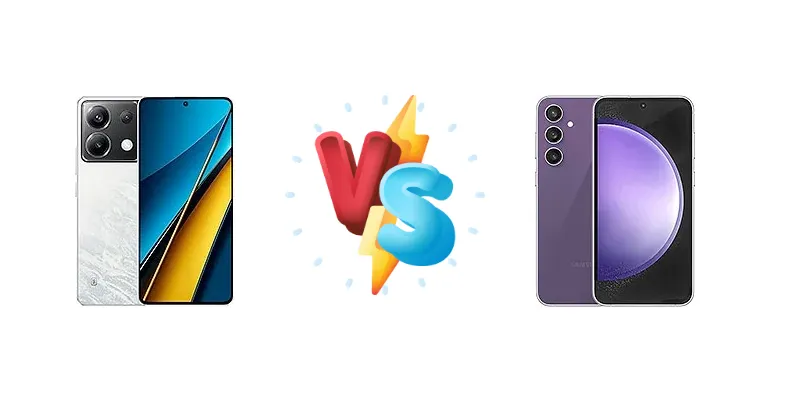
|
🏆 Quick Verdict
For the average user prioritizing battery life and rapid charging, the Xiaomi Poco X6 emerges as the winner. Its 10:11 active use score and 67W charging significantly outperform the S23 FE. However, users demanding peak performance and a more refined software experience will find the S23 FE a worthwhile investment.
| PHONES | ||
|---|---|---|
| Phone Names | Xiaomi Poco X6 | Samsung Galaxy S23 FE |
| Network | ||
|---|---|---|
| 2G bands | GSM 850 / 900 / 1800 / 1900 | GSM 850 / 900 / 1800 / 1900 |
| 3G bands | HSDPA 850 / 900 / 1700(AWS) / 1900 / 2100 - International | HSDPA 850 / 900 / 1700(AWS) / 1900 / 2100 |
| 4G bands | 1, 2, 3, 4, 5, 7, 8, 12, 13, 17, 18, 19, 20, 26, 28, 32, 38, 40, 41, 66 - International | 1, 2, 3, 4, 5, 7, 8, 12, 13, 17, 20, 26, 28, 38, 40, 41, 66 - International |
| 5G bands | 1, 3, 5, 7, 8, 20, 28, 38, 40, 41, 66, 77, 78 SA/NSA/Sub6 - International | 1, 2, 3, 5, 7, 8, 20, 28, 38, 40, 41, 66, 77, 78 SA/NSA/Sub6 - International |
| Speed | HSPA, LTE, 5G | HSPA, LTE, 5G |
| Technology | GSM / HSPA / LTE / 5G | GSM / HSPA / LTE / 5G |
| Launch | ||
|---|---|---|
| Announced | 2024, January 11 | 2023, October 04 |
| Status | Available. Released 2024, January 12 | Available. Released 2023, October 05 |
| Body | ||
|---|---|---|
| Build | Glass front (Gorilla Glass Victus), plastic frame, plastic back | Glass front (Gorilla Glass 5), glass back (Gorilla Glass 5), aluminum frame |
| Dimensions | 161.2 x 74.3 x 8 mm (6.35 x 2.93 x 0.31 in) | 158 x 76.5 x 8.2 mm (6.22 x 3.01 x 0.32 in) |
| SIM | Nano-SIM + Nano-SIM | · Nano-SIM· Nano-SIM + Nano-SIM· Nano-SIM + Nano-SIM + eSIM (max 2 at a time) |
| Weight | 181 g (6.38 oz) | 209 g (7.37 oz) |
| Display | ||
|---|---|---|
| Protection | Corning Gorilla Glass Victus | Corning Gorilla Glass 5 |
| Resolution | 1220 x 2712 pixels, 20:9 ratio (~446 ppi density) | 1080 x 2340 pixels, 19.5:9 ratio (~403 ppi density) |
| Size | 6.67 inches, 107.4 cm2 (~89.7% screen-to-body ratio) | 6.4 inches, 100.5 cm2 (~83.2% screen-to-body ratio) |
| Type | AMOLED, 68B colors, 120Hz, 1920Hz PWM, Dolby Vision, 500 nits (typ), 1200 nits (HBM), 1800 nits (peak) | Dynamic AMOLED 2X, 120Hz, HDR10+, 1450 nits (peak) |
| Platform | ||
|---|---|---|
| CPU | Octa-core (4x2.40 GHz Cortex-A78 & 4x1.95 GHz Cortex-A55) | Octa-core (1x2.8 GHz Cortex-X2 & 3x2.50 GHz Cortex-A710 & 4x1.8 GHz Cortex-A510) - InternationalOcta-core (1x3.00 GHz Cortex-X2 & 3x2.50 GHz Cortex-A710 & 4x1.80 GHz Cortex-A510) - USA |
| Chipset | Qualcomm SM7435-AB Snapdragon 7s Gen 2 (4 nm) | Exynos 2200 (4 nm) - InternationalQualcomm SM8450 Snapdragon 8 Gen 1 (4 nm) - USA |
| GPU | Adreno 710 | Xclipse 920 - InternationalAdreno 730 - USA |
| OS | Android 13, up to 3 major Android upgrades, HyperOS | Android 13, up to 4 major Android upgrades, One UI 8 |
| Memory | ||
|---|---|---|
| Card slot | No | No |
| Internal | 256GB 8GB RAM, 256GB 12GB RAM, 512GB 12GB RAM | 128GB 8GB RAM, 256GB 8GB RAM |
| Main Camera | ||
|---|---|---|
| Features | LED flash, HDR, panorama | LED flash, HDR, panorama |
| Triple | 64 MP, f/1.8, 25mm (wide), 1/2.0", 0.7µm, PDAF, OIS 8 MP, f/2.2, 118˚ (ultrawide), 1/4.0", 1.12µm 2 MP (macro) | 50 MP, f/1.8, 23mm (wide), 1/1.57", 1.0µm, dual pixel PDAF, OIS 8 MP, f/2.4, 76mm (telephoto), 1/4.5", 1.0µm, PDAF, OIS, 3x optical zoom 12 MP, f/2.2, 13mm, 123˚ (ultrawide), 1/3.0", 1.12µm |
| Video | 4K@30fps, 1080p@30/60fps, gyro-EIS | 8K@24fps, 4K@30/60fps, 1080p@30/60/120/240fps |
| Selfie camera | ||
|---|---|---|
| Features | HDR | - |
| Single | 16 MP, f/2.5, (wide), 1.0µm | 10 MP, f/2.4, 25mm (wide), 1/3.0", 1.22µm |
| Video | 1080p@30/60fps | 4K@30/60fps, 1080p@30/60fps; gyro-EIS |
| Sound | ||
|---|---|---|
| 35mm jack | Yes | No |
| Loudspeaker | Yes, with dual speakers | Yes, with stereo speakers |
| Comms | ||
|---|---|---|
| Bluetooth | 5.2, A2DP, LE | 5.3, A2DP, LE |
| Infrared port | Yes | - |
| NFC | Yes (market/region dependent) | Yes |
| Positioning | GPS, GLONASS, GALILEO, BDS | GPS, GLONASS, GALILEO, BDS |
| Radio | No | Unspecified |
| USB | USB Type-C 2.0, OTG | USB Type-C, OTG |
| WLAN | Wi-Fi 802.11 a/b/g/n/ac, dual-band, Wi-Fi Direct | Wi-Fi 802.11 a/b/g/n/ac/6e, dual-band, Wi-Fi Direct |
| Features | ||
|---|---|---|
| Sensors | Fingerprint (under display, optical), accelerometer, gyro, proximity, compass | Fingerprint (under display, optical), accelerometer, gyro, compass |
| Battery | ||
|---|---|---|
| Charging | 67W wired, 100% in 44 min | 25W wired, PD3.0, 50% in 30 min 15W wireless Reverse wireless |
| Type | 5100 mAh | Li-Ion 4500 mAh |
| Misc | ||
|---|---|---|
| Colors | Black, White, Blue | Mint, Cream, Graphite, Purple, Indigo, Tangerine |
| Models | 23122PCD1G, 23122PCD1I | SM-S711B, SM-S711B/DS, SM-S711U1, SM-S711U, SM-S711W, SM-S7110, SM-S711N |
| Price | € 279.99 / $ 213.57 / ₹ 17,990 | $ 219.95 / C$ 327.90 / £ 248.99 / € 272.00 / ₹ 34,999 |
| SAR | 1.09 W/kg (head) 1.03 W/kg (body) | 0.80 W/kg (head) 0.72 W/kg (body) |
| SAR EU | 1.00 W/kg (head) 1.00 W/kg (body) | 0.76 W/kg (head) 1.04 W/kg (body) |
Xiaomi Poco X6
- Significantly faster charging (67W)
- Longer battery life (10:11h active use)
- Brighter display (1339 nits)
- Less powerful chipset
- Potentially less refined camera processing
Samsung Galaxy S23 FE
- More powerful processor (Exynos 2200/Snapdragon 8 Gen 1)
- Wireless charging and reverse wireless charging
- Potentially better camera image processing
- Shorter battery life (8:28h active use)
- Slower charging (25W)
Display Comparison
The Poco X6 boasts a brighter display, reaching a measured 1339 nits compared to the S23 FE’s 985 nits. This translates to better visibility under direct sunlight. While both utilize AMOLED technology, the S23 FE’s panel is likely to have better color accuracy due to Samsung’s display expertise. However, the Poco X6’s higher peak brightness is a significant advantage for outdoor use. Neither specification details refresh rate, but both are expected to offer at least 120Hz.
Camera Comparison
Both phones feature capable photo and video capabilities, but details are limited. The S23 FE likely benefits from Samsung’s advanced image processing algorithms and potentially a larger main sensor (spec not provided). The Poco X6’s camera performance will depend heavily on software optimization. Without sensor size information, it’s difficult to definitively declare a winner. The presence of a 2MP macro camera on the Poco X6 is unlikely to significantly impact image quality and should be considered a secondary feature. The S23 FE’s flagship lineage suggests superior video recording capabilities.
Performance
The chipset is where the biggest difference lies. The S23 FE ships with either the Exynos 2200 (International) or Snapdragon 8 Gen 1 (USA), both 4nm chips, while the Poco X6 utilizes the Snapdragon 7s Gen 2 (also 4nm). The Exynos 2200/Snapdragon 8 Gen 1 offer significantly higher CPU and GPU performance, as evidenced by their Cortex-X2 prime cores (2.8/3.0 GHz respectively) versus the Poco’s Cortex-A78 cores (2.40 GHz). However, the Snapdragon 7s Gen 2 is more power-efficient, contributing to the Poco X6’s superior battery life. The S23 FE’s higher performance will be noticeable in demanding games and applications, but may come at the cost of thermal throttling, particularly with the Exynos variant. The Poco X6’s chipset is optimized for efficiency, providing a smoother experience for everyday tasks.
Battery Life
The Poco X6 shines in battery performance, achieving 10:11 hours of active use, compared to the S23 FE’s 8:28 hours. This difference is partially attributable to the more efficient Snapdragon 7s Gen 2 chipset. Furthermore, the Poco X6’s 67W wired charging is significantly faster than the S23 FE’s 25W charging, reaching 100% in just 44 minutes versus approximately 60 minutes for the S23 FE to reach 50% (with PD3.0). The S23 FE does offer 15W wireless charging and reverse wireless charging, features absent on the Poco X6.
Buying Guide
Buy the Xiaomi Poco X6 if you need exceptional battery endurance, incredibly fast charging, and a vibrant display for media consumption, all without breaking the bank. Buy the Samsung Galaxy S23 FE if you prioritize a more powerful processor for demanding tasks like gaming and video editing, a more polished software experience with longer update support, and the added convenience of wireless charging.