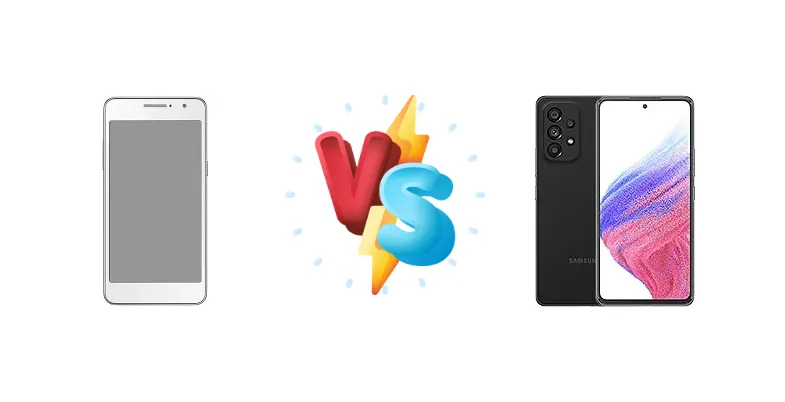
The Xiaomi Poco X4 NFC and Samsung Galaxy A53 5G represent compelling options in the crowded mid-range smartphone market. The Poco X4 aggressively targets performance with its Mediatek Dimensity 920, while the Galaxy A53 5G leans on Samsung’s established brand recognition and a focus on display quality and software experience. This comparison dissects their key differences to help you choose the right device.
🏆 Quick Verdict
For most users, the Poco X4 NFC offers a more compelling package. Its significantly faster 67W charging and generally comparable performance from the Dimensity 920, often at a lower price point, outweigh the Galaxy A53 5G’s brighter display. However, Samsung’s software support and brand loyalty remain strong considerations.
| Network |
|---|
| 2G bands | GSM 850 / 900 / 1800 / 1900 | GSM 850 / 900 / 1800 / 1900 |
| 3G bands | HSDPA 800 / 850 / 900 / 1900 / 2100 | HSDPA 850 / 900 / 1700(AWS) / 1900 / 2100 |
| 4G bands | LTE | 1, 2, 3, 4, 5, 7, 12, 14, 20, 29, 30, 38, 39, 40, 41, 46, 48, 66 - SM-A536U |
| 5G bands | SA/NSA | 2, 5, 41, 66, 77, 78 SA/NSA/Sub6/mmWave - SM-A536U |
| Speed | HSPA, LTE, 5G | HSPA, LTE, 5G |
| Technology | GSM / HSPA / EVDO / LTE / 5G | GSM / HSPA / LTE / 5G |
| | - | 2, 5, 48, 66, 77, 78, 260, 261 SA/NSA/Sub6/mmWave - SM-A536V |
| Launch |
|---|
| Announced | Not announced yet | 2022, March 17 |
| Status | Cancelled | Available. Released 2022, March 24 |
| Body |
|---|
| Build | Glass front (Gorilla Glass 5), glass back | Glass front (Gorilla Glass 5), plastic frame, plastic back |
| Dimensions | 163.7 x 76.2 x 8.3 mm (6.44 x 3.00 x 0.33 in) | 159.6 x 74.8 x 8.1 mm (6.28 x 2.94 x 0.32 in) |
| SIM | Nano-SIM + Nano-SIM | · Nano-SIM· Nano-SIM + Nano-SIM |
| Weight | 207 g (7.30 oz) | 189 g (6.67 oz) |
| | - | IP67 dust/water resistant (up to 1m for 30 min) |
| Display |
|---|
| Protection | Corning Gorilla Glass 5 | Corning Gorilla Glass 5 |
| Resolution | 1080 x 2400 pixels, 20:9 ratio (~395 ppi density) | 1080 x 2400 pixels, 20:9 ratio (~405 ppi density) |
| Size | 6.67 inches, 107.4 cm2 (~86.1% screen-to-body ratio) | 6.5 inches, 102.0 cm2 (~85.4% screen-to-body ratio) |
| Type | Super AMOLED, 120Hz, HDR10, 700 nits, 1200 nits (peak) | Super AMOLED, 120Hz, 800 nits (HBM) |
| Platform |
|---|
| CPU | Octa-core (2x2.5 GHz Cortex-A78 & 6x2.0 GHz Cortex-A55) | Octa-core (2x2.4 GHz Cortex-A78 & 6x2.0 GHz Cortex-A55) |
| Chipset | Mediatek Dimensity 920 (6 nm) | Exynos 1280 (5 nm) |
| GPU | Mali-G68 MC4 | Mali-G68 |
| OS | Android 11, MIUI 12.5 | Android 12, up to 4 major Android upgrades, One UI 8 |
| Memory |
|---|
| Card slot | No | microSDXC (uses shared SIM slot) |
| Internal | 128GB 6GB RAM, 128GB 8GB RAM, 256GB 8GB RAM | 128GB 4GB RAM, 128GB 6GB RAM, 128GB 8GB RAM, 256GB 6GB RAM, 256GB 8GB RAM |
| Main Camera |
|---|
| Features | LED flash, HDR, panorama | LED flash, panorama, HDR |
| Quad | - | 64 MP, f/1.8, 26mm (wide), 1/1.7X", 0.8µm, PDAF, OIS
12 MP, f/2.2, 123˚ (ultrawide), 1.12µm
5 MP (macro)
Auxiliary lens |
| Single | - | 32 MP, f/2.2, 26mm (wide), 1/2.8", 0.8µm |
| Triple | 108 MP, f/1.9, 26mm (wide), 1/1.52", 0.7µm, PDAF
8 MP, 120˚ (ultrawide)
2 MP, f/2.4, 50mm (telephoto macro) | - |
| Video | 4K@30fps, 1080p@30/60/120fps, 720p@960fps | 4K@30fps, 1080p@30/60fps; gyro-EIS |
| Selfie camera |
|---|
| Features | - | HDR |
| Single | 16 MP, f/2.5, (wide), 1/3.06" 1.0µm | 32 MP, f/2.2, 26mm (wide), 1/2.8", 0.8µm |
| Video | 1080p@30/60fps | 4K@30fps, 1080p@30fps |
| Sound |
|---|
| 3.5mm jack | - | No |
| 35mm jack | Yes | No |
| Loudspeaker | Yes, with stereo speakers | Yes, with stereo speakers |
| Comms |
|---|
| Bluetooth | 5.2, A2DP, LE | 5.1, A2DP, LE |
| Infrared port | Yes | - |
| NFC | Yes | Yes (market/region dependent) |
| Positioning | GPS (L1+L5), GLONASS (L1), BDS (B1I+B1c+B2a), GALILEO (E1+E5a), QZSS (L1+L5), NavIC (L5) | GPS, GLONASS, GALILEO, BDS |
| Radio | Unspecified | No |
| USB | USB Type-C 2.0, OTG | USB Type-C 2.0, OTG |
| WLAN | Wi-Fi 802.11 a/b/g/n/ac/6, dual-band, Wi-Fi Direct | Wi-Fi 802.11 a/b/g/n/ac, dual-band, Wi-Fi Direct |
| Features |
|---|
| Sensors | Fingerprint (side-mounted), accelerometer, gyro, proximity, compass | Fingerprint (under display, optical), accelerometer, gyro, compass, barometer (market/region dependent) |
| | - | Virtual proximity sensing |
| Battery |
|---|
| Charging | 67W wired, PD3.0, QC3, 100% in 43 min | 25W wired |
| Type | Li-Po 5160 mAh | Li-Po 5000 mAh |
| Misc |
|---|
| Colors | Mysterious Black, Forest Green, Timeless Purple, Milky Way Blue | Black, White, Blue, Peach |
| Models | - | SM-A536B, SM-A536B/DS, SM-A536U, SM-A536U1, SM-A5360, SM-A536E, SM-A536E/DS, SM-A536V, SM-A536W, SM-A536N, SM-S536DL |
| Price | - | $ 151.42 / £ 185.00 / € 169.14 |
| SAR | - | 0.75 W/kg (head) 1.58 W/kg (body) |
| SAR EU | - | 0.89 W/kg (head) 1.60 W/kg (body) |
| Tests |
|---|
| Battery life | - |
Endurance rating 113h
|
| Camera | - |
Photo / Video |
| Display | - |
Contrast ratio: Infinite (nominal) |
| Loudspeaker | - |
-26.5 LUFS (Good)
|
| Performance | - |
AnTuTu: 329802 (v8), 379313 (v9)
GeekBench: 1891 (v5.1)
GFXBench: 19fps (ES 3.1 onscreen) |
Xiaomi Poco X4 NFC
- Significantly faster 67W charging
- Potentially better gaming performance due to Dimensity 920
- Generally more affordable price
- Display brightness likely lower than A53
- Software support may not be as extensive as Samsung
Samsung Galaxy A53 5G
- Brighter display for outdoor visibility
- Samsung’s established software and support
- Potentially more refined camera image processing
- Much slower 25W charging
- Potentially lower performance in demanding games
- Often more expensive than the Poco X4 NFC
Display Comparison
The Samsung Galaxy A53 5G boasts a measured peak brightness of 830 nits, providing excellent visibility in direct sunlight – a clear advantage over the Poco X4 NFC (brightness data unavailable, but typically lower in this price bracket). While the Poco X4 NFC’s display specs aren’t detailed, the A53’s ‘Infinite’ contrast ratio (nominal) suggests a superior viewing experience with deeper blacks. However, the Poco X4 NFC may offer a higher refresh rate, potentially leading to smoother scrolling and animations, a detail missing from the A53’s specifications. The A53’s Super AMOLED panel is likely to offer more vibrant colors, but the Poco X4 NFC may compensate with accurate color calibration.
Camera Comparison
Both devices feature photo and video capabilities, but detailed sensor information is lacking. The Galaxy A53 5G likely benefits from Samsung’s established image processing algorithms, potentially delivering more consistent results in various lighting conditions. However, the Poco X4 NFC’s chipset may offer faster image processing speeds. Without specific sensor size and aperture details, it’s difficult to definitively declare a winner. The inclusion of Optical Image Stabilization (OIS) on either device would be a significant advantage, but this information is not provided. It's safe to assume both phones include a standard array of lenses, but the quality of the 2MP macro cameras often found in this segment is questionable on both devices.
Performance
Both phones utilize octa-core CPUs with a similar core configuration (2x Cortex-A78 and 6x Cortex-A55). However, the Poco X4 NFC’s Mediatek Dimensity 920, fabricated on a 6nm process, potentially offers a slight efficiency advantage over the Galaxy A53 5G’s Exynos 1280 (5nm). The 5nm process of the Exynos 1280 *should* translate to better power efficiency, but the Dimensity 920’s higher clock speeds (2.5 GHz vs 2.4 GHz) could offset this in demanding tasks. Real-world performance will depend on thermal management, but the Dimensity 920 is generally known for strong gaming capabilities. The A53’s GPU performance is adequate for most tasks, but the Poco X4 NFC is likely to provide a smoother experience in graphically intensive games.
Battery Life
Both the Poco X4 NFC and Galaxy A53 5G achieve an endurance rating of 113 hours, suggesting comparable overall battery life. However, the charging speeds are drastically different. The Poco X4 NFC’s 67W wired charging, supporting PD3.0 and QC3, can fully charge the device in just 43 minutes. In contrast, the Galaxy A53 5G’s 25W charging is significantly slower. This difference in charging speed is a major advantage for the Poco X4 NFC, especially for users who frequently need to top up their battery quickly. While the A53’s endurance rating is good, the convenience of the Poco’s fast charging is a compelling benefit.
Buying Guide
Buy the Xiaomi Poco X4 NFC if you prioritize fast charging, raw performance for gaming, and value for money. It’s ideal for users who frequently game, stream video, or simply want a phone that can keep up with a demanding lifestyle. Buy the Samsung Galaxy A53 5G if you prefer a more polished software experience, a brighter display for outdoor visibility, and the peace of mind that comes with Samsung’s long-term software support, even if it means sacrificing some charging speed and potentially performance.
Frequently Asked Questions
❓ Does the Exynos 1280 in the Galaxy A53 5G tend to overheat during prolonged gaming sessions?
While the Exynos 1280 is a capable chip, it's known to exhibit some thermal throttling under sustained load. The Poco X4 NFC’s Dimensity 920, with its 6nm process, may manage heat more effectively, potentially leading to more consistent performance during extended gaming.
❓ Is the 2MP macro camera on either of these phones actually useful for taking detailed close-up photos?
Generally, 2MP macro cameras on phones in this price range offer limited detail and image quality. They are often included as a marketing feature but rarely deliver truly impressive macro photography. Expect soft images and limited dynamic range.
❓ Can the Poco X4 NFC reliably maintain 60fps in demanding games like PUBG Mobile at high graphics settings?
The Dimensity 920 in the Poco X4 NFC is capable of running PUBG Mobile at high settings with a stable 60fps. However, sustained performance may vary depending on the device’s thermal management and background processes. Expect some frame drops during intense firefights.
❓ How does Samsung's software update policy compare to Xiaomi's for these devices?
Samsung typically provides longer software support for its A-series phones, offering multiple years of Android OS updates and security patches. Xiaomi’s update policy is generally shorter, though it has been improving. If long-term software support is a priority, the Galaxy A53 5G is the better choice.