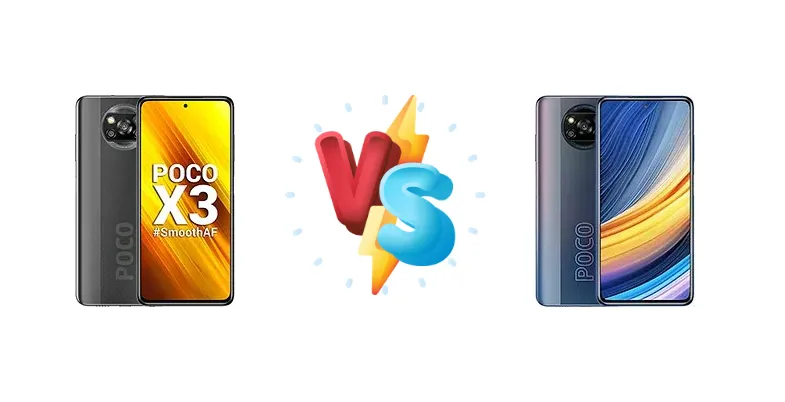
The Xiaomi Poco X3 and X3 Pro represent a fascinating case study in incremental upgrades. Both phones target the budget-conscious gamer, but the X3 Pro’s jump to the Snapdragon 860 chipset raises the question: is the performance boost worth the extra cost? This comparison dissects the key differences to help you choose the right device.
🏆 Quick Verdict
For most users, the Poco X3 Pro is the clear winner. The Snapdragon 860 provides a substantial performance uplift, particularly in gaming, and the faster charging mitigates any battery life concerns. While the X3 remains a capable device, the X3 Pro offers a significantly better experience for demanding tasks.
| Network |
|---|
| 2G bands | GSM 850 / 900 / 1800 / 1900 | GSM 850 / 900 / 1800 / 1900 |
| 3G bands | HSDPA 850 / 900 / 1900 / 2100 | HSDPA 850 / 900 / 1700(AWS) / 1900 / 2100 |
| 4G bands | 1, 3, 5, 8, 40, 41 | 1, 2, 3, 4, 5, 7, 8, 20, 28, 38, 40, 41 - International |
| Speed | HSPA, LTE | HSPA, LTE |
| Technology | GSM / HSPA / LTE | GSM / HSPA / LTE |
| | - | 1, 2, 3, 5, 8, 38, 40, 41 - India |
| Launch |
|---|
| Announced | 2020, September 22 | 2021, March 22 |
| Status | Available. Released 2020, September 29 | Available. Released 2021, March 24 |
| Body |
|---|
| Build | Glass front (Gorilla Glass 5), plastic frame, plastic back | Glass front (Gorilla Glass 6), plastic back |
| Dimensions | 165.3 x 76.8 x 10.1 mm (6.51 x 3.02 x 0.40 in) | 165.3 x 76.8 x 9.4 mm (6.51 x 3.02 x 0.37 in) |
| SIM | Nano-SIM + Nano-SIM | Nano-SIM + Nano-SIM |
| Weight | 225 g (7.94 oz) | 215 g (7.58 oz) |
| | IP53, dust and splash resistant | IP53, dust and splash resistant |
| Display |
|---|
| Protection | Corning Gorilla Glass 5 | Corning Gorilla Glass 6 |
| Resolution | 1080 x 2400 pixels, 20:9 ratio (~395 ppi density) | 1080 x 2400 pixels, 20:9 ratio (~395 ppi density) |
| Size | 6.67 inches, 107.4 cm2 (~84.6% screen-to-body ratio) | 6.67 inches, 107.4 cm2 (~84.6% screen-to-body ratio) |
| Type | IPS LCD, 120Hz, HDR10, 450 nits (typ) | IPS LCD, 120Hz, 2404Hz PWM, HDR10, 450 nits (typ) |
| Platform |
|---|
| CPU | Octa-core (2x2.3 GHz Kryo 470 Gold & 6x1.8 GHz Kryo 470 Silver) | Octa-core (1x2.96 GHz Kryo 485 Gold & 3x2.42 GHz Kryo 485 Gold & 4x1.78 GHz Kryo 485 Silver) |
| Chipset | Qualcomm SM7150-AC Snapdragon 732G (8 nm) | Qualcomm Snapdragon 860 (7 nm) |
| GPU | Adreno 618 | Adreno 640 |
| OS | Android 10, MIUI 12 | Android 11, upgradable to Android 12, MIUI 13 for POCO |
| Memory |
|---|
| Card slot | microSDXC (uses shared SIM slot) | microSDXC (uses shared SIM slot) |
| Internal | 64GB 6GB RAM, 128GB 6GB RAM, 128GB 8GB RAM | 128GB 6GB RAM, 128GB 8GB RAM, 256GB 6GB RAM, 256GB 8GB RAM |
| | UFS 2.1 | UFS 3.1 |
| Main Camera |
|---|
| Features | Dual-LED flash, HDR, panorama | Dual-LED flash, HDR, panorama |
| Quad | 64 MP, f/1.9, (wide), 1/1.73", 0.8µm, PDAF
13 MP, f/2.2, 119˚ (ultrawide), 1.0µm
2 MP (macro)
Auxiliary lens | 48 MP, f/1.8, (wide), 1/2.0", 0.8µm, PDAF
8 MP, f/2.2, 119˚ (ultrawide), 1.0µm
2 MP (macro)
Auxiliary lens |
| Single | - | 20 MP, f/2.2, (wide), 1/3.4", 0.8µm |
| Video | 4K@30fps, 1080p@30/120fps, 720p@960fps; gyro-EIS | 4K@30fps, 1080p@30/60/120/240fps, 1080p@960fps, gyro-EIS |
| Selfie camera |
|---|
| Features | HDR, panorama | HDR, panorama |
| Single | 20 MP, f/2.2, (wide), 1/3.4", 0.8µm | 20 MP, f/2.2, (wide), 1/3.4", 0.8µm |
| Video | 1080p@30fps | 1080p@30fps |
| Sound |
|---|
| 3.5mm jack | Yes | Yes |
| 35mm jack | Yes | Yes |
| Loudspeaker | Yes, with stereo speakers | Yes, with stereo speakers |
| | 24-bit/192kHz audio | 24-bit/192kHz audio |
| Comms |
|---|
| Bluetooth | 5.1, A2DP, LE | 5.0, A2DP, LE |
| Infrared port | Yes | Yes |
| NFC | No | Yes (market/region dependent) |
| Positioning | GPS, GLONASS, BDS | GPS, GLONASS, GALILEO, BDS |
| Radio | FM radio, recording | FM radio, recording |
| USB | USB Type-C 2.0, OTG | USB Type-C 2.0, OTG |
| WLAN | Wi-Fi 802.11 a/b/g/n/ac, dual-band, Wi-Fi Direct | Wi-Fi 802.11 a/b/g/n/ac, dual-band, Wi-Fi Direct |
| Features |
|---|
| Sensors | Fingerprint (side-mounted), accelerometer, gyro, proximity, compass | Fingerprint (side-mounted), accelerometer, gyro, proximity, compass |
| Battery |
|---|
| Charging | 33W wired | 33W wired, 59% in 30 min, 100% in 59 min |
| Type | Li-Po 6000 mAh | Li-Po 5160 mAh |
| Misc |
|---|
| Colors | Cobalt Blue, Shadow Gray | Phantom Black, Frost Blue, Metal Bronze |
| Models | MZB07Z0IN, MZB07Z1IN, MZB07Z2IN, MZB07Z3IN, MZB07Z4IN, MZB9965IN, M2007J20CI | M2102J20SG, M2102J20SI |
| Price | About 230 EUR | $ 128.04 / £ 249.99 |
| SAR | 0.75 W/kg (head) 0.61 W/kg (body) | 0.99 W/kg (head) 0.67 W/kg (body) |
| SAR EU | - | 0.57 W/kg (head) 0.90 W/kg (body) |
| Tests |
|---|
| Battery life | - |
Endurance rating 112h
|
| Camera | - |
Photo / Video |
| Display | - |
Contrast ratio: 1401:1 (nominal) |
| Loudspeaker | - |
-26.1 LUFS (Good)
|
| Performance | - |
AnTuTu: 453223 (v8)
GeekBench: 2574 (v5.1)
GFXBench: 38fps (ES 3.1 onscreen) |
Xiaomi Poco X3
- More affordable price point
- Competent performance for everyday tasks
- 120Hz display for smooth scrolling
- Significantly slower performance than the X3 Pro
- Potentially slower charging speeds
- Less capable GPU for demanding games
Xiaomi Poco X3 Pro
- Superior performance with Snapdragon 860
- Faster 33W charging (59 minutes to full)
- Better suited for gaming and multitasking
- Higher price tag
- Similar battery endurance to the X3
- May run slightly warmer under heavy load
Display Comparison
Both the Poco X3 and X3 Pro feature a 6.67-inch 120Hz display with a 1401:1 contrast ratio, suggesting a similar visual experience in terms of color depth and black levels. However, the lack of detailed brightness specifications makes it difficult to determine if one panel is significantly brighter than the other. The high refresh rate on both devices ensures smooth scrolling and animations, but the X3 Pro’s more powerful GPU is better equipped to consistently deliver high frame rates in demanding games.
Camera Comparison
Both phones are listed as having Photo/Video capabilities, but detailed sensor information is missing. Given the market positioning, it’s likely both feature a similar primary sensor, but the X3 Pro’s more powerful ISP (Image Signal Processor) within the Snapdragon 860 could result in better image processing, particularly in low-light conditions. Without specific details on sensor size and aperture, it’s difficult to definitively declare a winner, but the X3 Pro has the potential for superior image quality due to its chipset.
Performance
The core difference lies in the chipset. The Poco X3’s Snapdragon 732G (8nm) is a capable mid-range processor, featuring an octa-core configuration with 2x2.3 GHz Kryo 470 Gold and 6x1.8 GHz Kryo 470 Silver cores. The X3 Pro, however, boasts the Snapdragon 860 (7nm), a significant step up. Its octa-core setup – 1x2.96 GHz Kryo 485 Gold, 3x2.42 GHz Kryo 485 Gold, and 4x1.78 GHz Kryo 485 Silver – delivers substantially higher CPU and GPU performance. The 7nm process node of the 860 also contributes to improved thermal efficiency, potentially reducing throttling during extended gaming sessions. This translates to smoother gameplay and faster app loading times on the X3 Pro.
Battery Life
Both devices share an endurance rating of 112 hours, suggesting comparable battery life in typical usage scenarios. However, the X3 Pro’s 33W wired charging is significantly faster, reaching 59% in 30 minutes and 100% in 59 minutes. While the X3 also supports 33W charging, it lacks the specific timing data, implying a slower full charge. This faster charging speed on the X3 Pro is a key advantage for users who prioritize convenience and quick top-ups.
Buying Guide
Buy the Xiaomi Poco X3 if you prioritize affordability and need a reliable daily driver for basic tasks like browsing, social media, and light gaming. It’s an excellent choice for users who don’t push their phones to the limit. Buy the Xiaomi Poco X3 Pro if you’re a mobile gamer, frequently multitask, or simply want a phone that feels noticeably faster and more responsive. The X3 Pro’s superior chipset and charging speed justify the price premium for power users.
Frequently Asked Questions
❓ Will the Snapdragon 860 in the Poco X3 Pro overheat during prolonged gaming sessions?
The Snapdragon 860 is known for its strong performance and relatively good thermal management. While it may get warm during extended gaming, the 7nm process node and Xiaomi’s cooling solutions should prevent significant throttling. However, sustained peak performance will inevitably generate heat.
❓ Is the difference in performance between the Snapdragon 732G and 860 noticeable in everyday tasks?
For basic tasks like browsing, social media, and video streaming, the difference will be minimal. However, when launching apps, multitasking, or playing demanding games, the Snapdragon 860 in the X3 Pro will feel significantly faster and more responsive.
❓ Does the Poco X3 Pro support higher frame rates in popular games like PUBG or Call of Duty: Mobile?
Yes, the Snapdragon 860’s Adreno 640 GPU is capable of delivering higher frame rates in many games. While specific frame rate support depends on the game itself, the X3 Pro is more likely to achieve 60fps or higher settings compared to the X3.
❓ How does the charging speed of the Poco X3 Pro compare to other phones in its price range?
The Poco X3 Pro’s 33W charging is relatively fast for its price range. While some competitors offer faster charging speeds, the X3 Pro’s 59-minute full charge time is competitive and provides a convenient charging experience.