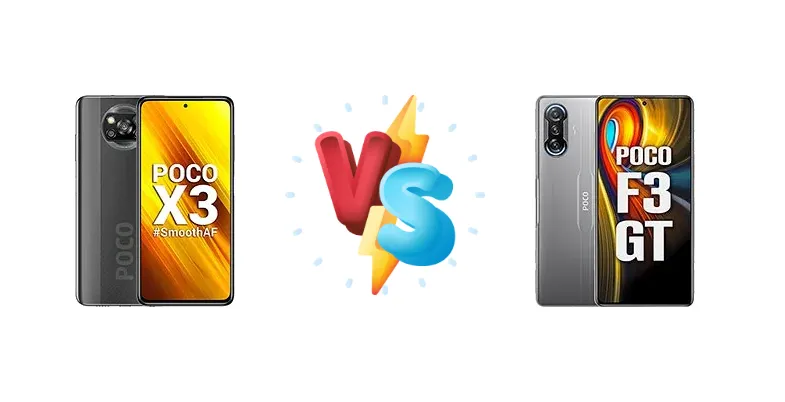
The Xiaomi Poco X3 and F3 GT represent distinct approaches to the mid-range smartphone market. The X3, released earlier, focuses on delivering a well-rounded experience at an aggressive price point. The F3 GT, a later release, aggressively targets gamers with a more powerful chipset and faster charging, but at a higher cost. This comparison dissects the key differences to help you choose the right Poco for your needs.
🏆 Quick Verdict
For most users, the Poco F3 GT is the superior choice, offering significantly faster performance thanks to the Dimensity 1200 and a dramatically quicker 67W charging solution. However, the Poco X3 remains a compelling option for budget-conscious users who prioritize battery life and don't require top-tier gaming capabilities.
| Network |
|---|
| 2G bands | GSM 850 / 900 / 1800 / 1900 | GSM 850 / 900 / 1800 / 1900 |
| 3G bands | HSDPA 850 / 900 / 1900 / 2100 | HSDPA 850 / 900 / 1900 / 2100 |
| 4G bands | 1, 3, 5, 8, 40, 41 | 1, 3, 5, 8, 40, 41 |
| 5G bands | - | 77, 78 SA/NSA |
| Speed | HSPA, LTE | HSPA, LTE, 5G |
| Technology | GSM / HSPA / LTE | GSM / HSPA / LTE / 5G |
| Launch |
|---|
| Announced | 2020, September 22 | 2021, July 23 |
| Status | Available. Released 2020, September 29 | Available. Released 2021, July 26 |
| Body |
|---|
| Build | Glass front (Gorilla Glass 5), plastic frame, plastic back | Glass front (Gorilla Glass 5), glass back (Gorilla Glass 5) |
| Dimensions | 165.3 x 76.8 x 10.1 mm (6.51 x 3.02 x 0.40 in) | 161.9 x 76.9 x 8.3 mm (6.37 x 3.03 x 0.33 in) |
| SIM | Nano-SIM + Nano-SIM | Nano-SIM + Nano-SIM |
| Weight | 225 g (7.94 oz) | 205 g (7.23 oz) |
| | IP53, dust and splash resistant | Physical pop-up gaming triggers
IP53, dust and splash resistant |
| Display |
|---|
| Protection | Corning Gorilla Glass 5 | Corning Gorilla Glass 5 |
| Resolution | 1080 x 2400 pixels, 20:9 ratio (~395 ppi density) | 1080 x 2400 pixels, 20:9 ratio (~395 ppi density) |
| Size | 6.67 inches, 107.4 cm2 (~84.6% screen-to-body ratio) | 6.67 inches, 107.4 cm2 (~86.3% screen-to-body ratio) |
| Type | IPS LCD, 120Hz, HDR10, 450 nits (typ) | AMOLED, 1B colors, 120Hz, HDR10+, 500 nits (typ) |
| Platform |
|---|
| CPU | Octa-core (2x2.3 GHz Kryo 470 Gold & 6x1.8 GHz Kryo 470 Silver) | Octa-core (1x3.0 GHz Cortex-A78 & 3x2.6 GHz Cortex-A78 & 4x2.0 GHz Cortex-A55) |
| Chipset | Qualcomm SM7150-AC Snapdragon 732G (8 nm) | Mediatek Dimensity 1200 (6 nm) |
| GPU | Adreno 618 | Mali-G77 MC9 |
| OS | Android 10, MIUI 12 | Android 11, upgradable to Android 12, MIUI 13 for POCO |
| Memory |
|---|
| Card slot | microSDXC (uses shared SIM slot) | No |
| Internal | 64GB 6GB RAM, 128GB 6GB RAM, 128GB 8GB RAM | 128GB 6GB RAM, 128GB 8GB RAM, 256GB 8GB RAM |
| | UFS 2.1 | UFS 3.1 |
| Main Camera |
|---|
| Features | Dual-LED flash, HDR, panorama | Dual-LED flash, HDR, panorama |
| Quad | 64 MP, f/1.9, (wide), 1/1.73", 0.8µm, PDAF
13 MP, f/2.2, 119˚ (ultrawide), 1.0µm
2 MP (macro)
Auxiliary lens | - |
| Single | - | 16 MP, f/2.5, (wide), 1/3.06" 1.0µm |
| Triple | - | 64 MP, f/1.7, 26mm (wide), 1/2.0", 0.7µm, PDAF
8 MP, f/2.2, 120˚ (ultrawide)
2 MP (macro) |
| Video | 4K@30fps, 1080p@30/120fps, 720p@960fps; gyro-EIS | 4K@30fps, 1080p@30/60/120fps, 720p@960fps, HDR |
| Selfie camera |
|---|
| Features | HDR, panorama | HDR, panorama |
| Single | 20 MP, f/2.2, (wide), 1/3.4", 0.8µm | 16 MP, f/2.5, (wide), 1/3.06" 1.0µm |
| Video | 1080p@30fps | 1080p@30fps, HDR |
| Sound |
|---|
| 3.5mm jack | Yes | No |
| 35mm jack | Yes | No |
| Loudspeaker | Yes, with stereo speakers | Yes, with stereo speakers |
| | 24-bit/192kHz audio | 24-bit/192kHz audio
Tuned by JBL |
| Comms |
|---|
| Bluetooth | 5.1, A2DP, LE | 5.1, A2DP, LE |
| Infrared port | Yes | Yes |
| NFC | No | Yes (market/region dependent) |
| Positioning | GPS, GLONASS, BDS | GPS, GLONASS, GALILEO, BDS |
| Radio | FM radio, recording | No |
| USB | USB Type-C 2.0, OTG | USB Type-C 2.0, OTG |
| WLAN | Wi-Fi 802.11 a/b/g/n/ac, dual-band, Wi-Fi Direct | Wi-Fi 802.11 a/b/g/n/ac/6, dual-band, Wi-Fi Direct |
| Features |
|---|
| Sensors | Fingerprint (side-mounted), accelerometer, gyro, proximity, compass | Fingerprint (side-mounted), accelerometer, gyro, proximity, compass |
| Battery |
|---|
| Charging | 33W wired | 67W wired, PD3.0, QC3, 100% in 42 min |
| Type | Li-Po 6000 mAh | Li-Po 5065 mAh |
| Misc |
|---|
| Colors | Cobalt Blue, Shadow Gray | Predator Black, Gunmetal Silver |
| Models | MZB07Z0IN, MZB07Z1IN, MZB07Z2IN, MZB07Z3IN, MZB07Z4IN, MZB9965IN, M2007J20CI | MZB09C6IN, M2104K10I |
| Price | About 230 EUR | About 300 EUR |
| SAR | 0.75 W/kg (head) 0.61 W/kg (body) | 0.81 W/kg (head) 0.48 W/kg (body) |
Xiaomi Poco X3
- More affordable price point
- Potentially longer battery life (depending on capacity)
- Good overall value for money
- Significantly slower processor
- Slower charging speeds
- Less capable gaming performance
Xiaomi Poco F3 GT
- Much faster Dimensity 1200 processor
- Blazing-fast 67W charging
- Superior gaming performance
- Higher price tag
- Potentially shorter battery life (depending on capacity)
- May run warmer under heavy load
Display Comparison
While both phones likely feature LCD panels (data not provided), the core difference lies in their processing power. The display experience will be largely similar, but the F3 GT’s more powerful GPU will allow for higher, more stable frame rates in games. Bezels are likely comparable given both phones target similar screen sizes. Color accuracy is unknown without testing, but both will likely aim for acceptable sRGB coverage.
Camera Comparison
Without detailed sensor information, a direct camera comparison is difficult. However, the F3 GT’s higher processing power allows for more sophisticated image processing algorithms, potentially resulting in better dynamic range and low-light performance. The X3 likely relies on software optimization to compensate for a potentially less capable sensor. The presence of OIS (Optical Image Stabilization) on either device is unknown, but would be a significant advantage for video recording and low-light photography. The 2MP macro cameras on both devices are likely of limited utility, serving primarily as marketing features.
Performance
The Poco F3 GT’s Mediatek Dimensity 1200, fabricated on a 6nm process, represents a substantial leap in performance over the Poco X3’s Snapdragon 732G (8nm). The Dimensity 1200’s octa-core configuration, featuring a high-clocked Cortex-A78 prime core (3.0 GHz) and additional A78 performance cores (2.6 GHz), provides significantly faster CPU speeds and improved multi-core performance. This translates to snappier app launches, smoother multitasking, and a far superior gaming experience. The Snapdragon 732G, while capable, is geared towards efficient performance rather than outright speed. The F3 GT’s likely use of faster LPDDR5 RAM further enhances its performance advantage.
Battery Life
The Poco X3’s battery capacity is unknown, but its 33W charging is significantly slower than the F3 GT’s 67W charging. The F3 GT can reach 100% charge in a claimed 42 minutes, a substantial time saving. While a larger battery capacity on the X3 might offer longer screen-on time, the F3 GT’s faster charging mitigates range anxiety. The Dimensity 1200’s 6nm process also contributes to improved power efficiency, potentially offsetting some of the battery capacity difference.
Buying Guide
Buy the Xiaomi Poco X3 if you need a reliable daily driver with good battery life and are on a tight budget. It's ideal for casual users, students, and those who prioritize longevity over raw power. Buy the Xiaomi Poco F3 GT if you're a mobile gamer, frequently multitask, or value incredibly fast charging. Its Dimensity 1200 chipset and 67W charging make it a performance powerhouse.
Frequently Asked Questions
❓ Will the Dimensity 1200 in the Poco F3 GT overheat during prolonged gaming sessions?
While the Dimensity 1200 is a powerful chip, Xiaomi likely implemented thermal management solutions (heat pipes, graphite sheets) to mitigate overheating. However, sustained high-intensity gaming will inevitably generate heat. The F3 GT’s performance will likely be sustained for longer periods than the X3, but some throttling is possible.
❓ Is the 33W charging on the Poco X3 slow compared to modern standards?
Yes, 33W charging is relatively slow compared to the 67W charging on the F3 GT and other recent smartphones. Expect a full charge to take significantly longer, potentially over 90 minutes. This is a trade-off for the X3’s lower price.
❓ Does the Poco F3 GT support high refresh rate gaming?
The Dimensity 1200 is capable of driving high refresh rate displays, and the F3 GT likely supports a 120Hz refresh rate. This, combined with the powerful GPU, allows for smoother and more responsive gaming experiences in supported titles.
❓ How does the Snapdragon 732G handle demanding apps like video editing software?
The Snapdragon 732G can handle basic video editing tasks, but it will struggle with complex projects or high-resolution footage. Rendering times will be significantly longer compared to the Poco F3 GT’s Dimensity 1200.