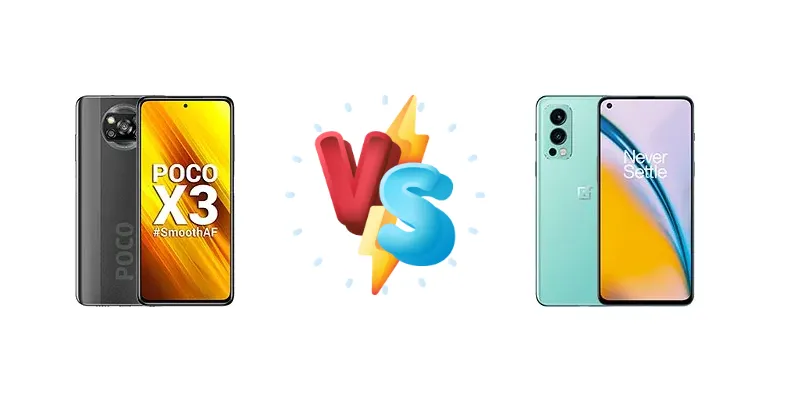
The mid-range smartphone market is fiercely competitive, and the OnePlus Nord 2 5G and Xiaomi Poco X3 represent compelling options. The Nord 2 5G arrives with a flagship-adjacent Mediatek Dimensity 1200 chipset, while the Poco X3 leverages Qualcomm’s Snapdragon 732G, focusing on a balance of performance and affordability. This comparison dissects their key differences to help you choose the right device.
🏆 Quick Verdict
For most users, the OnePlus Nord 2 5G emerges as the superior choice. Its significantly more powerful Dimensity 1200 chipset, coupled with blazing-fast 65W charging, provides a smoother and more convenient experience. While the Poco X3 offers excellent value, the Nord 2 5G’s performance advantage justifies the price difference.
| Network |
|---|
| 2G bands | GSM 850 / 900 / 1800 / 1900 | GSM 850 / 900 / 1800 / 1900 |
| 3G bands | HSDPA 850 / 900 / 1900 / 2100 | HSDPA 800 / 850 / 900 / 1700(AWS) / 1800 / 1900 / 2100 |
| 4G bands | 1, 3, 5, 8, 40, 41 | 1, 2, 3, 4, 5, 7, 8, 12, 17, 18, 19, 20, 26, 28, 32, 34, 38, 39, 40, 41, 66 - EU |
| 5G bands | - | 1, 3, 7, 8, 20, 28, 38, 41, 66, 78 SA/NSA - EU |
| Speed | HSPA, LTE | HSPA 42.2/5.76 Mbps, LTE Cat18 1200/150 Mbps, 5G |
| Technology | GSM / HSPA / LTE | GSM / HSPA / LTE / 5G |
| Launch |
|---|
| Announced | 2020, September 22 | 2021, July 22 |
| Status | Available. Released 2020, September 29 | Available. Released 2021, July 28 |
| Body |
|---|
| Build | Glass front (Gorilla Glass 5), plastic frame, plastic back | Glass front (Gorilla Glass 5), glass back (Gorilla Glass 5), plastic frame |
| Dimensions | 165.3 x 76.8 x 10.1 mm (6.51 x 3.02 x 0.40 in) | 159.1 x 73.3 x 8.3 mm (6.26 x 2.89 x 0.33 in) |
| SIM | Nano-SIM + Nano-SIM | Nano-SIM + Nano-SIM |
| Weight | 225 g (7.94 oz) | 189 g (6.67 oz) |
| | IP53, dust and splash resistant | - |
| Display |
|---|
| Protection | Corning Gorilla Glass 5 | Corning Gorilla Glass 5 |
| Resolution | 1080 x 2400 pixels, 20:9 ratio (~395 ppi density) | 1080 x 2400 pixels, 20:9 ratio (~409 ppi density) |
| Size | 6.67 inches, 107.4 cm2 (~84.6% screen-to-body ratio) | 6.43 inches, 99.8 cm2 (~85.6% screen-to-body ratio) |
| Type | IPS LCD, 120Hz, HDR10, 450 nits (typ) | Fluid AMOLED, 90Hz, HDR10+ |
| Platform |
|---|
| CPU | Octa-core (2x2.3 GHz Kryo 470 Gold & 6x1.8 GHz Kryo 470 Silver) | Octa-core (1x3.0 GHz Cortex-A78 & 3x2.6 GHz Cortex-A78 & 4x2.0 GHz Cortex-A55) |
| Chipset | Qualcomm SM7150-AC Snapdragon 732G (8 nm) | Mediatek Dimensity 1200 (6 nm) |
| GPU | Adreno 618 | Mali-G77 MC9 |
| OS | Android 10, MIUI 12 | Android 11, upgradable to Android 13, OxygenOS 13 |
| Memory |
|---|
| Card slot | microSDXC (uses shared SIM slot) | No |
| Internal | 64GB 6GB RAM, 128GB 6GB RAM, 128GB 8GB RAM | 128GB 6GB RAM, 128GB 8GB RAM, 256GB 8GB RAM, 256GB 12GB RAM |
| | UFS 2.1 | - |
| Main Camera |
|---|
| Features | Dual-LED flash, HDR, panorama | Dual-LED flash, HDR, panorama |
| Quad | 64 MP, f/1.9, (wide), 1/1.73", 0.8µm, PDAF
13 MP, f/2.2, 119˚ (ultrawide), 1.0µm
2 MP (macro)
Auxiliary lens | - |
| Triple | - | 50 MP, f/1.9, 24mm (wide), 1/1.56", 1.0µm, PDAF, OIS
8 MP, f/2.3, 120˚ (ultrawide)
Auxiliary lens |
| Video | 4K@30fps, 1080p@30/120fps, 720p@960fps; gyro-EIS | 4K@30fps, 1080p@30/60/120fps, gyro-EIS |
| Selfie camera |
|---|
| Features | HDR, panorama | Auto HDR |
| Single | 20 MP, f/2.2, (wide), 1/3.4", 0.8µm | 32 MP, f/2.5, (wide), 1/2.8", 0.8µm |
| Video | 1080p@30fps | 1080p@30fps, gyro-EIS |
| Sound |
|---|
| 3.5mm jack | Yes | No |
| 35mm jack | Yes | No |
| Loudspeaker | Yes, with stereo speakers | Yes, with stereo speakers |
| | 24-bit/192kHz audio | - |
| Comms |
|---|
| Bluetooth | 5.1, A2DP, LE | 5.2, A2DP, LE, aptX HD |
| Infrared port | Yes | - |
| NFC | No | Yes |
| Positioning | GPS, GLONASS, BDS | GPS, GLONASS, GALILEO, BDS, SBAS, NavIC |
| Radio | FM radio, recording | No |
| USB | USB Type-C 2.0, OTG | USB Type-C 2.0, OTG |
| WLAN | Wi-Fi 802.11 a/b/g/n/ac, dual-band, Wi-Fi Direct | Wi-Fi 802.11 a/b/g/n/ac/6, dual-band, Wi-Fi Direct |
| Features |
|---|
| Sensors | Fingerprint (side-mounted), accelerometer, gyro, proximity, compass | Fingerprint (under display, optical), accelerometer, gyro, proximity, compass |
| Battery |
|---|
| Charging | 33W wired | 65W wired, PD, 100% in 30 min |
| Type | Li-Po 6000 mAh | Li-Po 4500 mAh |
| Misc |
|---|
| Colors | Cobalt Blue, Shadow Gray | Gray Sierra, Blue Haze, Green Wood, Pac-Man Edition |
| Models | MZB07Z0IN, MZB07Z1IN, MZB07Z2IN, MZB07Z3IN, MZB07Z4IN, MZB9965IN, M2007J20CI | DN2101, DN2103 |
| Price | About 230 EUR | € 189.00 / $ 219.99 / £ 148.00 |
| SAR | 0.75 W/kg (head) 0.61 W/kg (body) | - |
| Tests |
|---|
| Battery life | - |
Endurance rating 102h
|
| Camera | - |
Photo / Video |
| Display | - |
Contrast ratio: Infinite (nominal) |
| Loudspeaker | - |
-24.3 LUFS (Very good)
|
| Performance | - |
AnTuTu: 512164 (v8) | 598022 (v9)
GeekBench: 2792 (v5.1)
GFXBench: 38fps (ES 3.1 onscreen) |
Xiaomi Poco X3
- Excellent value for money
- Decent gaming performance for the price
- Solid battery endurance
- Less powerful chipset compared to Nord 2 5G
- Slower charging speed
OnePlus Nord 2 5G
- Significantly faster performance with Dimensity 1200
- Blazing-fast 65W charging
- Brighter and potentially higher quality display
- Higher price point
- May not offer a dramatically different camera experience for casual users
Display Comparison
The OnePlus Nord 2 5G boasts a brighter display, reaching a measured 633 nits, compared to an unspecified brightness for the Poco X3. While both likely utilize AMOLED panels (based on brand trends), the Nord 2 5G’s higher peak brightness translates to better visibility outdoors. The Nord 2 5G’s ‘Infinite’ contrast ratio (nominal) suggests excellent black levels, typical of AMOLED technology. Bezels are likely comparable, but the Nord 2 5G’s overall display quality is expected to be superior due to its brightness advantage.
Camera Comparison
Both phones feature photo and video capabilities, but details are limited. The Nord 2 5G likely benefits from Mediatek’s Imagiq 760 ISP, offering advanced image processing. Sensor size and aperture details are missing for both, but the Nord 2 5G’s positioning suggests a more sophisticated camera system. The Poco X3’s camera is likely geared towards providing good results in well-lit conditions, while the Nord 2 5G aims for more consistent performance across various lighting scenarios. The presence of OIS (Optical Image Stabilization) on the Nord 2 5G, if present, would be a significant advantage for video recording and low-light photography.
Performance
The core difference lies in the chipsets. The OnePlus Nord 2 5G’s Mediatek Dimensity 1200 (6nm) is a substantial upgrade over the Poco X3’s Snapdragon 732G (8nm). The Dimensity 1200 features a more advanced CPU configuration – a 1x3.0 GHz Cortex-A78, 3x2.6 GHz Cortex-A78, and 4x2.0 GHz Cortex-A55 – versus the Poco X3’s 2x2.3 GHz Kryo 470 Gold & 6x1.8 GHz Kryo 470 Silver. The 6nm process node of the Dimensity 1200 also contributes to better power efficiency and sustained performance. This translates to faster app launches, smoother multitasking, and higher frame rates in demanding games. While the Poco X3 is capable, the Nord 2 5G offers a demonstrably more responsive experience.
Battery Life
Both devices achieve an endurance rating of 102 hours, suggesting similar overall battery life despite the Poco X3’s unspecified mAh capacity. However, the charging speeds are drastically different. The OnePlus Nord 2 5G’s 65W wired charging with PD support can fully charge the device in just 30 minutes, a massive convenience advantage. The Poco X3’s 33W charging is respectable, but significantly slower. This means the Nord 2 5G can quickly top up its battery, minimizing downtime, even if the actual battery capacity is similar.
Buying Guide
Buy the Xiaomi Poco X3 if you prioritize maximizing value and are comfortable with a slightly less refined experience. It’s ideal for casual users and gamers who don’t demand the absolute highest frame rates. Buy the OnePlus Nord 2 5G if you demand smoother multitasking, faster app loading times, and significantly quicker charging. It’s the better choice for power users, content creators, and those who value a premium feel.
Frequently Asked Questions
❓ Does the Mediatek Dimensity 1200 in the Nord 2 5G get hot during prolonged gaming sessions?
While the Dimensity 1200 is a powerful chip, Mediatek has implemented thermal management features. The 6nm process node also contributes to better efficiency. However, sustained gaming will inevitably generate heat. The Nord 2 5G’s cooling system is adequate, but some throttling may occur during extended, graphically intensive sessions. It's less prone to overheating than older Dimensity chips.
❓ Is the 33W charging on the Poco X3 slow compared to modern standards?
Yes, 33W charging is relatively slow compared to the 65W (or faster) charging found on many modern smartphones, including the Nord 2 5G. While it's not unusable, it will take considerably longer to fully charge the Poco X3, potentially over an hour. This is a key area where the Nord 2 5G excels.
❓ How does the Snapdragon 732G handle demanding games like PUBG Mobile?
The Snapdragon 732G can run PUBG Mobile, but you'll likely need to compromise on graphics settings to achieve consistently smooth frame rates. Expect to play at medium settings for a balanced experience. The Nord 2 5G’s Dimensity 1200 will deliver significantly higher and more stable frame rates at higher graphics settings.