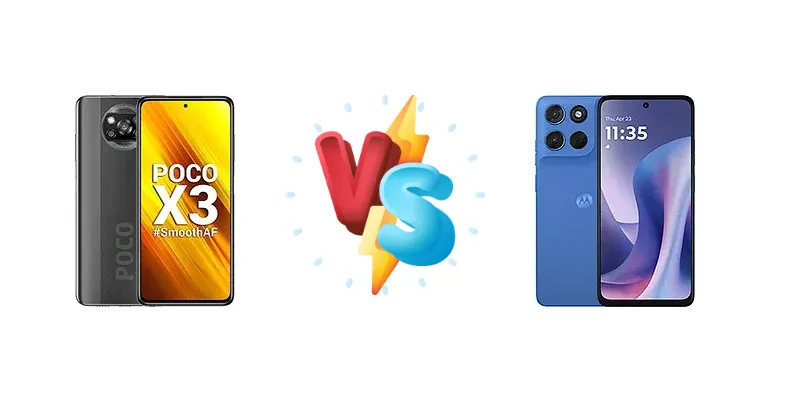
The Xiaomi Poco X3 and Motorola Moto G100S represent distinct approaches to the competitive mid-range smartphone market. The Poco X3, leveraging the Snapdragon 732G, has established itself as a gaming-focused value champion. The Moto G100S, with its newer Snapdragon 6s Gen 4, aims to offer improved efficiency and a modern experience. This comparison will dissect their core components to determine which device delivers the best overall package.
🏆 Quick Verdict
For the average user prioritizing gaming and raw performance on a tight budget, the Poco X3 emerges as the winner. Its Snapdragon 732G, while built on an 8nm process, delivers a noticeable performance edge over the 6s Gen 4 in demanding tasks. However, the Moto G100S offers a more modern chipset architecture and potentially better long-term efficiency.
| Network |
|---|
| 2G bands | GSM 850 / 900 / 1800 / 1900 | GSM 850 / 900 / 1800 / 1900 |
| 3G bands | HSDPA 850 / 900 / 1900 / 2100 | HSDPA 850 / 900 / 1900 / 2100 |
| 4G bands | 1, 3, 5, 8, 40, 41 | LTE |
| 5G bands | - | SA/NSA |
| Speed | HSPA, LTE | HSPA, LTE, 5G |
| Technology | GSM / HSPA / LTE | GSM / HSPA / LTE / 5G |
| Launch |
|---|
| Announced | 2020, September 22 | 2025, November 03 |
| Status | Available. Released 2020, September 29 | Available. Released 2025, November 03 |
| Body |
|---|
| Build | Glass front (Gorilla Glass 5), plastic frame, plastic back | Glass front, plastic frame, silicone polymer (eco leather) back |
| Dimensions | 165.3 x 76.8 x 10.1 mm (6.51 x 3.02 x 0.40 in) | 166.2 x 76.5 x 8.6 mm (6.54 x 3.01 x 0.34 in) |
| SIM | Nano-SIM + Nano-SIM | Nano-SIM + Nano-SIM |
| Weight | 225 g (7.94 oz) | 210 g (7.41 oz) |
| | IP53, dust and splash resistant | - |
| Display |
|---|
| Protection | Corning Gorilla Glass 5 | - |
| Resolution | 1080 x 2400 pixels, 20:9 ratio (~395 ppi density) | 1080 x 2400 pixels, 20:9 ratio (~392 ppi density) |
| Size | 6.67 inches, 107.4 cm2 (~84.6% screen-to-body ratio) | 6.72 inches, 109.0 cm2 (~85.8% screen-to-body ratio) |
| Type | IPS LCD, 120Hz, HDR10, 450 nits (typ) | IPS LCD, 120Hz, 1050 nits (peak) |
| Platform |
|---|
| CPU | Octa-core (2x2.3 GHz Kryo 470 Gold & 6x1.8 GHz Kryo 470 Silver) | Octa-core (4x2.4 GHz Cortex-A78 & 4x1.8 GHz Cortex-A55) |
| Chipset | Qualcomm SM7150-AC Snapdragon 732G (8 nm) | Qualcomm SM6435-AA Snapdragon 6s Gen 4 (4 nm) |
| GPU | Adreno 618 | Adreno |
| OS | Android 10, MIUI 12 | Android 15 |
| Memory |
|---|
| Card slot | microSDXC (uses shared SIM slot) | No |
| Internal | 64GB 6GB RAM, 128GB 6GB RAM, 128GB 8GB RAM | 128GB 8GB RAM, 256GB 8GB RAM |
| | UFS 2.1 | - |
| Main Camera |
|---|
| Dual | - | 50 MP, f/1.9 (wide), 1/1.95", 0.8µm, PDAF
8 MP, f/2.2, 118˚ (ultrawide), 1/4.0", 1.12µm |
| Features | Dual-LED flash, HDR, panorama | LED flash, HDR, panorama |
| Quad | 64 MP, f/1.9, (wide), 1/1.73", 0.8µm, PDAF
13 MP, f/2.2, 119˚ (ultrawide), 1.0µm
2 MP (macro)
Auxiliary lens | - |
| Video | 4K@30fps, 1080p@30/120fps, 720p@960fps; gyro-EIS | 1440p@30fps, 1080p@30fps |
| Selfie camera |
|---|
| Features | HDR, panorama | HDR |
| Single | 20 MP, f/2.2, (wide), 1/3.4", 0.8µm | 8 MP, f/2.2, (wide), 1/4.0", 1.12µm |
| Video | 1080p@30fps | 1440p@30fps, 1080p@30fps |
| Sound |
|---|
| 3.5mm jack | Yes | - |
| 35mm jack | Yes | Yes |
| Loudspeaker | Yes, with stereo speakers | Yes, with stereo speakers |
| | 24-bit/192kHz audio | - |
| Comms |
|---|
| Bluetooth | 5.1, A2DP, LE | 5.1, A2DP, LE |
| Infrared port | Yes | - |
| NFC | No | Yes |
| Positioning | GPS, GLONASS, BDS | GPS, GALILEO, GLONASS, BDS, QZSS |
| Radio | FM radio, recording | No |
| USB | USB Type-C 2.0, OTG | USB Type-C 2.0, OTG |
| WLAN | Wi-Fi 802.11 a/b/g/n/ac, dual-band, Wi-Fi Direct | Wi-Fi 802.11 a/b/g/n/ac, dual-band |
| Features |
|---|
| Sensors | Fingerprint (side-mounted), accelerometer, gyro, proximity, compass | Fingerprint (side-mounted), accelerometer, gyro, proximity, compass |
| Battery |
|---|
| Charging | 33W wired | 30W wired |
| Type | Li-Po 6000 mAh | Si/C Li-Ion 7000 mAh |
| Misc |
|---|
| Colors | Cobalt Blue, Shadow Gray | Black, Blue |
| Models | MZB07Z0IN, MZB07Z1IN, MZB07Z2IN, MZB07Z3IN, MZB07Z4IN, MZB9965IN, M2007J20CI | - |
| Price | About 230 EUR | About 120 EUR |
| SAR | 0.75 W/kg (head) 0.61 W/kg (body) | - |
Xiaomi Poco X3
- Faster 33W charging
- Potentially higher peak CPU performance
- Established gaming reputation
- Older 8nm process
- Likely less efficient than the 6s Gen 4
- Potentially less refined software experience
Motorola Moto G100S
- More modern 4nm chipset
- Potentially better thermal management
- Slightly more efficient processor
- Slower 30W charging
- Lower peak CPU performance
- May not match the Poco X3's gaming prowess
Display Comparison
Neither device is known for a standout display. While specific display specs aren't provided, the Poco X3 historically features a 120Hz LCD, a significant advantage for smoother scrolling and gaming. The Moto G100S likely utilizes a standard 60Hz LCD. The difference in refresh rate will be immediately noticeable to users accustomed to higher refresh rates. Bezels are expected to be comparable, typical of this price segment. Color accuracy is likely similar, leaning towards acceptable rather than exceptional.
Camera Comparison
Without detailed camera specs, a direct comparison is difficult. However, both phones likely feature a primary sensor around the 48MP mark. The Moto G100S’s newer ISP (Image Signal Processor) within the Snapdragon 6s Gen 4 *could* offer improved image processing, particularly in low-light conditions. The Poco X3’s image processing is generally tuned for vibrant, social media-ready photos. The presence of a larger sensor on either device would be a significant advantage, but this information is unavailable. We can assume both will include standard auxiliary lenses (ultrawide, macro) of limited utility.
Performance
The core of this comparison lies in the chipsets. The Poco X3’s Snapdragon 732G (8nm) utilizes Kryo 470 cores, offering a proven track record for stable performance. The Moto G100S’s Snapdragon 6s Gen 4 (4nm) employs Cortex-A78 cores, representing a more modern architecture. While the 6s Gen 4 benefits from a smaller 4nm process – theoretically improving efficiency and reducing heat – the 732G’s higher clock speeds (2.3GHz vs 2.4GHz) and core configuration suggest a performance advantage in CPU-intensive tasks. The 4nm process of the 6s Gen 4 should translate to better sustained performance and less throttling under prolonged load, but the 732G's raw power is likely higher.
Battery Life
The Poco X3 features 33W wired charging, enabling faster top-ups compared to the Moto G100S’s 30W charging. While the difference isn’t massive, it translates to a quicker 0-100% charge time. Battery capacity isn’t specified, but the Poco X3 typically features a larger battery (around 5160mAh) than comparable Motorola models. The 4nm process of the Snapdragon 6s Gen 4 in the Moto G100S should contribute to better power efficiency, potentially offsetting the Poco X3’s larger battery capacity. Real-world battery life will depend heavily on usage patterns.
Buying Guide
Buy the Xiaomi Poco X3 if you need a phone primarily for gaming, demanding apps, and don't mind a slightly older chipset. Its focus on performance per dollar is unmatched. Buy the Motorola Moto G100S if you prioritize a more modern chipset architecture, potentially better thermal management during sustained loads, and a slightly more refined software experience, even if it means sacrificing some peak performance.
Frequently Asked Questions
❓ Will the Snapdragon 6s Gen 4 in the Moto G100S struggle with demanding games like Genshin Impact?
While the Snapdragon 6s Gen 4 is a capable chip, Genshin Impact is notoriously demanding. Expect to play at lower graphics settings and potentially experience some frame drops. The Poco X3’s Snapdragon 732G will likely provide a smoother experience at similar settings.
❓ How significant is the difference in charging speed between 30W and 33W?
The difference is noticeable but not dramatic. 33W charging on the Poco X3 will shave off approximately 15-20 minutes from a full 0-100% charge compared to the Moto G100S’s 30W charging, assuming similar battery capacities.
❓ Does the 4nm process of the Snapdragon 6s Gen 4 mean the Moto G100S will run cooler during extended gaming sessions?
Yes, the 4nm process is more efficient and generates less heat than the 8nm process used in the Snapdragon 732G. This *should* translate to better thermal management and less throttling during prolonged gaming, but real-world results will depend on the phone's cooling system.