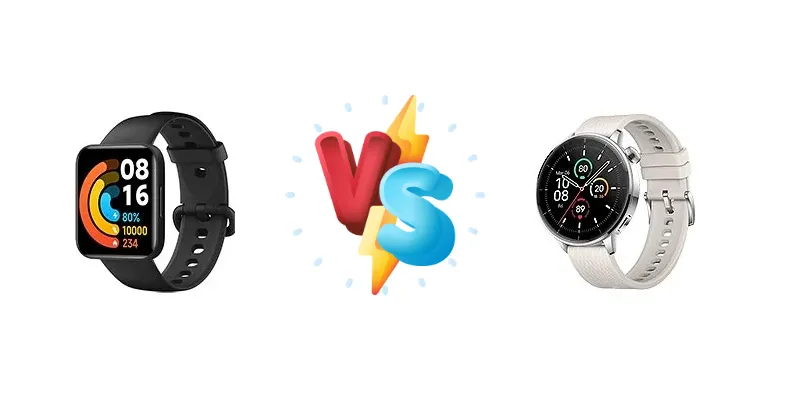
The smartwatch market is increasingly competitive, with options available at every price point. We're pitting the Xiaomi Poco Watch against the OnePlus Watch 3 43mm, two contenders aiming to deliver a compelling experience without breaking the bank. This comparison focuses on how the OnePlus's modern chipset stacks up against the Poco's unknown internals, and which watch offers the best overall value.
🏆 Quick Verdict
For the average user prioritizing performance and future-proofing, the OnePlus Watch 3 43mm is the clear winner. Its Qualcomm Snapdragon W5 Gen 1 chipset provides a significant advantage in responsiveness and efficiency. However, the Poco Watch may appeal to those seeking the absolute lowest price point, assuming it offers acceptable basic functionality.
| Network |
|---|
| 2G bands | N/A | N/A |
| 3G bands | N/A | N/A |
| 4G bands | N/A | N/A |
| EDGE | No | No |
| GPRS | No | No |
| Speed | No | - |
| Technology | No cellular connectivity | No cellular connectivity |
| | No | - |
| Launch |
|---|
| Announced | 2022, April 26 | 2025, July 08 |
| Status | Available. Released 2022, April 28 | Available. Released 2025, July 08 |
| Body |
|---|
| Build | Plastic back, plastic frame | Glass front, stainless steel frame, plastic back |
| Dimensions | 39.1 x 34.4 x 10 mm (1.54 x 1.35 x 0.39 in) | 43.2 x 43.2 x 11 mm (1.70 x 1.70 x 0.43 in) |
| SIM | No | No |
| Weight | 31 g (1.09 oz) | 37.8 g (1.34 oz) |
| | Waterproof (5ATM)
50m water resistant | - |
| Display |
|---|
| Resolution | 360 x 320 pixels (~301 ppi density) | 466 x 466 pixels (~352 ppi density) |
| Size | 1.6 inches | 1.32 inches |
| Type | AMOLED | AMOLED, 1000 nits (peak) |
| Platform |
|---|
| Chipset | - | Qualcomm Snapdragon W5 Gen 1 (4 nm) |
| OS | Proprietary OS | Wear OS |
| Memory |
|---|
| Card slot | No | No |
| Internal | Unspecified storage | 32GB 2GB RAM |
| Sound |
|---|
| 3.5mm jack | No | - |
| 35mm jack | No | No |
| Loudspeaker | No | Yes |
| Comms |
|---|
| Bluetooth | 5.0, A2DP, LE | 5.2, A2DP, LE |
| NFC | Unspecified | Yes |
| Positioning | GPS, GLONASS, GALILEO, BDS | GPS, GLONASS, GALILEO, BDS, QZSS |
| Radio | No | No |
| USB | No | No |
| WLAN | No | Wi-Fi 802.11 a/b/g/n, dual-band |
| Features |
|---|
| Sensors | Accelerometer, heart rate, compass, SpO2 | Accelerometer, gyro, barometer, compass, heart rate, SpO2 |
| Battery |
|---|
| Type | Li-Ion 225 mAh | Li-Ion 354 mAh |
| Misc |
|---|
| Colors | Black, Blue, Ivory | Black Steel, Silver Steel |
| Price | About 90 EUR | € 211.90 |
Xiaomi Poco Watch
- Potentially the lowest price point in the smartwatch market.
- May offer basic fitness tracking features.
- Lightweight design (assumption based on market segment)
- Unknown chipset and performance capabilities.
- Likely limited software support and updates.
- Display specifications are unknown, potentially impacting visual quality.
OnePlus Watch 3 43mm
- Powerful Qualcomm Snapdragon W5 Gen 1 chipset for smooth performance.
- Efficient 4nm process for extended battery life.
- AMOLED display for vibrant visuals.
- Higher price compared to the Poco Watch.
- 43mm size may be too small for some users.
- Software experience may not be as customizable as some Wear OS alternatives.
Display Comparison
Specific display details for the Poco Watch are unavailable. The OnePlus Watch 3 43mm features an AMOLED display, a standard for smartwatches, offering vibrant colors and good contrast. Without knowing the Poco Watch's panel type, it's difficult to assess its color accuracy or viewing angles. The OnePlus Watch 3's 43mm size suggests a focus on comfort for smaller wrists, while the Poco Watch's size is unknown. The OnePlus Watch 3 likely benefits from the Snapdragon W5 Gen 1's display processing capabilities, potentially enabling features like Always-On Display with minimal battery impact.
Camera Comparison
Neither the Poco Watch nor the OnePlus Watch 3 are marketed as having camera capabilities. Smartwatches rarely prioritize camera quality, focusing instead on core smartwatch functions. This section is therefore not applicable to this comparison.
Performance
The OnePlus Watch 3 43mm is powered by the Qualcomm Snapdragon W5 Gen 1 (4nm). This chipset represents a significant leap forward in smartwatch performance and efficiency compared to older generations. The 4nm process node is crucial, delivering improved thermal management and reduced power consumption. The Poco Watch's chipset is unknown, but given its price point, it likely utilizes a less powerful and less efficient processor. This translates to slower app loading times, less fluid animations, and potentially shorter battery life on the Poco Watch. Users who frequently use apps or rely on real-time data like GPS will see a substantial benefit from the Snapdragon W5 Gen 1 in the OnePlus Watch 3.
Battery Life
The Poco Watch's battery capacity is unknown. The OnePlus Watch 3 43mm's battery life is expected to be optimized by the Snapdragon W5 Gen 1's power efficiency. While the exact mAh capacity isn't specified, the 4nm process allows for longer runtimes on a single charge. The Snapdragon W5 Gen 1 also supports fast charging, enabling quicker top-ups when needed. Without knowing the Poco Watch's battery size and charging speed, it's difficult to make a direct comparison, but the OnePlus Watch 3 is likely to offer a more consistent and reliable battery experience.
Buying Guide
Buy the Xiaomi Poco Watch if you need a basic smartwatch for notifications and simple fitness tracking, and your budget is extremely limited. You're likely accepting compromises in performance and software support. Buy the OnePlus Watch 3 43mm if you prefer a smoother, more responsive experience with a modern chipset, better health tracking capabilities, and a more polished software experience, even if it comes at a slightly higher cost.
Frequently Asked Questions
❓ How does the Snapdragon W5 Gen 1 in the OnePlus Watch 3 impact app responsiveness compared to a typical budget smartwatch chipset?
The Snapdragon W5 Gen 1 is a significant upgrade. Its architecture and processing power allow for much faster app loading times, smoother animations, and a more responsive user interface. Budget smartwatches often struggle with lag and stuttering, especially when running multiple apps or using complex features like GPS. The W5 Gen 1 minimizes these issues.
❓ If I primarily use a smartwatch for notifications and basic step tracking, is the extra cost of the OnePlus Watch 3 justified?
If your needs are truly limited to notifications and basic step tracking, the Poco Watch might suffice. However, the OnePlus Watch 3 offers a more refined experience even for these basic functions. The faster processor ensures notifications arrive promptly and the step tracking is likely more accurate due to improved sensor processing. The long-term benefit of a more capable chipset is future-proofing.
❓ What kind of health tracking features does the OnePlus Watch 3 offer beyond basic step counting?
The OnePlus Watch 3 includes advanced health tracking features such as continuous heart rate monitoring, SpO2 (blood oxygen) monitoring, stress tracking, and sleep tracking. It also supports over 100 workout modes, providing detailed metrics for various activities. The Poco Watch's health tracking capabilities are unknown, but likely limited compared to the OnePlus Watch 3.