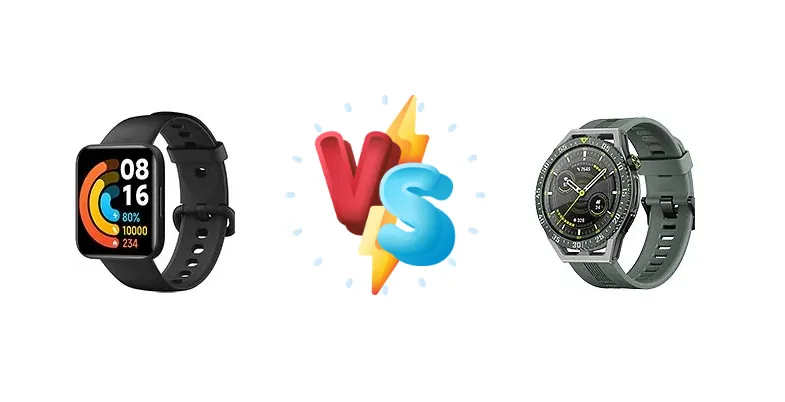
The sub-$100 smartwatch market is heating up, with the Xiaomi Poco Watch and Huawei Watch GT 3 SE vying for dominance. Both aim to deliver essential smartwatch features without breaking the bank, but they take different approaches. The Poco Watch represents Xiaomi’s value-focused strategy, while the GT 3 SE leverages Huawei’s established smartwatch expertise and wireless charging convenience.
🏆 Quick Verdict
For the average user prioritizing convenience and a more refined experience, the Huawei Watch GT 3 SE is the better choice. Its wireless charging capability and likely more mature software ecosystem outweigh the Poco Watch’s potential cost advantage, given the limited available specifications for the Poco Watch.
| Network |
|---|
| 2G bands | N/A | N/A |
| 3G bands | N/A | N/A |
| 4G bands | N/A | N/A |
| EDGE | No | No |
| GPRS | No | No |
| Speed | No | No |
| Technology | No cellular connectivity | No cellular connectivity |
| | No | - |
| Launch |
|---|
| Announced | 2022, April 26 | 2022, November 10 |
| Status | Available. Released 2022, April 28 | Available. Released 2022, November 10 |
| Body |
|---|
| Build | Plastic back, plastic frame | Glass front, plastic back, plastic frame |
| Dimensions | 39.1 x 34.4 x 10 mm (1.54 x 1.35 x 0.39 in) | 46.4 x 46.4 x 11 mm (1.83 x 1.83 x 0.43 in) |
| SIM | No | No |
| Weight | 31 g (1.09 oz) | 35.6 g (1.27 oz) |
| | Waterproof (5ATM)
50m water resistant | 50m water resistant
5 ATM
Compatible with standard 22mm straps (46mm model) |
| Display |
|---|
| Resolution | 360 x 320 pixels (~301 ppi density) | 466 x 466 pixels (~326 ppi density) |
| Size | 1.6 inches | 1.43 inches |
| Type | AMOLED | AMOLED |
| Platform |
|---|
| OS | Proprietary OS | HarmonyOS 2.0 |
| Memory |
|---|
| Card slot | No | No |
| Internal | Unspecified storage | 4GB |
| Sound |
|---|
| 3.5mm jack | No | No |
| 35mm jack | No | No |
| Loudspeaker | No | Yes |
| Comms |
|---|
| Bluetooth | 5.0, A2DP, LE | Yes |
| NFC | Unspecified | No |
| Positioning | GPS, GLONASS, GALILEO, BDS | GPS |
| Radio | No | No |
| USB | No | No |
| WLAN | No | No |
| Features |
|---|
| Sensors | Accelerometer, heart rate, compass, SpO2 | Accelerometer, gyro, heart rate, barometer, compass, SpO2 |
| Battery |
|---|
| Charging | - | Wireless |
| Type | Li-Ion 225 mAh | 455 mAh |
| Misc |
|---|
| Colors | Black, Blue, Ivory | Graphite Black, Wilderness Green |
| Models | - | RUNE-B29 |
| Price | About 90 EUR | About 200 EUR |
Xiaomi Poco Watch
- Potentially lower price point
- Xiaomi’s established ecosystem
- Likely lightweight design
- Unknown specifications limit assessment
- Potentially basic software experience
- Likely lacks advanced features
Huawei Watch GT 3 SE
- Convenient wireless charging
- Huawei’s optimized software
- Potentially more accurate fitness tracking
- Wireless charging is slower than wired
- Huawei’s app ecosystem limitations
- May be slightly more expensive
Display Comparison
Without specific display details for the Poco Watch, we can infer it likely utilizes a standard LCD panel to maintain its low price point. The Huawei Watch GT 3 SE, while also not boasting a cutting-edge display, benefits from Huawei’s optimization. Expect the GT 3 SE to offer better color reproduction and viewing angles. The absence of LTPO technology in either watch suggests neither will have adaptive refresh rates for power saving, but the GT 3 SE’s likely higher quality panel will be more visible outdoors.
Camera Comparison
Neither the Poco Watch nor the Huawei Watch GT 3 SE feature cameras. This is standard for budget smartwatches, as including a camera adds cost and complexity without significant user benefit in this segment.
Performance
The Poco Watch’s chipset remains unknown, but given its price bracket, it likely employs a basic, power-efficient processor sufficient for notifications and basic fitness tracking. The Huawei Watch GT 3 SE, benefiting from Huawei’s in-house chip development, likely features a more optimized processor for its software. While neither watch is designed for intensive tasks, the GT 3 SE’s processor will likely provide a smoother user experience and more accurate sensor readings. RAM specifications are unavailable for both, but the GT 3 SE’s optimized software will likely mitigate any RAM limitations.
Battery Life
Battery capacity for both devices is currently unknown. However, the Huawei Watch GT 3 SE’s wireless charging capability introduces a trade-off. Wireless charging is less efficient than wired charging, meaning it may take longer to fully charge the GT 3 SE. The Poco Watch, if utilizing wired charging, could potentially achieve faster charging speeds. Real-world battery life will depend heavily on usage patterns and sensor activity, but Huawei’s power management optimizations likely give the GT 3 SE an edge.
Buying Guide
Buy the Xiaomi Poco Watch if you need a bare-bones smartwatch experience and are extremely price-sensitive, willing to potentially compromise on software polish and features. Buy the Huawei Watch GT 3 SE if you prefer the convenience of wireless charging, a potentially more robust app ecosystem, and a generally more premium feel, even within the budget segment.
Frequently Asked Questions
❓ Does the Huawei Watch GT 3 SE require a smartphone to function fully?
While the Huawei Watch GT 3 SE can function independently for basic timekeeping and fitness tracking, pairing it with a smartphone (Android or iOS) unlocks its full potential, including notifications, call handling, and advanced data synchronization through the Huawei Health app.
❓ What type of wireless charger is compatible with the Huawei Watch GT 3 SE?
The Huawei Watch GT 3 SE supports Qi wireless charging. This means it is compatible with most standard Qi-enabled wireless chargers, though Huawei recommends using its own charger for optimal charging speeds and efficiency.
❓ Is the Poco Watch compatible with iPhones?
Compatibility with iPhones is likely limited. While basic Bluetooth connectivity may function, full feature support, including app integration and data synchronization, is typically optimized for Android devices within Xiaomi’s ecosystem.