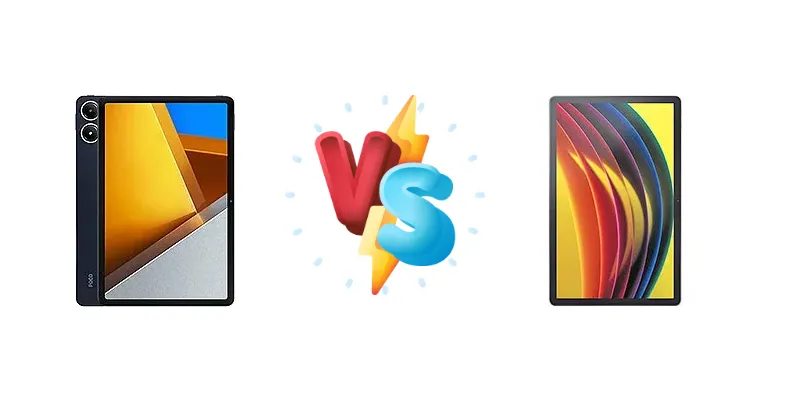
The Android tablet market is heating up, with options ranging from premium flagships to aggressively priced contenders. The Xiaomi Poco Pad and Lenovo Tab P11 Plus represent two distinct approaches: the Poco Pad aims for a strong performance-per-dollar ratio with a modern chipset, while the Tab P11 Plus focuses on delivering a solid experience at an even more accessible price point. This comparison dives deep into their specifications to determine which tablet best suits your needs.
🏆 Quick Verdict
For most users, the Xiaomi Poco Pad emerges as the superior choice. Its Snapdragon 7s Gen 2 chipset provides a significant performance advantage over the Lenovo Tab P11 Plus’s Helio G90T, translating to smoother multitasking and a more responsive user experience. While the Tab P11 Plus offers a compelling value proposition, the Poco Pad’s extra power justifies the price difference.
| Network |
|---|
| 2G bands | N/A | GSM 850 / 900 / 1800 / 1900 |
| 3G bands | N/A | HSDPA 850 / 900 / 1900 / 2100 |
| 4G bands | - | 1, 2, 3, 4, 5, 7, 8, 20, 28, 38, 40, 41 |
| EDGE | N/A | - |
| GPRS | N/A | - |
| Speed | - | HSPA, LTE - cellular model only |
| Technology | No cellular connectivity | GSM / HSPA / LTE |
| Launch |
|---|
| Announced | 2024, May 23 | 2021, June 28 |
| Status | Available. Released 2024, May 23 | Available. Released 2021, July 29 |
| Body |
|---|
| Build | Glass front (Gorilla Glass 3), aluminum frame, aluminum back | - |
| Dimensions | 280 x 181.9 x 7.5 mm (11.02 x 7.16 x 0.30 in) | 258.4 x 163 x 7.5 mm (10.17 x 6.42 x 0.30 in) |
| SIM | No | Nano-SIM (cellular model only) |
| Weight | 571 g (1.26 lb) | 490 g (1.08 lb) |
| | - | Stylus support |
| Display |
|---|
| Protection | Corning Gorilla Glass 3 | - |
| Resolution | 1600 x 2560 pixels, 16:10 ratio (~249 ppi density) | 1200 x 2000 pixels, 5:3 ratio (~212 ppi density) |
| Size | 12.1 inches, 424.5 cm2 (~83.4% screen-to-body ratio) | 11.0 inches, 344.4 cm2 (~81.8% screen-to-body ratio) |
| Type | IPS LCD, 68B colors, 120Hz, Dolby Vision, 600 nits (HBM) | IPS LCD, 400 nits (typ) |
| Platform |
|---|
| CPU | Octa-core (4x2.40 GHz Cortex-A78 & 4x1.95 GHz Cortex-A55) | Octa-core (2x2.05 GHz Cortex-A76 & 6x2.0 GHz Cortex-A55) |
| Chipset | Qualcomm SM7435-AB Snapdragon 7s Gen 2 (4 nm) | Mediatek MT6785 Helio G90T (12 nm) |
| GPU | Adreno 710 | Mali-G76 MC4 |
| OS | Android 14, HyperOS | Android 11 |
| Memory |
|---|
| Card slot | microSDXC (dedicated slot) | microSDXC (dedicated slot) |
| Internal | 256GB 8GB RAM | 64GB 4GB RAM, 128GB 4GB RAM, 128GB 6GB RAM |
| Main Camera |
|---|
| Features | LED flash | LED flash |
| Single | 8 MP, f/2.0, (wide), 1/4.0", 1.12µm | 13 MP, (wide), AF |
| Video | 1080p@30fps | 1080p@30fps |
| Selfie camera |
|---|
| Single | 8 MP, f/2.3, (wide), 1/4.0", 1.12µm | 8 MP, (wide) |
| Video | 1080p@30fps | 1080p@30fps |
| Sound |
|---|
| 3.5mm jack | - | No |
| 35mm jack | Yes | No |
| Loudspeaker | Yes, with stereo speakers (4 speakers) | Yes, with stereo speakers (4 speakers) |
| Comms |
|---|
| Bluetooth | 5.2, A2DP, LE, aptX HD, aptX Adaptive | 5.1, A2DP, LE |
| NFC | No | No |
| Positioning | No | GPS, GLONASS, BDS - cellular model only |
| Radio | No | FM radio |
| USB | USB Type-C 2.0 | USB Type-C 2.0 |
| WLAN | Wi-Fi 802.11 a/b/g/n/ac/6, dual-band, Wi-Fi Direct | Wi-Fi 802.11 a/b/g/n/ac, dual-band, Wi-Fi Direct |
| Features |
|---|
| Sensors | Accelerometer, gyro, proximity (accessories only), compass | Accelerometer, gyro, proximity |
| Battery |
|---|
| Charging | 33W wired, PD3.0, QC3+ | 20W wired |
| Type | 10000 mAh | Li-Po 7700 mAh |
| Misc |
|---|
| Colors | Dark Gray, Blue | Slate Grey, Platinum Grey, Modernist teal |
| Models | 2405CPCFBG | ZA940124SE |
| Price | About 280 EUR | About 300 EUR |
| SAR | 1.09 W/kg (body) | - |
| SAR EU | 0.99 W/kg (body) | - |
Xiaomi Poco Pad
- Significantly faster processor for smoother performance
- Brighter and higher contrast display for better viewing
- Faster charging with PD3.0 and QC3+ support
- Potentially higher price point
- May run slightly warmer under heavy load
Lenovo Tab P11 Plus
- More affordable price
- Decent battery life for basic tasks
- Lightweight and portable design
- Older and less powerful processor
- Slower charging speed
- Display likely lacks the brightness and contrast of the Poco Pad
Display Comparison
The Poco Pad boasts a display capable of reaching 564 nits of peak brightness, a substantial improvement over what’s typically found in this price bracket. This translates to excellent visibility even in brightly lit environments. The 1356:1 contrast ratio further enhances the viewing experience, delivering deeper blacks and more vibrant colors. While the Tab P11 Plus’s display specifications aren’t provided, Lenovo generally opts for IPS LCD panels, which are known for good color accuracy but typically lack the contrast and brightness of the Poco Pad’s panel. The Poco Pad’s brighter display is particularly beneficial for media consumption and outdoor use.
Camera Comparison
Neither tablet is positioned as a photography powerhouse, and detailed camera specs are limited. However, the focus should be on video conferencing capabilities. While specific sensor details are unavailable, the Poco Pad’s superior processing power likely contributes to better image quality during video calls, particularly in challenging lighting conditions. The Tab P11 Plus’s Helio G90T, while capable, is less equipped to handle complex image processing tasks.
Performance
The core difference between these tablets lies in their chipsets. The Poco Pad’s Qualcomm Snapdragon 7s Gen 2 (4nm) is a significant leap forward compared to the Lenovo Tab P11 Plus’s MediaTek Helio G90T (12nm). The 4nm process node of the Snapdragon 7s Gen 2 offers superior power efficiency and thermal management, meaning less throttling during sustained workloads. The Snapdragon’s CPU configuration – Octa-core (4x2.40 GHz Cortex-A78 & 4x1.95 GHz Cortex-A55) – also provides a performance edge over the Tab P11 Plus’s Octa-core (2x2.05 GHz Cortex-A76 & 6x2.0 GHz Cortex-A55). This translates to faster app loading times, smoother multitasking, and a more enjoyable gaming experience on the Poco Pad.
Battery Life
The Poco Pad achieves an impressive 9:15h of active use, demonstrating excellent battery life despite its powerful processor. The 33W wired charging with PD3.0 and QC3+ support allows for relatively quick top-ups. The Lenovo Tab P11 Plus, with its 20W charging, will take considerably longer to fully recharge. While the Tab P11 Plus’s battery capacity isn’t specified, the Poco Pad’s combination of efficient chipset and fast charging provides a clear advantage for users who rely on their tablet throughout the day.
Buying Guide
Buy the Xiaomi Poco Pad if you prioritize performance for gaming, demanding apps, or frequent multitasking. Its newer chipset and faster processing speeds will provide a noticeably smoother experience. Buy the Lenovo Tab P11 Plus if you primarily need a tablet for basic tasks like streaming video, browsing the web, and light productivity. It’s a great option for users on a tight budget who don’t require cutting-edge performance.
Frequently Asked Questions
❓ Will the Poco Pad handle demanding games like Genshin Impact or Call of Duty Mobile?
The Snapdragon 7s Gen 2 in the Poco Pad is capable of running many popular games, including Genshin Impact and Call of Duty Mobile. However, you may need to adjust graphics settings to achieve a consistently smooth frame rate. The Tab P11 Plus’s Helio G90T will struggle with these titles at higher settings.
❓ Is the 33W charging on the Poco Pad a significant improvement over the 20W charging on the Lenovo Tab P11 Plus?
Yes, the 33W charging on the Poco Pad is noticeably faster. While exact 0-100% times aren’t available, you can expect a significantly shorter recharge time compared to the Tab P11 Plus, especially when using a compatible PD3.0 or QC3+ charger.
❓ Does the Poco Pad support stylus input or keyboard attachments?
While not explicitly stated, Xiaomi often includes stylus and keyboard support on their Pad devices. Checking official accessory listings for the Poco Pad is recommended to confirm compatibility. The Lenovo Tab P11 Plus also supports keyboard and stylus accessories, sold separately.