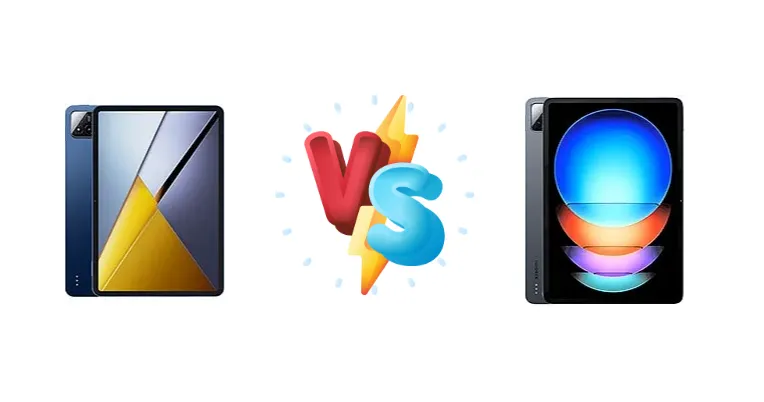
Xiaomi’s tablet lineup is expanding, offering options for a wide range of users. The Poco Pad X1 aims to deliver strong performance at a more accessible price point, while the Xiaomi Pad 6S Pro 12.4 represents the brand’s flagship tablet experience. This comparison dissects the key differences between these two devices, focusing on performance, display, and charging to determine which tablet best suits your needs.
🏆 Quick Verdict
For most users, the Xiaomi Pad 6S Pro 12.4 is the superior choice, justifying its higher price with a significantly more powerful Snapdragon 8 Gen 2 chipset and a brighter, higher-quality display. However, the Poco Pad X1 provides excellent value for budget-conscious users who prioritize a smooth experience over absolute top-tier performance.
| Network |
|---|
| 2G bands | N/A | N/A |
| 3G bands | N/A | N/A |
| 4G bands | N/A | - |
| EDGE | N/A | N/A |
| GPRS | N/A | N/A |
| Technology | No cellular connectivity | No cellular connectivity |
| Launch |
|---|
| Announced | 2025, November 26 | 2024, February 22 |
| Status | Available. Released 2025, November 26 | Available. Released 2024, February 22 |
| Body |
|---|
| Build | Glass front, aluminum frame, aluminum back | Glass front (Gorilla Glass 5), aluminum frame, aluminum back |
| Dimensions | 251.2 x 173.4 x 6.2 mm (9.89 x 6.83 x 0.24 in) | 278.7 x 191.6 x 6.3 mm (10.97 x 7.54 x 0.25 in) |
| SIM | No | No |
| Weight | 500 g (1.10 lb) | 590 g (1.30 lb) |
| Display |
|---|
| Protection | - | Corning Gorilla Glass 5 |
| Resolution | 2136 x 3200 pixels, 3:2 ratio (~344 ppi density) | 2032 x 3048 pixels, 3:2 ratio (~295 ppi density) |
| Size | 11.2 inches, 373.7 cm2 (~85.8% screen-to-body ratio) | 12.4 inches, 457.8 cm2 (~85.7% screen-to-body ratio) |
| Type | IPS LCD, 68B colors, 144Hz, HDR10, Dolby Vision, 800 nits (peak) | IPS LCD, 68B colors, 144Hz, HDR10, Dolby Vision, 900 nits (peak) |
| Platform |
|---|
| CPU | Octa-core (1x2.8 GHz Cortex-X4 & 4x2.6 GHz Cortex-A720 & 3x1.9 GHz Cortex-A520) | Octa-core (1x3.2 GHz Cortex-X3 & 2x2.8 GHz Cortex-A715 & 2x2.8 GHz Cortex-A710 & 3x2.0 GHz Cortex-A510) |
| Chipset | Qualcomm SM7675-AB Snapdragon 7+ Gen 3 (4 nm) | Qualcomm SM8550-AB Snapdragon 8 Gen 2 (4 nm) |
| GPU | Adreno 732 | Adreno 740 |
| OS | Android 15, up to 4 major Android upgrades, HyperOS 2 | Android 14, up to 3 major Android upgrades, HyperOS |
| Memory |
|---|
| Card slot | No | No |
| Internal | 256GB 8GB RAM, 512GB 8GB RAM | 256GB 8GB RAM, 256GB 12GB RAM, 512GB 12GB RAM, 1TB 16GB RAM |
| Main Camera |
|---|
| Dual | - | 50 MP, f/1.8, (wide), 1/2.76", 0.64µm, PDAF
Auxiliary lens |
| Features | LED flash, HDR, panorama | LED flash, HDR, panorama |
| Single | 13 MP, f/2.2, (wide), 1/3.06", 1.12µm, PDAF | - |
| Video | 4K@30fps, 1080p@30/60fps | 4K@30/60fps, 1080p@30/60fps |
| Selfie camera |
|---|
| Features | HDR | - |
| Single | 8 MP, f/2.3, (wide), 1/4.0", 1.12µm | 32 MP, f/2.2, (wide), 1/3.6", 0.61µm |
| Video | 1080p@30fps | 1080p@30fps |
| Sound |
|---|
| 35mm jack | No | No |
| Loudspeaker | Yes, with stereo speakers, Dolby Atmos (4 speakers) | Yes, with stereo speakers (6 speakers) |
| Comms |
|---|
| Bluetooth | 5.4, LHDC 5 | 5.3, A2DP, LE, LHDC |
| Infrared port | Yes | - |
| NFC | Yes (data transfer only; not for payments - market/region dependent) | Yes (file transfer only) |
| Positioning | No | No |
| Radio | No | No |
| USB | USB Type-C 3.2, accessory connector | USB Type-C 3.2, accessory connector |
| WLAN | Wi-Fi 802.11 a/b/g/n/ac/6 or 6e, dual-band, Wi-Fi Direct | Wi-Fi 802.11 a/b/g/n/a/6/7, dual-band, Wi-Fi Direct |
| Features |
|---|
| Sensors | Accelerometer, gyro, proximity, compass | Fingerprint (side-mounted), accelerometer, gyro, proximity (accessories only), compass |
| Battery |
|---|
| Charging | 45W wired, PD3.0, QC3+, 100% in 1h 34 min | 120W wired, PD3.0, QC4, 45% in 10 min, 100% in 35 min |
| Type | 8850 mAh | 10000 mAh |
| Misc |
|---|
| Colors | Gray, Blue | Black, Blue, Green |
| Models | 25099RP08G | 24018RPACG |
| Price | - | About 700 EUR |
| SAR EU | - | 0.99 W/kg (body) |
Xiaomi Poco Pad X1
- More affordable price point
- Capable Snapdragon 7+ Gen 3 processor
- 45W fast charging support
- Lower peak display brightness
- Slower charging speed compared to the 6S Pro
Xiaomi Pad 6S Pro 12.4
- Flagship Snapdragon 8 Gen 2 performance
- Brighter and higher contrast display
- Ultra-fast 120W charging
- Significantly higher price
- Potentially unnecessary power for casual users
Display Comparison
The Xiaomi Pad 6S Pro 12.4 boasts a demonstrably superior display experience. While both tablets utilize 4nm chipsets, the visual experience is markedly different. The 6S Pro achieves a measured peak brightness of 848 nits, significantly outshining the Poco Pad X1 (brightness data unavailable, but expected to be lower based on price point). Furthermore, the 1378:1 contrast ratio on the 6S Pro delivers deeper blacks and more vibrant colors. While both likely employ IPS LCD technology, the 6S Pro’s higher brightness and contrast make it far more usable in bright outdoor environments and provide a more immersive viewing experience for media consumption.
Camera Comparison
Given the tablet form factor, camera performance isn’t a primary concern for most users. However, the Pad 6S Pro 12.4 is likely to offer a more refined camera experience due to its higher-tier chipset and potentially larger sensor (data unavailable for both). The Poco Pad X1’s camera specifications are currently unknown, but it’s reasonable to expect a more basic setup. Without detailed sensor information, it’s difficult to make a definitive comparison, but the 8 Gen 2’s image signal processor (ISP) will provide superior image processing capabilities.
Performance
The core difference between these tablets lies in their chipsets. The Pad 6S Pro 12.4 is powered by the Qualcomm SM8550-AB Snapdragon 8 Gen 2, featuring an octa-core configuration with a prime Cortex-X3 core clocked at 3.2 GHz. This is a substantial upgrade over the Poco Pad X1’s Snapdragon 7+ Gen 3 (SM7675-AB). The 8 Gen 2’s architecture – 1x Cortex-X3, 2x Cortex-A715, 2x Cortex-A710, and 3x Cortex-A510 – offers superior single-core and multi-core performance compared to the Poco’s 1x Cortex-X4, 4x Cortex-A720, and 3x Cortex-A520. This translates to faster app loading times, smoother multitasking, and a more responsive gaming experience. The 4nm process node is shared, but the 8 Gen 2’s more advanced architecture provides a clear performance advantage.
Battery Life
The Xiaomi Pad 6S Pro 12.4 demonstrates a clear advantage in charging speed. Its 120W wired charging capability can deliver a 45% charge in just 10 minutes and a full charge in 35 minutes, utilizing QC4 and PD3.0 standards. The Poco Pad X1, with its 45W charging (PD3.0, QC3+), takes a considerably longer 1 hour and 34 minutes to reach 100%. While the Pad 6S Pro’s active use battery score of 11:14h is a good benchmark, the faster charging is a significant convenience factor, especially for users who rely heavily on their tablets throughout the day.
Buying Guide
Buy the Xiaomi Poco Pad X1 if you need a capable tablet for everyday tasks like streaming, browsing, and light gaming, and are looking for the best possible value. It’s ideal for students or casual users. Buy the Xiaomi Pad 6S Pro 12.4 if you demand flagship-level performance for demanding games, creative applications, or multitasking, and are willing to pay a premium for a superior display and faster charging.
Frequently Asked Questions
❓ Does the Snapdragon 7+ Gen 3 in the Poco Pad X1 struggle with graphically intensive games like Genshin Impact?
While the Snapdragon 7+ Gen 3 is a capable chip, demanding titles like Genshin Impact may require reduced graphics settings for a consistently smooth experience. The Poco Pad X1 will handle most games well, but the 6S Pro’s Snapdragon 8 Gen 2 offers a more headroom for high-fidelity gaming.
❓ Is the 120W charging on the Pad 6S Pro likely to degrade the battery health faster than the 45W charging on the Poco Pad X1?
While faster charging can theoretically contribute to slightly faster battery degradation over the long term, Xiaomi implements battery health management features to mitigate this. The convenience of the 6S Pro’s rapid charging likely outweighs the minimal potential impact on battery lifespan for most users.
❓ What type of display technology does each tablet use (e.g., IPS LCD, OLED)?
Both tablets are expected to utilize IPS LCD panels. While OLED offers superior contrast and black levels, IPS LCD is a cost-effective solution that still delivers good color accuracy and viewing angles. The 6S Pro’s higher brightness and contrast ratio enhance the IPS LCD experience.
❓ Does either tablet support stylus input and keyboard accessories?
Both the Poco Pad X1 and Xiaomi Pad 6S Pro 12.4 are compatible with Xiaomi’s Smart Pen (sold separately) and support Bluetooth keyboard accessories, transforming them into productivity tools. The 6S Pro’s more powerful processor may offer a slightly more responsive stylus experience.