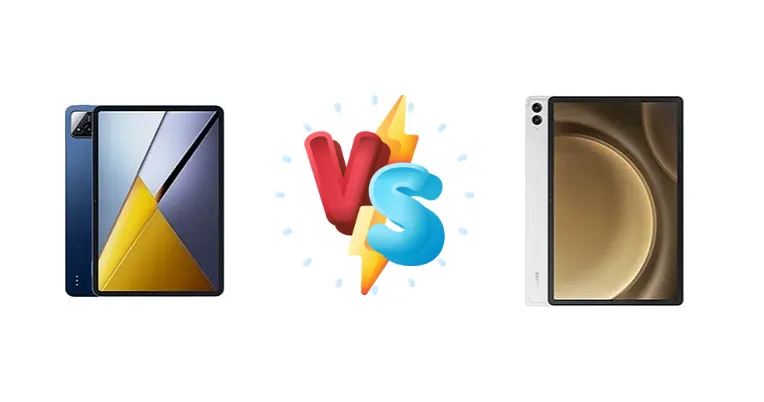
The Android tablet market is heating up, with Xiaomi’s Poco Pad X1 challenging Samsung’s established Galaxy Tab S9 FE+ lineup. Both tablets aim for the mid-range, but take different approaches to achieving it. The Poco Pad X1 leverages a newer generation Snapdragon chipset, while the Galaxy Tab S9 FE+ relies on Samsung’s in-house Exynos silicon. This comparison dissects the key differences to help you choose the right tablet for your needs.
🏆 Quick Verdict
For users prioritizing raw performance and future-proofing, the Xiaomi Poco Pad X1 emerges as the winner. Its Snapdragon 7+ Gen 3 chipset, built on a 4nm process, delivers a noticeable performance edge over the 5nm Exynos 1380 in the Galaxy Tab S9 FE+. However, the S9 FE+ benefits from Samsung’s software ecosystem and potentially better long-term software support.
| Network |
|---|
| 2G bands | N/A | GSM 850 / 900 / 1800 / 1900 |
| 3G bands | N/A | HSDPA 850 / 900 / 1700(AWS) / 1900 / 2100 |
| 4G bands | N/A | 1, 2, 3, 4, 5, 7, 8, 12, 13, 17, 20, 26, 28, 32, 38, 40, 41, 66 |
| 5G bands | - | 1, 3, 5, 7, 8, 20, 28, 38, 40, 41, 66, 77, 78 SA/NSA/Sub6 |
| EDGE | N/A | - |
| GPRS | N/A | - |
| Speed | - | HSPA, LTE, 5G - cellular model only |
| Technology | No cellular connectivity | GSM / HSPA / LTE / 5G |
| Launch |
|---|
| Announced | 2025, November 26 | 2023, October 04 |
| Status | Available. Released 2025, November 26 | Available. Released 2023, October 16 |
| Body |
|---|
| Build | Glass front, aluminum frame, aluminum back | Glass front, aluminum back, aluminum frame |
| Dimensions | 251.2 x 173.4 x 6.2 mm (9.89 x 6.83 x 0.24 in) | 285.4 x 185.4 x 6.5 mm (11.24 x 7.30 x 0.26 in) |
| SIM | No | Nano-SIM + eSIM (cellular model only) |
| Weight | 500 g (1.10 lb) | 627 g or 628 g (1.38 lb) |
| Display |
|---|
| Resolution | 2136 x 3200 pixels, 3:2 ratio (~344 ppi density) | 1600 x 2560 pixels, 16:10 ratio (~243 ppi density) |
| Size | 11.2 inches, 373.7 cm2 (~85.8% screen-to-body ratio) | 12.4 inches, 445.8 cm2 (~84.3% screen-to-body ratio) |
| Type | IPS LCD, 68B colors, 144Hz, HDR10, Dolby Vision, 800 nits (peak) | IPS LCD, 90Hz |
| Platform |
|---|
| CPU | Octa-core (1x2.8 GHz Cortex-X4 & 4x2.6 GHz Cortex-A720 & 3x1.9 GHz Cortex-A520) | Octa-core (4x2.4 GHz Cortex-A78 & 4x2.0 GHz Cortex-A55) |
| Chipset | Qualcomm SM7675-AB Snapdragon 7+ Gen 3 (4 nm) | Exynos 1380 (5 nm) |
| GPU | Adreno 732 | Mali-G68 MP5 |
| OS | Android 15, up to 4 major Android upgrades, HyperOS 2 | Android 13, up to 4 major Android upgrades, One UI 6 |
| Memory |
|---|
| Card slot | No | microSDXC (dedicated slot) |
| Internal | 256GB 8GB RAM, 512GB 8GB RAM | 128GB 6GB RAM, 128GB 8GB RAM, 256GB 8GB RAM, 256GB 12GB RAM |
| Main Camera |
|---|
| Dual | - | 8 MP, (wide)
8 MP, (ultrawide) |
| Features | LED flash, HDR, panorama | - |
| Single | 13 MP, f/2.2, (wide), 1/3.06", 1.12µm, PDAF | - |
| Video | 4K@30fps, 1080p@30/60fps | 4K@30fps, 1080p@30fps |
| Selfie camera |
|---|
| Features | HDR | - |
| Single | 8 MP, f/2.3, (wide), 1/4.0", 1.12µm | 12 MP, (ultrawide) |
| Video | 1080p@30fps | Yes |
| Sound |
|---|
| 35mm jack | No | No |
| Loudspeaker | Yes, with stereo speakers, Dolby Atmos (4 speakers) | Yes, with stereo speakers |
| Comms |
|---|
| Bluetooth | 5.4, LHDC 5 | 5.3, A2DP, LE |
| Infrared port | Yes | - |
| NFC | Yes (data transfer only; not for payments - market/region dependent) | No |
| Positioning | No | GPS, GALILEO, GLONASS, BDS, QZSS - cellular model only |
| Radio | No | No |
| USB | USB Type-C 3.2, accessory connector | USB Type-C 2.0, magnetic connector |
| WLAN | Wi-Fi 802.11 a/b/g/n/ac/6 or 6e, dual-band, Wi-Fi Direct | Wi-Fi 802.11 a/b/g/n/ac/6, dual-band, Wi-Fi Direct |
| Features |
|---|
| Sensors | Accelerometer, gyro, proximity, compass | Fingerprint (side-mounted), accelerometer, gyro, compass, proximity (accessories only) |
| Battery |
|---|
| Charging | 45W wired, PD3.0, QC3+, 100% in 1h 34 min | 45W wired, QC2.0 |
| Type | 8850 mAh | Li-Po 10090 mAh |
| Misc |
|---|
| Colors | Gray, Blue | Mint, Silver, Gray, Lavender |
| Models | 25099RP08G | SM-X610, SM-X616B |
| Price | - | About 770 EUR |
| SAR | - | 0.77 W/kg (body) |
| SAR EU | - | 0.50 W/kg (body) |
Xiaomi Poco Pad X1
- More powerful Snapdragon 7+ Gen 3 chipset
- 4nm process for better efficiency and less throttling
- Supports PD3.0 and QC3+ for wider charger compatibility
- Xiaomi’s software update track record is less consistent than Samsung’s
- Camera performance likely similar to the S9 FE+
Samsung Galaxy Tab S9 FE+
- Integration with Samsung ecosystem
- Samsung’s One UI software experience
- Potentially better display calibration
- Older Exynos 1380 chipset
- Less efficient 5nm process
- QC2.0 charging standard is less modern
Display Comparison
Neither device’s display specifications were provided, so we must infer. Given the price points, both likely utilize IPS LCD panels. However, the Poco Pad X1’s newer chipset *could* support higher refresh rates, potentially offering a smoother visual experience. Samsung typically excels in display calibration, so the S9 FE+ may offer more accurate colors out of the box. Bezels are likely comparable, focusing on maximizing screen real estate within their respective size classes. Without specific nit ratings, it’s difficult to determine which offers superior outdoor visibility.
Camera Comparison
Camera performance is unlikely to be a primary differentiator in this segment. Without specific sensor details, it’s safe to assume both tablets feature modest camera setups geared towards casual use. The absence of information suggests neither device will excel in low-light photography. Image processing will likely lean towards Samsung’s typically vibrant style on the S9 FE+, while the Poco Pad X1 may offer a more natural look. Any differences will be minimal for the average user.
Performance
The core of the difference lies in the chipsets. The Poco Pad X1’s Snapdragon 7+ Gen 3 (4nm) boasts a Cortex-X4 prime core clocked at 2.8 GHz, paired with Cortex-A720 performance cores. This architecture is significantly newer and more efficient than the Exynos 1380 (5nm) in the Galaxy Tab S9 FE+, which uses older Cortex-A78 and A55 cores. The 4nm fabrication process of the Snapdragon further enhances efficiency, leading to less heat generation and potentially sustained performance. While the Exynos 1380 is a capable chip, the Snapdragon 7+ Gen 3 offers a clear advantage in CPU-intensive tasks and gaming. The Poco Pad X1 is likely to exhibit less throttling under sustained load.
Battery Life
Both tablets support 45W wired charging, with the Poco Pad X1 claiming a full charge in 1 hour and 34 minutes. The Galaxy Tab S9 FE+ supports QC2.0, while the Poco Pad X1 supports the more modern PD3.0 and QC3+ standards, potentially offering wider compatibility with chargers. Without knowing the battery capacities, it’s difficult to definitively say which offers better battery life. However, the Snapdragon 7+ Gen 3’s superior efficiency could translate to longer runtimes on the Poco Pad X1, even with a similarly sized battery. The faster charging protocols on the Poco Pad X1 also provide a slight convenience advantage.
Buying Guide
Buy the Xiaomi Poco Pad X1 if you need a tablet for demanding tasks like gaming, video editing, or multitasking, and value the latest chipset technology. Its faster processor and potentially better thermal management make it ideal for power users. Buy the Samsung Galaxy Tab S9 FE+ if you prefer a tablet deeply integrated with the Samsung ecosystem, prioritize stylus support (sold separately), and appreciate Samsung’s One UI software experience. It’s a strong choice for productivity and media consumption within the Samsung world.
Frequently Asked Questions
❓ Does the Exynos 1380 in the Galaxy Tab S9 FE+ tend to overheat during extended gaming sessions?
The Exynos 1380 is a capable chip, but its 5nm process and older core architecture are more prone to thermal throttling than the Snapdragon 7+ Gen 3. While it won't necessarily overheat to the point of being unusable, expect performance to dip slightly after prolonged gaming. The Poco Pad X1, with its 4nm Snapdragon, is better equipped to maintain sustained performance.
❓ How does the software update policy differ between Xiaomi and Samsung for these tablets?
Samsung generally provides longer and more consistent software update support for its tablets compared to Xiaomi. While Xiaomi has improved in recent years, Samsung typically guarantees several years of OS updates and security patches. This is a significant consideration for users who prioritize long-term software support and security.
❓ Can the Poco Pad X1 handle demanding games like Genshin Impact or Call of Duty Mobile at high settings?
The Snapdragon 7+ Gen 3 in the Poco Pad X1 is well-equipped to handle demanding games like Genshin Impact and Call of Duty Mobile. Expect playable frame rates at high settings, though you may need to adjust graphics settings for optimal performance. The Exynos 1380 in the S9 FE+ will likely require lower settings to achieve similar frame rates.