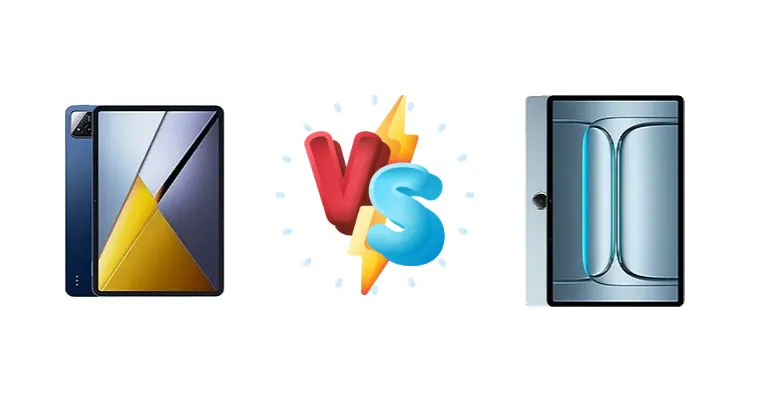
The Android tablet market is heating up, with the Xiaomi Poco Pad X1 and OnePlus Pad Lite vying for the attention of budget-conscious consumers. Both aim to deliver a compelling experience without breaking the bank, but they take distinctly different approaches to achieving that goal, primarily through their chipset choices. This comparison dives deep into the specifications and performance implications to determine which tablet offers the best value.
🏆 Quick Verdict
For most users, the Xiaomi Poco Pad X1 emerges as the stronger choice. Its Snapdragon 7+ Gen 3 chipset provides a significant performance advantage over the OnePlus Pad Lite’s Helio G100, translating to smoother multitasking and better gaming. While the OnePlus Pad Lite offers a slightly more streamlined software experience, the Poco Pad X1’s raw power justifies the price difference.
| Network |
|---|
| 2G bands | N/A | GSM 850 / 900 / 1800 / 1900 - cellular model only |
| 3G bands | N/A | HSDPA 850 / 900 / 2100 - cellular model only |
| 4G bands | N/A | LTE - cellular model only |
| EDGE | N/A | - |
| GPRS | N/A | - |
| Speed | - | HSPA, LTE - cellular model only |
| Technology | No cellular connectivity | GSM / HSPA / LTE |
| Launch |
|---|
| Announced | 2025, November 26 | 2025, July 08 |
| Status | Available. Released 2025, November 26 | Available. Released 2025, August 14 |
| Body |
|---|
| Build | Glass front, aluminum frame, aluminum back | - |
| Dimensions | 251.2 x 173.4 x 6.2 mm (9.89 x 6.83 x 0.24 in) | 254.9 x 166.5 x 7.4 mm (10.04 x 6.56 x 0.29 in) |
| SIM | No | Yes - cellular model only |
| Weight | 500 g (1.10 lb) | 530 g (1.17 lb) |
| Display |
|---|
| Resolution | 2136 x 3200 pixels, 3:2 ratio (~344 ppi density) | 1200 x 1920 pixels, 16:10 ratio (~207 ppi density) |
| Size | 11.2 inches, 373.7 cm2 (~85.8% screen-to-body ratio) | 11.0 inches, 347.5 cm2 (~81.9% screen-to-body ratio) |
| Type | IPS LCD, 68B colors, 144Hz, HDR10, Dolby Vision, 800 nits (peak) | IPS LCD, 1B colors, 90Hz, 500 nits |
| Platform |
|---|
| CPU | Octa-core (1x2.8 GHz Cortex-X4 & 4x2.6 GHz Cortex-A720 & 3x1.9 GHz Cortex-A520) | Octa-core (2x2.2 GHz Cortex-A76 & 6x2.0 GHz Cortex-A55) |
| Chipset | Qualcomm SM7675-AB Snapdragon 7+ Gen 3 (4 nm) | Mediatek Helio G100 (6 nm) |
| GPU | Adreno 732 | Mali-G57 MC2 |
| OS | Android 15, up to 4 major Android upgrades, HyperOS 2 | Android 15, OxygenOS 15 |
| Memory |
|---|
| Card slot | No | Unspecified |
| Internal | 256GB 8GB RAM, 512GB 8GB RAM | 128GB 6GB RAM, 128GB 8GB RAM |
| Main Camera |
|---|
| Features | LED flash, HDR, panorama | - |
| Single | 13 MP, f/2.2, (wide), 1/3.06", 1.12µm, PDAF | 5 MP |
| Video | 4K@30fps, 1080p@30/60fps | 1080p@30fps |
| Selfie camera |
|---|
| Features | HDR | - |
| Single | 8 MP, f/2.3, (wide), 1/4.0", 1.12µm | 5 MP |
| Video | 1080p@30fps | 1080p@30fps |
| Sound |
|---|
| 35mm jack | No | No |
| Loudspeaker | Yes, with stereo speakers, Dolby Atmos (4 speakers) | Yes, with stereo speakers (4 speakers, Hi-Res audio) |
| Comms |
|---|
| Bluetooth | 5.4, LHDC 5 | 5.2, A2DP, LE, aptX HD |
| Infrared port | Yes | - |
| NFC | Yes (data transfer only; not for payments - market/region dependent) | No |
| Positioning | No | GPS, (cellular model only) - unconfirmed |
| Radio | No | No |
| USB | USB Type-C 3.2, accessory connector | USB Type-C 2.0 |
| WLAN | Wi-Fi 802.11 a/b/g/n/ac/6 or 6e, dual-band, Wi-Fi Direct | Wi-Fi 802.11 a/b/g/n/ac, dual-band |
| Features |
|---|
| Sensors | Accelerometer, gyro, proximity, compass | Unspecified |
| Battery |
|---|
| Charging | 45W wired, PD3.0, QC3+, 100% in 1h 34 min | 33W wired |
| Type | 8850 mAh | Li-Po 9340 mAh |
| Misc |
|---|
| Colors | Gray, Blue | Aero Blue |
| Models | 25099RP08G | OPD2480 |
| Price | - | About 200 EUR |
Xiaomi Poco Pad X1
- Significantly more powerful Snapdragon 7+ Gen 3 chipset
- Faster 45W charging with PD3.0/QC3+ support
- Potentially better thermal management due to 4nm process
- Software experience may be more cluttered (typical of Xiaomi)
- Price is likely higher than the OnePlus Pad Lite
OnePlus Pad Lite
- Clean and streamlined OxygenOS software experience
- Potentially more affordable price point
- Sufficient performance for basic tasks and media consumption
- Less powerful MediaTek Helio G100 chipset
- Slower 33W charging
- May struggle with demanding games and applications
Display Comparison
Neither device's display specifications are provided, so a direct comparison is limited. However, given the market positioning, we can infer that both likely utilize IPS LCD panels. The key differentiator will likely be resolution and brightness. The Poco Pad X1, targeting a slightly higher performance tier, may feature a higher resolution display. Bezels are also a crucial factor; smaller bezels contribute to a more immersive viewing experience. Color accuracy, while not specified, is often a trade-off in this price range, with both likely covering around 90-95% of the sRGB color gamut.
Camera Comparison
Without specific camera specs, a detailed comparison is impossible. However, it’s reasonable to assume both tablets feature modest camera setups geared towards video calls and casual snapshots. The absence of details suggests neither device prioritizes photography. Image processing will likely be software-driven, with Xiaomi’s typically offering more vibrant, saturated images, while OnePlus tends towards a more natural look. The presence or absence of features like HDR support will be key differentiators, but remain unknown without further information.
Performance
The core of the difference lies in the chipsets. The Xiaomi Poco Pad X1’s Qualcomm SM7675-AB Snapdragon 7+ Gen 3 (4nm) is a clear step up from the OnePlus Pad Lite’s MediaTek Helio G100 (6nm). The Snapdragon’s Cortex-X4 prime core, clocked at 2.8 GHz, offers significantly higher single-core performance, crucial for responsive UI and app loading. The 4nm process node also provides superior power efficiency, leading to better thermal management and potentially longer battery life under sustained load. The Helio G100, while capable, relies on older Cortex-A76 cores and a less efficient 6nm process. This translates to lower peak performance and potentially more throttling during intensive tasks. The Snapdragon 7+ Gen 3 also benefits from a more advanced GPU, offering a better gaming experience.
Battery Life
The Poco Pad X1’s 45W wired charging with PD3.0 and QC3+ support is a significant advantage over the OnePlus Pad Lite’s 33W charging. The Poco Pad X1 can reach 100% charge in 1 hour and 34 minutes, while the OnePlus Pad Lite will take considerably longer. While battery capacity isn’t specified, the Snapdragon 7+ Gen 3’s efficiency could offset a potentially smaller battery size in the Poco Pad X1, resulting in comparable real-world battery life. The faster charging speed, however, provides a more convenient user experience.
Buying Guide
Buy the Xiaomi Poco Pad X1 if you prioritize performance for gaming, demanding applications, or future-proofing. Its superior chipset will handle heavier workloads with ease. Buy the OnePlus Pad Lite if you value a clean, minimalist software experience and are primarily focused on media consumption and light tasks. The G100 is sufficient for everyday use, but won't offer the same headroom as the Snapdragon.
Frequently Asked Questions
❓ Will the Snapdragon 7+ Gen 3 in the Poco Pad X1 handle demanding games like Genshin Impact at high settings?
The Snapdragon 7+ Gen 3 is a capable chipset and should be able to run Genshin Impact at medium to high settings with playable frame rates. However, sustained performance will depend on the Poco Pad X1’s thermal management solution. Expect some frame drops during extended gaming sessions.
❓ Is the MediaTek Helio G100 in the OnePlus Pad Lite sufficient for streaming video and browsing the web?
Yes, the Helio G100 is perfectly adequate for everyday tasks like streaming video (Netflix, YouTube) and web browsing. It won’t offer the same level of responsiveness as the Snapdragon 7+ Gen 3, but it will provide a smooth experience for these common use cases.
❓ Does the Poco Pad X1 support expandable storage via microSD card?
This information is not provided in the specifications. However, Xiaomi often includes microSD card support in their tablets, so it's a possibility. Check official product listings for confirmation.
❓ How does the software experience differ between Xiaomi's MIUI and OnePlus's OxygenOS?
OxygenOS is known for its clean, minimalist interface and lack of bloatware, offering a near-stock Android experience. MIUI, on the other hand, is more heavily customized with additional features and pre-installed apps. Some users prefer MIUI's customization options, while others find it cluttered.