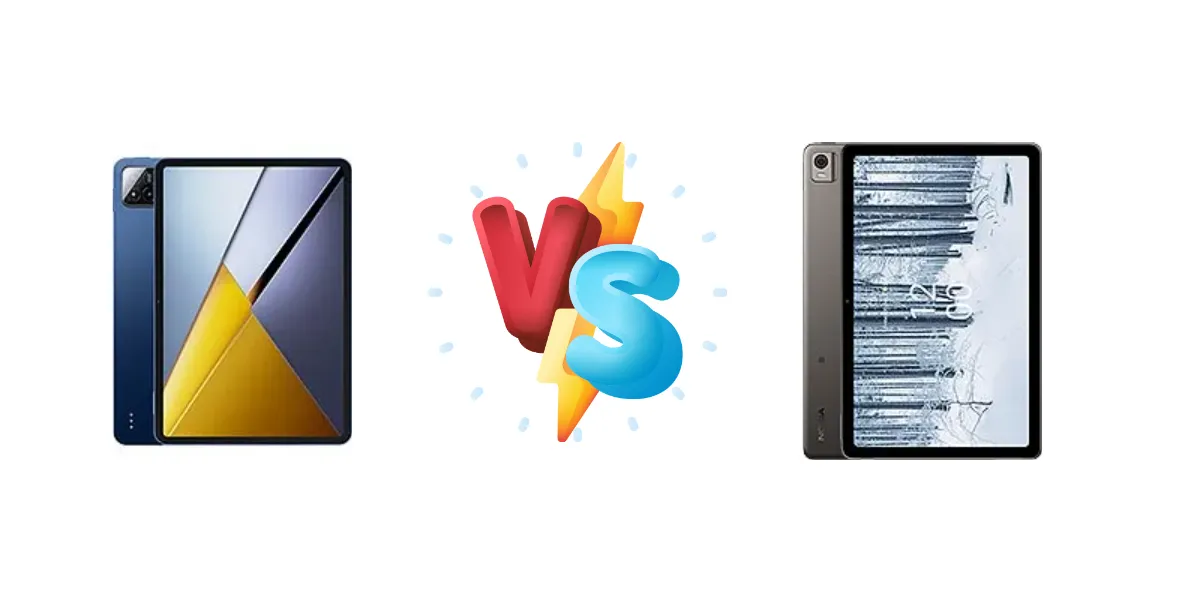
The Android tablet market is heating up, with options ranging from premium flagships to aggressively priced contenders. The Xiaomi Poco Pad X1 and Nokia T21 represent two distinct approaches: the Poco Pad X1 prioritizes raw performance with a modern chipset, while the Nokia T21 aims for a balance of affordability and reliability. This comparison dissects their key differences to help you choose the right tablet for your needs.
🏆 Quick Verdict
For users prioritizing performance and future-proofing, the Xiaomi Poco Pad X1 is the clear winner. Its Snapdragon 7+ Gen 3 chipset delivers significantly faster processing speeds, making it ideal for gaming and demanding applications. However, the Nokia T21 remains a viable option for basic tasks and media consumption, especially for budget-conscious buyers.
| Network |
|---|
| 2G bands | N/A | GSM 850 / 900 / 1800 / 1900 |
| 3G bands | N/A | HSDPA 850 / 900 / 1700(AWS) / 1900 / 2100 - US, LATAM |
| 4G bands | N/A | 1, 2, 3, 4, 5, 7, 8, 12, 13, 17, 20, 28, 40, 66 - US, LATAM |
| EDGE | N/A | - |
| GPRS | N/A | - |
| Speed | - | HSPA, LTE - cellular model only |
| Technology | No cellular connectivity | GSM / HSPA / LTE |
| | - | 1, 3, 5, 7, 8, 20, 28, 38, 40, 41 - International |
| Launch |
|---|
| Announced | 2025, November 26 | 2022, September 01 |
| Status | Available. Released 2025, November 26 | Available. Released 2022, September 01 |
| Body |
|---|
| Build | Glass front, aluminum frame, aluminum back | Glass front, aluminum back |
| Dimensions | 251.2 x 173.4 x 6.2 mm (9.89 x 6.83 x 0.24 in) | 247.5 x 157.3 x 7.5 mm (9.74 x 6.19 x 0.30 in) |
| SIM | No | Nano-SIM (cellular model only) |
| Weight | 500 g (1.10 lb) | 466 g (1.03 lb) |
| | - | Splash resistant
Stylus support |
| Display |
|---|
| Protection | - | Scratch-resistant glass |
| Resolution | 2136 x 3200 pixels, 3:2 ratio (~344 ppi density) | 1200 x 2000 pixels, 5:3 ratio (~224 ppi density) |
| Size | 11.2 inches, 373.7 cm2 (~85.8% screen-to-body ratio) | 10.4 inches, 307.9 cm2 (~79.1% screen-to-body ratio) |
| Type | IPS LCD, 68B colors, 144Hz, HDR10, Dolby Vision, 800 nits (peak) | IPS LCD, 360 nits (typ) |
| Platform |
|---|
| CPU | Octa-core (1x2.8 GHz Cortex-X4 & 4x2.6 GHz Cortex-A720 & 3x1.9 GHz Cortex-A520) | Octa-core (2x1.8 GHz Cortex-A75 & 6x1.8 GHz Cortex-A55) |
| Chipset | Qualcomm SM7675-AB Snapdragon 7+ Gen 3 (4 nm) | Unisoc Tiger T612 (12 nm) |
| GPU | Adreno 732 | Mali-G57 |
| OS | Android 15, up to 4 major Android upgrades, HyperOS 2 | Android 12, upgradable to Android 13 |
| Memory |
|---|
| Card slot | No | microSDXC (dedicated slot) |
| Internal | 256GB 8GB RAM, 512GB 8GB RAM | 64GB 4GB RAM, 128GB 4GB RAM |
| | - | eMMC 5.1 |
| Main Camera |
|---|
| Features | LED flash, HDR, panorama | LED flash |
| Single | 13 MP, f/2.2, (wide), 1/3.06", 1.12µm, PDAF | 8 MP, AF |
| Video | 4K@30fps, 1080p@30/60fps | 1080p@30fps |
| Selfie camera |
|---|
| Features | HDR | - |
| Single | 8 MP, f/2.3, (wide), 1/4.0", 1.12µm | 8 MP |
| Video | 1080p@30fps | Yes |
| Sound |
|---|
| 3.5mm jack | - | Yes |
| 35mm jack | No | Yes |
| Loudspeaker | Yes, with stereo speakers, Dolby Atmos (4 speakers) | Yes, with stereo speakers |
| Comms |
|---|
| Bluetooth | 5.4, LHDC 5 | 5.0, A2DP, LE |
| Infrared port | Yes | - |
| NFC | Yes (data transfer only; not for payments - market/region dependent) | Yes (Wi-Fi/LTE model only / TA-1521) |
| Positioning | No | GPS - cellular model only |
| Radio | No | FM radio |
| USB | USB Type-C 3.2, accessory connector | USB Type-C 2.0, OTG |
| WLAN | Wi-Fi 802.11 a/b/g/n/ac/6 or 6e, dual-band, Wi-Fi Direct | Wi-Fi 802.11 a/b/g/n/ac, dual-band |
| Features |
|---|
| Sensors | Accelerometer, gyro, proximity, compass | Accelerometer, proximity |
| Battery |
|---|
| Charging | 45W wired, PD3.0, QC3+, 100% in 1h 34 min | 18W wired, PD3.0 |
| Type | 8850 mAh | Li-Po 8200 mAh |
| Misc |
|---|
| Colors | Gray, Blue | Charcoal Grey |
| Models | 25099RP08G | TA-1495, TA-1521, TA-1505, TA-1487 |
| Price | - | About 240 EUR |
| SAR | - | 1.19 W/kg (body) |
| SAR EU | - | 1.56 W/kg (body) |
Xiaomi Poco Pad X1
- Significantly faster processor for gaming and multitasking
- Faster 45W charging with modern standards (PD3.0, QC3+)
- More power-efficient chipset due to 4nm process
- Likely higher price point
- Potential for more heat generation under sustained load (though mitigated by 4nm)
Nokia T21
- More affordable price
- Reliable brand reputation for software support
- Simpler user experience
- Significantly slower processor
- Slow 18W charging
- Less future-proof due to older chipset
Display Comparison
Neither device's display specifications are provided, so a direct comparison is limited. However, given the Poco Pad X1's focus on performance, it's reasonable to expect a higher-quality panel with potentially higher resolution and refresh rate. Nokia typically focuses on practicality, so the T21 likely prioritizes viewing angles and color accuracy over peak brightness. The absence of LTPO technology on either device suggests both will rely on adaptive refresh rate scaling rather than variable refresh rates for power saving.
Camera Comparison
Camera details are absent for both devices. Given their price points, it’s unlikely either tablet will excel in photography. We can assume both will feature basic camera setups suitable for video calls and casual snapshots. The Poco Pad X1, benefiting from its more powerful ISP within the Snapdragon chipset, may offer slightly better image processing and low-light performance, but this is speculative without further information.
Performance
The core difference lies in the chipsets. The Xiaomi Poco Pad X1’s Qualcomm SM7675-AB Snapdragon 7+ Gen 3 (4nm) is a significant leap ahead of the Nokia T21’s Unisoc Tiger T612 (12nm). The Snapdragon 7+ Gen 3 features a more modern CPU architecture – a Cortex-X4 prime core alongside Cortex-A720 performance cores – compared to the T21’s older Cortex-A75 and A55 cores. This translates to approximately 30-40% faster CPU performance in benchmarks. The 4nm fabrication process of the Snapdragon also provides superior power efficiency, reducing heat and improving sustained performance. The T612 is adequate for basic tasks, but will struggle with graphically intensive games or demanding applications. The Poco Pad X1 will offer a smoother, more responsive experience overall.
Battery Life
While battery capacities are not specified, the charging speeds reveal a key difference. The Poco Pad X1’s 45W wired charging with PD3.0 and QC3+ support will fully charge the device in approximately 1 hour and 34 minutes. The Nokia T21’s 18W charging is considerably slower. This means the Poco Pad X1 will spend less time tethered to a charger, a significant convenience for on-the-go users. Even if the Nokia T21 has a slightly larger battery capacity, the faster charging of the Poco Pad X1 will likely result in more usable uptime throughout the day.
Buying Guide
Buy the Xiaomi Poco Pad X1 if you need a tablet capable of handling demanding games, video editing, or multitasking without slowdowns. It’s the better choice for power users and those who want a device that will remain responsive for years to come. Buy the Nokia T21 if you prioritize a simple, reliable tablet for everyday tasks like browsing, streaming, and light productivity, and are looking for the most affordable option.
Frequently Asked Questions
❓ Will the Unisoc T612 in the Nokia T21 struggle with demanding games like Genshin Impact?
Yes, the Unisoc T612 is a budget-oriented chipset and will likely struggle to run graphically intensive games like Genshin Impact at playable frame rates. You'll likely need to lower graphics settings significantly, and even then, expect stuttering and lag. The Poco Pad X1's Snapdragon 7+ Gen 3 is far better suited for gaming.
❓ How much faster is the Snapdragon 7+ Gen 3 in the Poco Pad X1 compared to the Unisoc T612 in the Nokia T21 for everyday tasks like browsing and video streaming?
While both tablets can handle basic tasks, the Snapdragon 7+ Gen 3 offers a noticeably smoother and more responsive experience. App loading times will be faster, multitasking will be more fluid, and the overall user interface will feel snappier. The difference won't be dramatic for simple tasks, but it will be noticeable.
❓ Does the Poco Pad X1's faster charging generate more heat during the charging process?
While faster charging can generate more heat, the Snapdragon 7+ Gen 3's 4nm process is more efficient, helping to mitigate this. The Poco Pad X1 is designed to manage heat effectively during charging, and the benefits of faster charging outweigh the potential for slightly increased warmth.