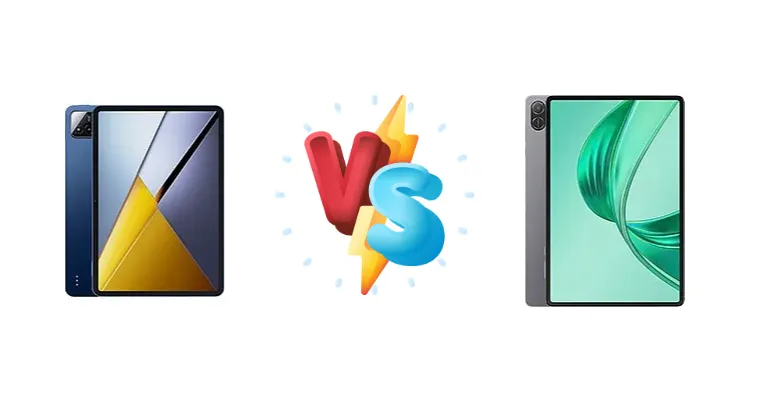
The tablet market is heating up with compelling options at various price points. The Xiaomi Poco Pad X1 aims to deliver flagship-adjacent performance with its Snapdragon 7+ Gen 3, while the Honor Pad X8a prioritizes longevity and affordability with its Snapdragon 680. This comparison dissects the core differences to help you determine which tablet best suits your daily usage.
🏆 Quick Verdict
For users prioritizing raw performance and faster charging, the Xiaomi Poco Pad X1 is the clear winner. Its Snapdragon 7+ Gen 3 offers a significant leap in processing power. However, the Honor Pad X8a excels in battery endurance and offers a compelling value proposition for those seeking a reliable, long-lasting tablet.
| Network |
|---|
| 2G bands | N/A | N/A |
| 3G bands | N/A | N/A |
| 4G bands | N/A | N/A |
| EDGE | N/A | No |
| GPRS | N/A | No |
| Technology | No cellular connectivity | No cellular connectivity |
| Launch |
|---|
| Announced | 2025, November 26 | 2024, August 08 |
| Status | Available. Released 2025, November 26 | Available. Released 2024, August 15 |
| Body |
|---|
| Build | Glass front, aluminum frame, aluminum back | Glass front, aluminum frame, aluminum back |
| Dimensions | 251.2 x 173.4 x 6.2 mm (9.89 x 6.83 x 0.24 in) | 257 x 168.5 x 7.3 mm (10.12 x 6.63 x 0.29 in) |
| SIM | No | No |
| Weight | 500 g (1.10 lb) | 495 g (1.09 lb) |
| Display |
|---|
| Protection | - | Mohs level 4 |
| Resolution | 2136 x 3200 pixels, 3:2 ratio (~344 ppi density) | 1200 x 1920 pixels, 16:10 ratio (~206 ppi density) |
| Size | 11.2 inches, 373.7 cm2 (~85.8% screen-to-body ratio) | 11.0 inches, 350.9 cm2 (~81.0% screen-to-body ratio) |
| Type | IPS LCD, 68B colors, 144Hz, HDR10, Dolby Vision, 800 nits (peak) | TFT LCD, 90Hz, 400 nits |
| Platform |
|---|
| CPU | Octa-core (1x2.8 GHz Cortex-X4 & 4x2.6 GHz Cortex-A720 & 3x1.9 GHz Cortex-A520) | Octa-core (4x2.4 GHz Kryo 265 Gold & 4x1.9 GHz Kryo 265 Silver) |
| Chipset | Qualcomm SM7675-AB Snapdragon 7+ Gen 3 (4 nm) | Qualcomm SM6225 Snapdragon 680 4G (6 nm) |
| GPU | Adreno 732 | Adreno 610 |
| OS | Android 15, up to 4 major Android upgrades, HyperOS 2 | Android 14, MagicOS 8 |
| Memory |
|---|
| Card slot | No | No |
| Internal | 256GB 8GB RAM, 512GB 8GB RAM | 64GB 4GB RAM, 128GB 4GB RAM |
| Main Camera |
|---|
| Features | LED flash, HDR, panorama | HDR |
| Single | 13 MP, f/2.2, (wide), 1/3.06", 1.12µm, PDAF | 5 MP, f/2.2, AF |
| Video | 4K@30fps, 1080p@30/60fps | 1080p@30fps |
| Selfie camera |
|---|
| Features | HDR | - |
| Single | 8 MP, f/2.3, (wide), 1/4.0", 1.12µm | 5 MP, f/2.2 |
| Video | 1080p@30fps | 1080p@30fps |
| Sound |
|---|
| 35mm jack | No | No |
| Loudspeaker | Yes, with stereo speakers, Dolby Atmos (4 speakers) | Yes, with stereo speakers (4 speakers) |
| Comms |
|---|
| Bluetooth | 5.4, LHDC 5 | 5.1, A2DP, LE |
| Infrared port | Yes | - |
| NFC | Yes (data transfer only; not for payments - market/region dependent) | No |
| Positioning | No | No |
| Radio | No | No |
| USB | USB Type-C 3.2, accessory connector | USB Type-C, OTG |
| WLAN | Wi-Fi 802.11 a/b/g/n/ac/6 or 6e, dual-band, Wi-Fi Direct | Wi-Fi 802.11 a/b/g/n/ac, dual-band |
| Features |
|---|
| Sensors | Accelerometer, gyro, proximity, compass | Accelerometer |
| Battery |
|---|
| Charging | 45W wired, PD3.0, QC3+, 100% in 1h 34 min | - |
| Type | 8850 mAh | Li-Ion 8300 mAh |
| Misc |
|---|
| Colors | Gray, Blue | Space Gray |
| Models | 25099RP08G | NDL-W09 |
| Price | - | About 150 EUR |
| EU LABEL |
|---|
| Battery | - | 133:17h endurance, 1200 cycles |
| Energy | - | Class D |
| Free fall | - | Class E (7 falls) |
| Repairability | - | Class C |
Xiaomi Poco Pad X1
- Significantly faster processor for demanding tasks
- 45W fast charging for quick power-ups
- More efficient 4nm chipset
- Likely shorter battery life compared to the X8a
- Potentially higher price point
Honor Pad X8a
- Exceptional battery endurance (133-17h)
- Long battery lifespan (1200 cycles)
- More affordable price
- Slower processor for demanding applications
- Likely slower charging speeds
Display Comparison
Display specifications are absent from the provided data, but considering the market positioning, we can infer differences. The Poco Pad X1, targeting a performance-focused user, likely features a higher resolution and refresh rate panel. The Honor Pad X8a, aiming for affordability, likely utilizes a standard LCD panel. The absence of LTPO technology in either device suggests neither will offer variable refresh rates for power saving. Bezels are likely comparable, given both are mid-range tablets.
Camera Comparison
Camera details are unavailable, but given the price segments, expectations should be tempered. Both tablets likely feature basic camera setups geared towards video calls and casual snapshots. The absence of information regarding sensor size or OIS suggests neither device will excel in low-light photography. Image processing will likely be optimized for social media sharing rather than professional-grade results. Without further data, it’s difficult to definitively declare a winner.
Performance
The core difference lies in the chipsets. The Poco Pad X1’s Qualcomm SM7675-AB Snapdragon 7+ Gen 3 (4nm) is a substantial upgrade over the Honor Pad X8a’s Snapdragon 680 (6nm). The 7+ Gen 3’s Cortex-X4 prime core at 2.8 GHz provides significantly faster single-core performance, crucial for responsive UI and app loading. The 7+ Gen 3 also benefits from a more modern CPU architecture (Cortex-A720) compared to the X8a’s Kryo 265 Gold cores. The 4nm process node further enhances efficiency, potentially leading to better thermal management under sustained load. While the X8a’s 6nm process is efficient, it can’t match the performance density of the 7+ Gen 3. This translates to a smoother experience for gaming and demanding applications on the Poco Pad X1.
Battery Life
The Honor Pad X8a boasts a significant advantage in battery endurance, rated at 133-17h of usage and a lifespan of 1200 cycles. While the Poco Pad X1’s battery capacity is unknown, its more powerful chipset and 45W fast charging (PD3.0, QC3+) are key differentiators. The 45W charging allows for a full charge in 1 hour and 34 minutes, a considerable advantage over the X8a’s likely slower charging speed. The X8a’s longevity rating suggests a focus on long-term battery health, while the Poco Pad X1 prioritizes quick top-ups.
Buying Guide
Buy the Xiaomi Poco Pad X1 if you need a tablet for demanding tasks like gaming, video editing, or multitasking, and value faster charging speeds. Buy the Honor Pad X8a if you prioritize all-day battery life, extended usage between charges, and a more budget-friendly price point, making it ideal for media consumption and light productivity.
Frequently Asked Questions
❓ Will the Snapdragon 680 in the Honor Pad X8a struggle with graphically intensive games?
The Snapdragon 680 is a capable processor for everyday tasks and light gaming, but it will likely struggle with demanding titles at higher settings. Expect to lower graphics settings and potentially experience frame drops in games like Genshin Impact or Call of Duty Mobile. The Poco Pad X1’s Snapdragon 7+ Gen 3 offers a significantly better gaming experience.
❓ How does the 45W charging on the Poco Pad X1 compare to typical tablet charging speeds?
45W charging is relatively fast for a tablet. While not on par with some flagship smartphones, it's considerably quicker than the charging speeds typically found in budget and mid-range tablets like the Honor Pad X8a. The Poco Pad X1’s ability to reach 100% charge in 1h 34min minimizes downtime.
❓ Is the 1200 charge cycle rating of the Honor Pad X8a a significant benefit?
Yes, the 1200 charge cycle rating indicates that the battery is designed to maintain a significant portion of its capacity even after being fully charged and discharged 1200 times. This suggests a longer overall lifespan for the battery compared to tablets with lower cycle ratings, offering better long-term value.