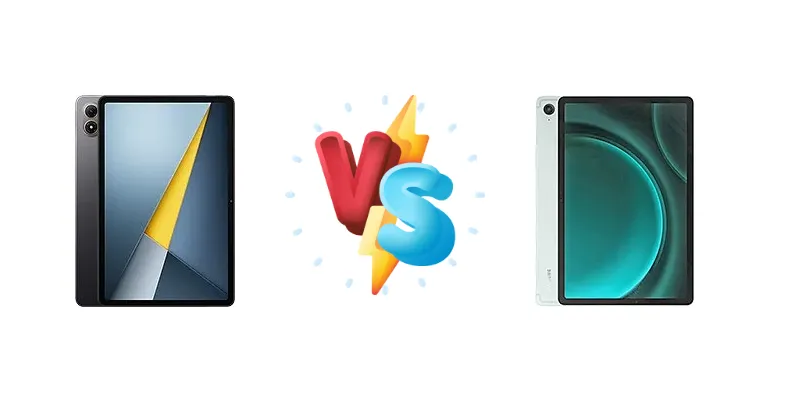
The tablet market is heating up, with compelling options at various price points. The Xiaomi Poco Pad M1 aims to disrupt the budget segment, while the Samsung Galaxy Tab S9 FE offers a more refined experience within the mid-range. This comparison dives deep into their specifications and performance to determine which tablet best suits your needs.
🏆 Quick Verdict
For the average user prioritizing raw performance and value, the Poco Pad M1 emerges as the winner. Its newer Snapdragon 7s Gen 4 chipset, built on a 4nm process, provides a noticeable performance edge over the Tab S9 FE’s Exynos 1380, despite the latter’s 5nm fabrication. However, Samsung’s software and ecosystem integration remain strong advantages.
| Network |
|---|
| 2G bands | N/A | GSM 850 / 900 / 1800 / 1900 |
| 3G bands | N/A | HSDPA 850 / 900 / 1700(AWS) / 1900 / 2100 |
| 4G bands | - | 1, 2, 3, 4, 5, 7, 8, 12, 13, 17, 20, 26, 28, 32, 38, 40, 41, 66 |
| 5G bands | - | 1, 3, 5, 7, 8, 20, 28, 38, 40, 41, 66, 77, 78 SA/NSA/Sub6 |
| EDGE | N/A | - |
| GPRS | N/A | - |
| Speed | - | HSPA, LTE, 5G - cellular model only |
| Technology | No cellular connectivity | GSM / HSPA / LTE / 5G |
| Launch |
|---|
| Announced | 2025, November 26 | 2023, October 04 |
| Status | Available. Released 2025, November 26 | Available. Released 2023, October 16 |
| Body |
|---|
| Build | Glass front, aluminum frame, aluminum back | Glass front, aluminum back, aluminum frame |
| Dimensions | 279.8 x 181.7 x 7.5 mm (11.02 x 7.15 x 0.30 in) | 254.3 x 165.8 x 6.5 mm (10.01 x 6.53 x 0.26 in) |
| SIM | No | Nano-SIM + eSIM (cellular model only) |
| Weight | 610 g (1.34 lb) | 523 g or 524 g (1.15 lb) |
| Display |
|---|
| Resolution | 1600 x 2560 pixels, 16:10 ratio (~249 ppi density) | 1440 x 2304 pixels, 16:10 ratio (~249 ppi density) |
| Size | 12.1 inches, 424.5 cm2 (~83.5% screen-to-body ratio) | 10.9 inches, 344.5 cm2 (~81.7% screen-to-body ratio) |
| Type | IPS LCD, 1B colors, 120Hz, Dolby Vision, 600 nits (HBM) | IPS LCD, 90Hz |
| Platform |
|---|
| CPU | Octa-core (1x2.7 GHz Cortex-A720 & 3x2.4 GHz Cortex-A720 & 4x1.8 GHz Cortex-A520) | Octa-core (4x2.4 GHz Cortex-A78 & 4x2.0 GHz Cortex-A55) |
| Chipset | Qualcomm SM7635-AC Snapdragon 7s Gen 4 (4 nm) | Exynos 1380 (5 nm) |
| GPU | Adreno 810 | Mali-G68 MP5 |
| OS | Android 15, HyperOS 2 | Android 13, up to 4 major Android upgrades, One UI 6 |
| Memory |
|---|
| Card slot | microSDXC (dedicated slot) | microSDXC (dedicated slot) |
| Internal | 256GB 8GB RAM | 128GB 6GB RAM, 128GB 8GB RAM, 256GB 8GB RAM |
| Main Camera |
|---|
| Features | Color spectrum sensor, LED flash, HDR | - |
| Single | 8 MP, f/2.0, (wide), 1/4.0", 1.12µm | 8 MP, (wide) |
| Video | 1080p@30fps | 4K@30fps, 1080p@30fps |
| Selfie camera |
|---|
| Single | 8 MP, f/2.3, (wide), 1/4.0", 1.12µm | 12 MP, (ultrawide) |
| Video | 1080p@30fps | Yes |
| Sound |
|---|
| 35mm jack | Yes | No |
| Loudspeaker | Yes, with stereo speakers, Dolby Atmos (4 speakers) | Yes, with stereo speakers |
| Comms |
|---|
| Bluetooth | 5.4, A2DP, LE, aptX HD, aptX Adaptive | 5.3, A2DP, LE |
| NFC | No | No |
| Positioning | No | GPS, GALILEO, GLONASS, BDS, QZSS - cellular model only |
| Radio | No | No |
| USB | USB Type-C 2.0, OTG | USB Type-C 2.0, magnetic connector |
| WLAN | Wi-Fi 802.11 a/b/g/n/a/6, dual-band, Wi-Fi Direct | Wi-Fi 802.11 a/b/g/n/ac/6, dual-band, Wi-Fi Direct |
| Features |
|---|
| Sensors | Accelerometer, gyro, proximity (accessories only), compass | Fingerprint (side-mounted), accelerometer, gyro, compass, proximity (accessories only) |
| Battery |
|---|
| Charging | 33W wired, PD3.0, QC3+
27W reverse wired | 45W wired, QC2.0 |
| Type | 12000 mAh | Li-Po 8000 mAh |
| Misc |
|---|
| Colors | Gray, Blue | Mint, Silver, Gray, Lavender |
| Models | 2509ARPBDG | SM-X510, SM-X516B |
| Price | - | About 300 EUR |
| SAR | - | 1.55 W/kg (body) |
| SAR EU | - | 0.59 W/kg (body) |
Xiaomi Poco Pad M1
- More powerful Snapdragon 7s Gen 4 chipset
- Faster charging speeds (33W vs 45W, but with newer standards)
- Potential for better power efficiency due to 4nm process
- Software support may be shorter than Samsung
- Brand recognition and ecosystem integration are weaker
Samsung Galaxy Tab S9 FE
- Seamless integration with Samsung ecosystem
- Potentially longer software support lifecycle
- Larger display size for enhanced media consumption
- Less powerful Exynos 1380 chipset
- Slower charging standard (QC2.0)
- Potentially lower performance in demanding tasks
Display Comparison
Neither device boasts a flagship-level display, but they differ in their approach. While specific display specs (resolution, panel type) are missing for the Poco Pad M1, the Tab S9 FE features a 10.9-inch TFT LCD. The Exynos 1380’s image signal processor will likely deliver slightly more vibrant colors on the Samsung tablet. However, the Poco Pad M1’s potential for a higher refresh rate (based on chipset capabilities) could offer smoother scrolling and animations. The Tab S9 FE’s larger screen size is beneficial for media consumption and multitasking.
Camera Comparison
Camera performance is unlikely to be a deciding factor for most tablet buyers. Both devices likely feature modest camera setups. Given the context, detailed camera specs are unavailable. However, Samsung generally excels in image processing, potentially offering more refined photos and videos with the Tab S9 FE. The Poco Pad M1’s chipset may offer computational photography benefits, but the overall image quality will likely be comparable.
Performance
The core difference lies in the chipsets. The Poco Pad M1’s Snapdragon 7s Gen 4 (4nm) utilizes a tri-cluster architecture with a prime Cortex-A720 core clocked at 2.7GHz, promising strong single-core performance. The Galaxy Tab S9 FE’s Exynos 1380 (5nm) employs a more traditional quad-core Cortex-A78 setup at 2.4GHz. While the 5nm process of the Exynos is more efficient, the architectural advantages and higher clock speed of the Snapdragon 7s Gen 4 likely translate to better overall performance, especially in graphically intensive tasks. The Poco Pad M1’s potential for faster LPDDR5x RAM (though unconfirmed) would further enhance its responsiveness.
Battery Life
The Poco Pad M1’s 33W wired charging with PD3.0 and QC3+ support is faster than the Tab S9 FE’s 45W QC2.0 charging. While the Tab S9 FE’s charging standard is older, the actual charging time difference may be minimal depending on battery capacity (which is currently unknown for both devices). The Snapdragon 7s Gen 4’s 4nm process should contribute to better power efficiency, potentially offsetting any capacity differences. The Poco Pad M1 also offers 27W reverse wired charging, a useful feature for topping up other devices.
Buying Guide
Buy the Xiaomi Poco Pad M1 if you need a tablet primarily for gaming, demanding multitasking, or content creation on a budget. Its Snapdragon 7s Gen 4 offers superior processing power for the price. Buy the Samsung Galaxy Tab S9 FE if you prioritize a more polished software experience, seamless integration with other Samsung devices, and a potentially longer software support lifecycle. It’s the better choice for users deeply embedded in the Samsung ecosystem.
Frequently Asked Questions
❓ Does the Exynos 1380 in the Galaxy Tab S9 FE tend to overheat during prolonged gaming sessions?
While the Exynos 1380 is a capable chip, it's known to throttle under sustained load, especially in less well-cooled devices. The Tab S9 FE’s thermal management is adequate for casual gaming, but extended sessions with demanding titles may result in noticeable performance drops. The Snapdragon 7s Gen 4 in the Poco Pad M1, with its 4nm process, is likely to manage heat more effectively.
❓ Is the 27W reverse wired charging on the Poco Pad M1 useful for charging a smartphone or other devices?
Yes, the 27W reverse wired charging is a genuinely useful feature. It allows you to use the Poco Pad M1 as a power bank to charge your smartphone, earbuds, or other USB-C devices. While not as fast as a dedicated charger, it's a convenient option when you're away from a power outlet.
❓ How does the software experience differ between Xiaomi's MIUI Pad and Samsung's One UI on a tablet?
Samsung's One UI is generally considered more polished and feature-rich, with a stronger focus on tablet optimization. Xiaomi's MIUI Pad, while improving, can sometimes feel cluttered and less intuitive. Samsung also offers longer software support, ensuring your tablet receives security updates and new features for a longer period.