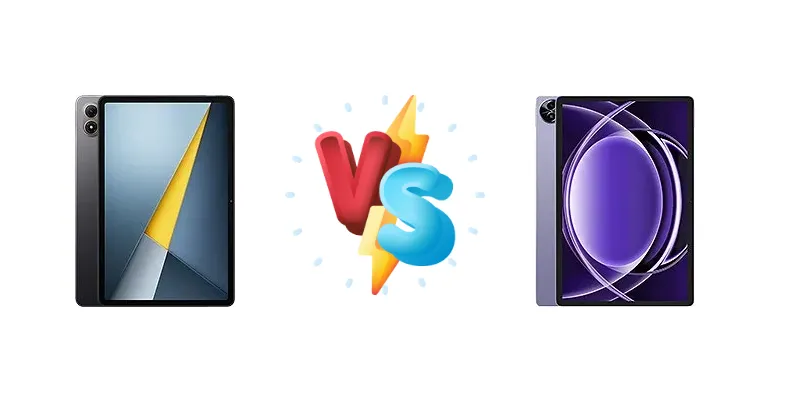
The budget tablet market is heating up, with Xiaomi and Realme offering compelling options. The Poco Pad M1 leverages Qualcomm's newer Snapdragon 7s Gen 4, while the Realme Pad 2 Lite opts for MediaTek's Helio G99. This comparison dives deep into the architectural differences, performance implications, and charging capabilities to determine which tablet best suits your needs.
🏆 Quick Verdict
For users prioritizing sustained performance and faster charging, the Xiaomi Poco Pad M1 is the clear winner. Its Snapdragon 7s Gen 4, built on a 4nm process, offers a significant advantage over the Realme Pad 2 Lite's 6nm Helio G99, especially during demanding tasks. However, the Realme Pad 2 Lite remains a viable option for casual users.
| Network |
|---|
| 2G bands | N/A | GSM 850 / 900 / 1800 / 1900 |
| 3G bands | N/A | HSDPA 850 / 900 / 2100 |
| 4G bands | - | 1, 3, 5, 7, 8, 20, 28, 38, 40, 41 |
| EDGE | N/A | - |
| GPRS | N/A | - |
| Speed | - | HSPA, LTE |
| Technology | No cellular connectivity | GSM / HSPA / LTE |
| Launch |
|---|
| Announced | 2025, November 26 | 2024, September 13 |
| Status | Available. Released 2025, November 26 | Available. Released 2024, September 26 |
| Body |
|---|
| Build | Glass front, aluminum frame, aluminum back | - |
| Dimensions | 279.8 x 181.7 x 7.5 mm (11.02 x 7.15 x 0.30 in) | 258 x 169.5 x 8.3 mm (10.16 x 6.67 x 0.33 in) |
| SIM | No | No |
| Weight | 610 g (1.34 lb) | 525 g (1.16 lb) |
| Display |
|---|
| Resolution | 1600 x 2560 pixels, 16:10 ratio (~249 ppi density) | 1200 x 1920 pixels, 16:10 ratio (~207 ppi density) |
| Size | 12.1 inches, 424.5 cm2 (~83.5% screen-to-body ratio) | 10.95 inches, 347.7 cm2 (~79.5% screen-to-body ratio) |
| Type | IPS LCD, 1B colors, 120Hz, Dolby Vision, 600 nits (HBM) | IPS LCD, 1B colors, 90Hz, 450 nits (peak) |
| Platform |
|---|
| CPU | Octa-core (1x2.7 GHz Cortex-A720 & 3x2.4 GHz Cortex-A720 & 4x1.8 GHz Cortex-A520) | Octa-core (2x2.2 GHz Cortex-A76 & 6x2.0 GHz Cortex-A55) |
| Chipset | Qualcomm SM7635-AC Snapdragon 7s Gen 4 (4 nm) | Mediatek Helio G99 (6 nm) |
| GPU | Adreno 810 | Mali-G57 MC2 |
| OS | Android 15, HyperOS 2 | Android 14, Realme UI 5.0 for Pad |
| Memory |
|---|
| Card slot | microSDXC (dedicated slot) | Unspecified |
| Internal | 256GB 8GB RAM | 128GB 4GB RAM, 128GB 8GB RAM |
| Main Camera |
|---|
| Features | Color spectrum sensor, LED flash, HDR | Panorama |
| Single | 8 MP, f/2.0, (wide), 1/4.0", 1.12µm | 8 MP, f/2.0 |
| Video | 1080p@30fps | 1080p@30fps |
| Selfie camera |
|---|
| Features | - | Panorama |
| Single | 8 MP, f/2.3, (wide), 1/4.0", 1.12µm | 5 MP, f/2.2 |
| Video | 1080p@30fps | 1080p@30fps |
| Sound |
|---|
| 35mm jack | Yes | No |
| Loudspeaker | Yes, with stereo speakers, Dolby Atmos (4 speakers) | Yes, with stereo speakers (4 speakers) |
| Comms |
|---|
| Bluetooth | 5.4, A2DP, LE, aptX HD, aptX Adaptive | 5.2, A2DP, LE |
| NFC | No | No |
| Positioning | No | GPS, GALILEO, GLONASS, BDS |
| Radio | No | No |
| USB | USB Type-C 2.0, OTG | USB Type-C |
| WLAN | Wi-Fi 802.11 a/b/g/n/a/6, dual-band, Wi-Fi Direct | Wi-Fi 802.11 a/b/g/n/ac, dual-band |
| Features |
|---|
| Sensors | Accelerometer, gyro, proximity (accessories only), compass | Accelerometer |
| Battery |
|---|
| Charging | 33W wired, PD3.0, QC3+
27W reverse wired | 15W wired |
| Type | 12000 mAh | 8300 mAh |
| Misc |
|---|
| Colors | Gray, Blue | Nebula Purple, Space Grey |
| Models | 2509ARPBDG | RMP2402 |
| Price | - | About 160 EUR |
Xiaomi Poco Pad M1
- Faster Snapdragon 7s Gen 4 processor
- Significantly faster 33W charging
- Reverse wired charging capability
- Potentially higher price
- No display specifications available for detailed analysis
Realme Pad 2 Lite
- Lower price point
- Decent performance for basic tasks
- MediaTek Helio G99 is power efficient
- Slower 15W charging
- Less powerful processor for demanding tasks
Display Comparison
Neither device's display specifications are provided, so a direct comparison is limited. However, considering the price points, both likely utilize IPS LCD panels. The Realme Pad 2 Lite, being the more budget-focused option, may have slightly lower brightness and color accuracy. Bezels are likely comparable, aiming for maximizing screen real estate within the budget constraints. Without specific data, it's reasonable to assume both offer adequate viewing experiences for media consumption.
Camera Comparison
Camera details are absent for both devices. Given their price bracket, expectations should be tempered. Both tablets likely feature a single main camera and potentially a depth sensor. Image quality will likely be adequate for casual snapshots and video calls, but not a primary focus. Without specific sensor sizes or apertures, it's difficult to assess which tablet might offer slightly better image quality.
Performance
The core difference lies in the chipsets. The Poco Pad M1's Snapdragon 7s Gen 4 (4nm) boasts a more modern CPU architecture – Cortex-A720 cores – compared to the Realme Pad 2 Lite’s Helio G99 (6nm) with Cortex-A76 and A55 cores. The 4nm fabrication process of the Snapdragon translates to improved power efficiency and thermal management, reducing the likelihood of performance throttling under sustained load. While the Helio G99 is a capable chip, the Snapdragon 7s Gen 4 offers a noticeable performance uplift in CPU-intensive tasks and gaming. The Snapdragon's CPU configuration (1x2.7 GHz Cortex-A720, 3x2.4 GHz Cortex-A720, 4x1.8 GHz Cortex-A520) provides a more balanced approach to performance compared to the Helio G99's (2x2.2 GHz Cortex-A76 & 6x2.0 GHz Cortex-A55).
Battery Life
The Poco Pad M1’s 33W wired charging with PD3.0 and QC3+ support is a significant advantage over the Realme Pad 2 Lite’s 15W charging. This translates to substantially faster charging times, allowing users to quickly top up their battery. While battery capacity isn't specified, the faster charging of the Poco Pad M1 mitigates any potential disadvantage from a slightly smaller battery. The 27W reverse wired charging on the Poco Pad M1 is also a unique feature, enabling it to charge other devices.
Buying Guide
Buy the Xiaomi Poco Pad M1 if you need a tablet capable of handling multitasking, moderate gaming, and benefit from significantly faster 33W charging. This is ideal for students or professionals who rely on their tablet throughout the day. Buy the Realme Pad 2 Lite if you prioritize a lower price point and primarily use your tablet for basic tasks like video streaming, web browsing, and light productivity. It's a good fit for casual users who don't require high-end performance.
Frequently Asked Questions
❓ Will the Poco Pad M1 handle demanding games like Genshin Impact or Call of Duty Mobile?
The Snapdragon 7s Gen 4 in the Poco Pad M1 is capable of running these games, but you'll likely need to adjust graphics settings to medium or low for a smooth experience. The 4nm process helps with thermal throttling, but sustained high frame rates may still lead to some performance dips. The Realme Pad 2 Lite's Helio G99 will struggle with these titles at playable frame rates.
❓ How long will it take to fully charge the Poco Pad M1 with the 33W charger?
While a precise time isn't available without knowing the battery capacity, the 33W charging should fully charge the Poco Pad M1 in approximately 1.5 to 2 hours, significantly faster than the Realme Pad 2 Lite. The support for PD3.0 and QC3+ ensures compatibility with a wider range of chargers.
❓ Is the Helio G99 in the Realme Pad 2 Lite sufficient for everyday tasks like browsing and video streaming?
Yes, the Helio G99 is perfectly adequate for everyday tasks like web browsing, video streaming, and social media. It's a power-efficient chip that will provide a smooth experience for these less demanding applications. However, it will show its limitations when multitasking or running more resource-intensive apps.