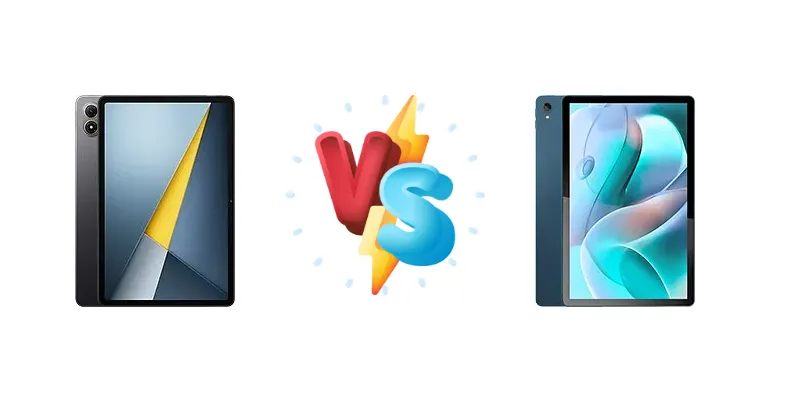
The Android tablet market is heating up, with options ranging from premium flagships to aggressively priced contenders. The Xiaomi Poco Pad M1 and Motorola Moto Tab G70 represent two distinct approaches: the Poco Pad M1 leverages a newer, more efficient Qualcomm chipset, while the Moto Tab G70 aims for value with a MediaTek Helio G90T. This comparison dissects their key differences to help you choose the right tablet for your needs.
🏆 Quick Verdict
For most users, the Xiaomi Poco Pad M1 emerges as the superior choice. Its Snapdragon 7s Gen 4 chipset, built on a 4nm process, delivers significantly better performance and efficiency than the Moto Tab G70’s 12nm Helio G90T. While the Moto Tab G70 offers a larger battery, the Poco Pad M1’s faster 33W charging mitigates this advantage.
| Network |
|---|
| 2G bands | N/A | GSM 850 / 900 / 1800 / 1900 |
| 3G bands | N/A | HSDPA 850 / 900 / 1900 / 2100 |
| 4G bands | - | 1, 2, 4, 7, 8, 20, 28, 38, 40, 41 |
| EDGE | N/A | - |
| GPRS | N/A | - |
| Speed | - | HSPA 42.2/5.76 Mbps, LTE Cat4 150/50 Mbps - cellular model only |
| Technology | No cellular connectivity | GSM / HSPA / LTE |
| Launch |
|---|
| Announced | 2025, November 26 | 2022, January 12 |
| Status | Available. Released 2025, November 26 | Available. Released 2022, January 13 |
| Body |
|---|
| Build | Glass front, aluminum frame, aluminum back | Glass front, aluminum back, aluminum frame |
| Dimensions | 279.8 x 181.7 x 7.5 mm (11.02 x 7.15 x 0.30 in) | 258.4 x 163 x 7.5 mm (10.17 x 6.42 x 0.30 in) |
| SIM | No | Nano-SIM (cellular model only) |
| Weight | 610 g (1.34 lb) | 500 g (1.10 lb) |
| | - | Water repellent design |
| Display |
|---|
| Resolution | 1600 x 2560 pixels, 16:10 ratio (~249 ppi density) | 1200 x 2000 pixels, 5:3 ratio (~212 ppi density) |
| Size | 12.1 inches, 424.5 cm2 (~83.5% screen-to-body ratio) | 11.0 inches, 344.4 cm2 (~81.8% screen-to-body ratio) |
| Type | IPS LCD, 1B colors, 120Hz, Dolby Vision, 600 nits (HBM) | IPS LCD, 400 nits (typ) |
| Platform |
|---|
| CPU | Octa-core (1x2.7 GHz Cortex-A720 & 3x2.4 GHz Cortex-A720 & 4x1.8 GHz Cortex-A520) | Octa-core (2x2.05 GHz Cortex-A76 & 6x2.0 GHz Cortex-A55) |
| Chipset | Qualcomm SM7635-AC Snapdragon 7s Gen 4 (4 nm) | Mediatek MT6785 Helio G90T (12 nm) |
| GPU | Adreno 810 | Mali-G76 MC4 |
| OS | Android 15, HyperOS 2 | Android 11 |
| Memory |
|---|
| Card slot | microSDXC (dedicated slot) | microSDXC (dedicated slot) |
| Internal | 256GB 8GB RAM | 64GB 4GB RAM, 128GB 6GB RAM |
| | - | eMMC 5.1 |
| Main Camera |
|---|
| Features | Color spectrum sensor, LED flash, HDR | LED flash |
| Single | 8 MP, f/2.0, (wide), 1/4.0", 1.12µm | 13 MP, f/2.2, 26mm (wide), AF |
| Video | 1080p@30fps | 1080p@30fps |
| Selfie camera |
|---|
| Single | 8 MP, f/2.3, (wide), 1/4.0", 1.12µm | 8 MP, f/2.0, 26mm (wide) |
| Video | 1080p@30fps | 1080p@30fps |
| Sound |
|---|
| 3.5mm jack | - | Yes |
| 35mm jack | Yes | Yes |
| Loudspeaker | Yes, with stereo speakers, Dolby Atmos (4 speakers) | Yes, with stereo speakers (4 speakers) |
| Comms |
|---|
| Bluetooth | 5.4, A2DP, LE, aptX HD, aptX Adaptive | 5.2, A2DP, LE |
| NFC | No | No |
| Positioning | No | GPS, GLONASS - cellular model only |
| Radio | No | No |
| USB | USB Type-C 2.0, OTG | USB Type-C 2.0, OTG |
| WLAN | Wi-Fi 802.11 a/b/g/n/a/6, dual-band, Wi-Fi Direct | Wi-Fi 802.11 a/b/g/n/ac, dual-band, Wi-Fi Direct |
| Features |
|---|
| Sensors | Accelerometer, gyro, proximity (accessories only), compass | Accelerometer, gyro, proximity |
| Battery |
|---|
| Charging | 33W wired, PD3.0, QC3+
27W reverse wired | 20W wired |
| Type | 12000 mAh | Li-Po 7700 mAh |
| Misc |
|---|
| Colors | Gray, Blue | Modernist Teal, Blue |
| Models | 2509ARPBDG | - |
| Price | - | About 380 EUR |
Xiaomi Poco Pad M1
- Superior Performance: Snapdragon 7s Gen 4 offers a significant performance boost.
- Faster Charging: 33W charging with PD3.0 and QC3+ is much quicker than 20W.
- Better Efficiency: 4nm process leads to improved battery life and reduced throttling.
- Potentially Higher Price: May cost slightly more than the Moto Tab G70.
- Display Specs Unknown: Display quality is uncertain without detailed specifications.
Motorola Moto Tab G70
- Potentially Longer Battery Life: Larger battery capacity (speculation) could offer extended usage.
- Lower Price: Likely more affordable than the Poco Pad M1.
- Simple Android Experience: Motorola typically offers a clean, near-stock Android experience.
- Inferior Performance: Helio G90T is significantly less powerful than the Snapdragon 7s Gen 4.
- Slower Charging: 20W charging is relatively slow compared to 33W.
- Less Efficient: 12nm process consumes more power and generates more heat.
Display Comparison
Neither device boasts a particularly standout display. Specifications are missing for both, but assuming typical IPS LCD panels for this price bracket, the focus shifts to performance. The absence of high refresh rates on either tablet suggests neither is geared towards fast-paced gaming visuals. Bezels are likely comparable, and color accuracy will be adequate for general use, but not professional work. The lack of LTPO technology means neither display will dynamically adjust refresh rates to save power.
Camera Comparison
Camera performance is unlikely to be a deciding factor for either tablet. Both are likely equipped with basic camera sensors suitable for video calls and casual snapshots. Without specific sensor details, it’s difficult to make a direct comparison. However, given the focus on value for both devices, image quality will likely be similar – adequate in good lighting conditions, but struggling in low light. The absence of OIS on either device further limits their photographic capabilities.
Performance
The core difference lies in the chipsets. The Poco Pad M1’s Qualcomm SM7635-AC Snapdragon 7s Gen 4 (4nm) is a clear upgrade over the Motorola Moto Tab G70’s MediaTek MT6785 Helio G90T (12nm). The 4nm fabrication process of the Snapdragon translates to significantly improved power efficiency and thermal management, reducing the likelihood of throttling during sustained workloads. The Snapdragon’s CPU configuration – 1x2.7 GHz Cortex-A720, 3x2.4 GHz Cortex-A720, and 4x1.8 GHz Cortex-A520 – offers a more modern and balanced architecture compared to the Moto Tab G70’s 2x2.05 GHz Cortex-A76 & 6x2.0 GHz Cortex-A55. This means the Poco Pad M1 will handle demanding apps and games with greater ease.
Battery Life
The Moto Tab G70 likely has a larger battery capacity (specifications missing), but the Poco Pad M1 compensates with significantly faster 33W wired charging (PD3.0, QC3+) compared to the Moto Tab G70’s 20W charging. The 33W charging on the Poco Pad M1 will drastically reduce charging times, potentially offsetting any battery life advantage the Moto Tab G70 might have. Furthermore, the Snapdragon 7s Gen 4’s superior power efficiency means the Poco Pad M1 will likely consume less power during typical usage, minimizing the impact of a potentially smaller battery.
Buying Guide
Buy the Xiaomi Poco Pad M1 if you prioritize performance for gaming, multitasking, and future-proofing. The Snapdragon 7s Gen 4 provides a smoother experience and better longevity. Buy the Motorola Moto Tab G70 if your primary use case is media consumption and light tasks, and you’re on a very tight budget. The larger battery *may* offer slightly longer screen-on time, but at the cost of overall responsiveness.
Frequently Asked Questions
❓ Will the Poco Pad M1 handle demanding games like Genshin Impact or Call of Duty Mobile?
The Snapdragon 7s Gen 4 in the Poco Pad M1 is capable of running these games, but you’ll likely need to adjust graphics settings to medium or low for a consistently smooth experience. The 4nm process helps mitigate throttling, but it’s not a flagship-level chipset.
❓ Is the 20W charging on the Moto Tab G70 slow compared to modern smartphones?
Yes, 20W is relatively slow by smartphone standards. Expect a full charge to take around 3-4 hours. The Poco Pad M1’s 33W charging is a significant improvement, potentially reducing charging time to under 2 hours.
❓ Does the Poco Pad M1 support external storage via microSD card?
Specifications are missing, but based on Poco’s typical offerings, it’s likely the Poco Pad M1 *does* support microSD card expansion, allowing you to increase storage capacity. The Moto Tab G70's support is unknown.
❓ Which tablet is better for video streaming and media consumption?
Both tablets are suitable for video streaming, but the Poco Pad M1’s more powerful processor may offer smoother playback of high-resolution content. However, the difference is unlikely to be noticeable for casual viewing.