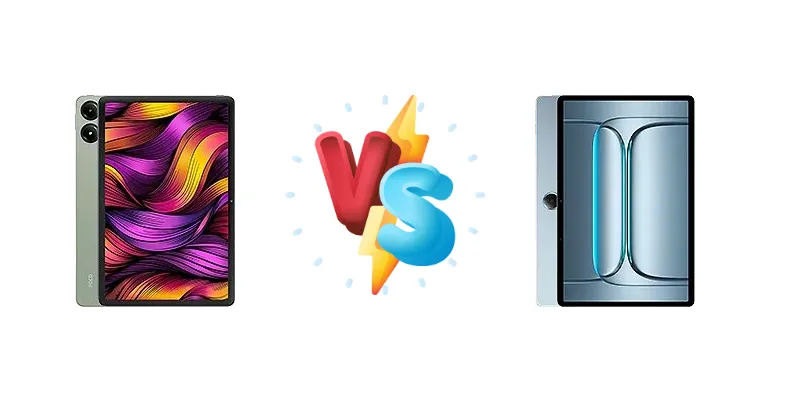
The budget tablet market is heating up, with the Xiaomi Poco Pad 5G and OnePlus Pad Lite vying for dominance. Both offer 5G connectivity and a focus on value, but they take distinctly different approaches to achieving it. This comparison dissects their core components to reveal which tablet delivers the best experience for your needs.
🏆 Quick Verdict
For most users, the Xiaomi Poco Pad 5G emerges as the stronger contender. Its Snapdragon 7s Gen 2 chipset, built on a more efficient 4nm process, provides a noticeable performance advantage and better long-term thermal management compared to the OnePlus Pad Lite’s Helio G100. While both charge at 33W, the Poco Pad’s superior processing power makes it the better choice for demanding tasks.
| Network |
|---|
| 2G bands | GSM 850 / 900 / 1800 / 1900 | GSM 850 / 900 / 1800 / 1900 - cellular model only |
| 3G bands | HSDPA 900 / 2100 | HSDPA 850 / 900 / 2100 - cellular model only |
| 4G bands | LTE | LTE - cellular model only |
| 5G bands | SA/NSA | - |
| Speed | HSPA, LTE, 5G | HSPA, LTE - cellular model only |
| Technology | GSM / HSPA / LTE / 5G | GSM / HSPA / LTE |
| Launch |
|---|
| Announced | 2024, August 23 | 2025, July 08 |
| Status | Available. Released 2024, August 27 | Available. Released 2025, August 14 |
| Body |
|---|
| Build | Glass front (Gorilla Glass 3), aluminum frame, aluminum back | - |
| Dimensions | 280 x 181.9 x 7.5 mm (11.02 x 7.16 x 0.30 in) | 254.9 x 166.5 x 7.4 mm (10.04 x 6.56 x 0.29 in) |
| SIM | Nano-SIM | Yes - cellular model only |
| Weight | 568 g (1.25 lb) | 530 g (1.17 lb) |
| Display |
|---|
| Protection | Corning Gorilla Glass 3 | - |
| Resolution | 1600 x 2560 pixels, 16:10 ratio (~249 ppi density) | 1200 x 1920 pixels, 16:10 ratio (~207 ppi density) |
| Size | 12.1 inches, 424.5 cm2 (~83.4% screen-to-body ratio) | 11.0 inches, 347.5 cm2 (~81.9% screen-to-body ratio) |
| Type | IPS LCD, 68B colors, 120Hz, Dolby Vision, 600 nits (HBM) | IPS LCD, 1B colors, 90Hz, 500 nits |
| Platform |
|---|
| CPU | Octa-core (4x2.40 GHz Cortex-A78 & 4x1.95 GHz Cortex-A55) | Octa-core (2x2.2 GHz Cortex-A76 & 6x2.0 GHz Cortex-A55) |
| Chipset | Qualcomm SM7435-AB Snapdragon 7s Gen 2 (4 nm) | Mediatek Helio G100 (6 nm) |
| GPU | Adreno 710 | Mali-G57 MC2 |
| OS | Android 14, HyperOS | Android 15, OxygenOS 15 |
| Memory |
|---|
| Card slot | microSDXC (dedicated slot) | Unspecified |
| Internal | 128GB 8GB RAM, 256GB 8GB RAM | 128GB 6GB RAM, 128GB 8GB RAM |
| Main Camera |
|---|
| Features | LED flash | - |
| Single | 8 MP, f/2.0, (wide), 1/4.0", 1.12µm | 5 MP |
| Video | 1080p@30fps | 1080p@30fps |
| Selfie camera |
|---|
| Single | 8 MP, f/2.3, (wide), 1/4.0", 1.12µm | 5 MP |
| Video | 1080p@30fps | 1080p@30fps |
| Sound |
|---|
| 35mm jack | Yes | No |
| Loudspeaker | Yes, with stereo speakers (4 speakers) | Yes, with stereo speakers (4 speakers, Hi-Res audio) |
| Comms |
|---|
| Bluetooth | 5.2, A2DP, LE, aptX HD, aptX Adaptive | 5.2, A2DP, LE, aptX HD |
| NFC | No | No |
| Positioning | GPS | GPS, (cellular model only) - unconfirmed |
| Radio | No | No |
| USB | USB Type-C 2.0 | USB Type-C 2.0 |
| WLAN | Wi-Fi 802.11 a/b/g/n/a/6, dual-band, Wi-Fi Direct | Wi-Fi 802.11 a/b/g/n/ac, dual-band |
| Features |
|---|
| Sensors | Accelerometer, gyro, proximity (accessories only), compass | Unspecified |
| Battery |
|---|
| Charging | 33W wired, PD3.0, QC3+ | 33W wired |
| Type | 10000 mAh | Li-Po 9340 mAh |
| Misc |
|---|
| Colors | Dark Gray, Blue | Aero Blue |
| Models | - | OPD2480 |
| Price | About 220 EUR | About 200 EUR |
Xiaomi Poco Pad 5G
- More powerful Snapdragon 7s Gen 2 chipset
- More efficient 4nm fabrication process
- PD3.0 and QC3+ charging compatibility
- Display specs currently unknown
- Camera performance likely basic
OnePlus Pad Lite
- Competitive price point
- Sleek and minimalist design (expected)
- 33W fast charging
- Less powerful Helio G100 chipset
- 6nm process less efficient than 4nm
- Potential for thermal throttling under heavy load
Display Comparison
Both tablets are expected to feature LCD panels, a common cost-saving measure in this price bracket. However, detailed display specs (resolution, peak brightness, color gamut) are currently unavailable. The absence of LTPO technology on either device suggests standard refresh rates. Bezels are likely to be comparable, focusing on maximizing screen real estate within the budget constraints. Color accuracy will likely be adequate for general use, but professional content creators may find limitations.
Camera Comparison
Given the budget nature of these tablets, camera performance isn't a primary focus. Detailed camera specs are unavailable, but it's safe to assume both will feature basic rear and front-facing cameras suitable for video calls and casual snapshots. Expect limited low-light performance and a lack of advanced features like optical image stabilization (OIS). Any secondary cameras (ultrawide, macro) are likely to be low-resolution and offer minimal benefit.
Performance
The core difference lies in the chipsets. The Xiaomi Poco Pad 5G’s Qualcomm Snapdragon 7s Gen 2 (4nm) boasts a more modern architecture – Cortex-A78 cores – and a smaller fabrication process than the OnePlus Pad Lite’s MediaTek Helio G100 (6nm). This 4nm process translates to improved power efficiency and reduced heat generation, crucial for sustained performance. While the Helio G100 utilizes Cortex-A76 cores, the Snapdragon’s architecture and process node give it a clear edge in CPU-intensive tasks. The Snapdragon’s GPU is also expected to outperform the Helio G100’s, resulting in smoother gaming experiences. RAM configurations are currently unknown, but LPDDR5X support would further enhance the Poco Pad 5G’s performance.
Battery Life
Both tablets support 33W wired charging, which should provide reasonably fast charging speeds – likely around 60-80 minutes for a full charge. Actual battery life will depend on usage patterns and battery capacity (currently unknown). The Snapdragon 7s Gen 2’s superior power efficiency in the Poco Pad 5G could translate to slightly longer battery life despite potentially having a similar capacity to the OnePlus Pad Lite. The 33W charging with PD3.0 and QC3+ support on the Poco Pad 5G offers broader compatibility with existing chargers.
Buying Guide
Buy the Xiaomi Poco Pad 5G if you prioritize sustained performance for gaming, multitasking, or content creation. Its more advanced chipset will handle demanding applications with greater ease. Buy the OnePlus Pad Lite if your primary use case revolves around media consumption, light browsing, and basic productivity, and you're seeking a slightly more streamlined software experience. The Pad Lite represents a solid, no-frills option for casual tablet users.
Frequently Asked Questions
❓ Will the Snapdragon 7s Gen 2 in the Poco Pad 5G handle demanding games like Genshin Impact?
The Snapdragon 7s Gen 2 is capable of running Genshin Impact, but you'll likely need to adjust graphics settings to medium or low for a consistently smooth experience. The 4nm process will help mitigate thermal throttling during extended gaming sessions, offering better sustained performance than the Helio G100.
❓ Is the OnePlus Pad Lite a good choice for students taking notes and reading e-books?
The OnePlus Pad Lite is well-suited for basic productivity tasks like note-taking and e-reading. Its LCD display will be adequate for these purposes, and the Helio G100 provides sufficient power for smooth operation of productivity apps. However, the Poco Pad 5G's faster processor could offer a more responsive experience when multitasking between apps.
❓ Does either tablet support expandable storage via microSD card?
This information is currently unavailable. Given the budget nature of both devices, it's unlikely that either will offer microSD card support. Users should carefully consider their storage needs and opt for a model with sufficient internal storage.