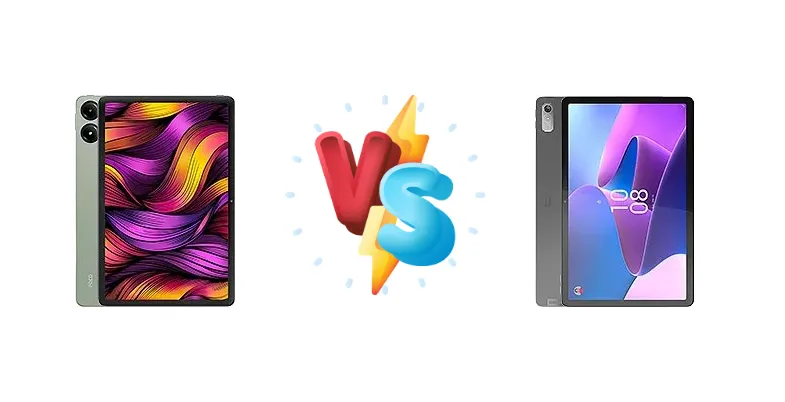
The Android tablet market is heating up, with both Xiaomi and Lenovo offering compelling options in the mid-range. The Poco Pad 5G aims to deliver 5G connectivity and solid performance, while the Lenovo Tab P11 Gen 2 focuses on a balanced experience. This comparison dissects their core components to determine which tablet best suits your needs.
🏆 Quick Verdict
For most users, the Xiaomi Poco Pad 5G emerges as the stronger choice. Its Snapdragon 7s Gen 2 chipset, built on a more efficient 4nm process, provides a performance edge and potentially better thermal management compared to the Lenovo Tab P11 Gen 2’s Helio G99. While both offer a similar experience, the Poco Pad 5G’s processor gives it a slight advantage.
| Network |
|---|
| 2G bands | GSM 850 / 900 / 1800 / 1900 | GSM 850 / 900 / 1800 / 1900 |
| 3G bands | HSDPA 900 / 2100 | HSDPA 800 / 850 / 900 / 1700(AWS) / 1900 / 2100 |
| 4G bands | LTE | 1, 2, 3, 4, 5, 7, 8, 12, 13, 18, 19, 20, 25, 26, 28, 38, 40, 41, 66 |
| 5G bands | SA/NSA | - |
| Speed | HSPA, LTE, 5G | HSPA, LTE - cellular model only |
| Technology | GSM / HSPA / LTE / 5G | GSM / HSPA / LTE |
| Launch |
|---|
| Announced | 2024, August 23 | 2022, September 01 |
| Status | Available. Released 2024, August 27 | Available. Released 2023, January |
| Body |
|---|
| Build | Glass front (Gorilla Glass 3), aluminum frame, aluminum back | - |
| Dimensions | 280 x 181.9 x 7.5 mm (11.02 x 7.16 x 0.30 in) | 269.1 x 169.4 x 7.4 mm (10.59 x 6.67 x 0.29 in) |
| SIM | Nano-SIM | Nano-SIM (cellular model only) |
| Weight | 568 g (1.25 lb) | 520 g (1.15 lb) |
| | - | Stylus support |
| Display |
|---|
| Protection | Corning Gorilla Glass 3 | - |
| Resolution | 1600 x 2560 pixels, 16:10 ratio (~249 ppi density) | 1200 x 2000 pixels, 5:3 ratio (~203 ppi density) |
| Size | 12.1 inches, 424.5 cm2 (~83.4% screen-to-body ratio) | 11.5 inches, 376.4 cm2 (~82.6% screen-to-body ratio) |
| Type | IPS LCD, 68B colors, 120Hz, Dolby Vision, 600 nits (HBM) | IPS LCD, 120Hz, 400 nits (typ) |
| Platform |
|---|
| CPU | Octa-core (4x2.40 GHz Cortex-A78 & 4x1.95 GHz Cortex-A55) | Octa-core (2x2.2 GHz Cortex-A76 & 6x2.0 GHz Cortex-A55) |
| Chipset | Qualcomm SM7435-AB Snapdragon 7s Gen 2 (4 nm) | Mediatek Helio G99 (6 nm) |
| GPU | Adreno 710 | Mali-G57 MC2 |
| OS | Android 14, HyperOS | Android 12L |
| Memory |
|---|
| Card slot | microSDXC (dedicated slot) | microSDXC (dedicated slot) |
| Internal | 128GB 8GB RAM, 256GB 8GB RAM | 64GB 4GB RAM, 128GB 4GB RAM, 128GB 6GB RAM |
| Main Camera |
|---|
| Features | LED flash | LED flash |
| Single | 8 MP, f/2.0, (wide), 1/4.0", 1.12µm | 13 MP, f/2.4, (wide), AF |
| Video | 1080p@30fps | 1080p@30fps |
| Selfie camera |
|---|
| Single | 8 MP, f/2.3, (wide), 1/4.0", 1.12µm | 8 MP, f/2.0 |
| Video | 1080p@30fps | 1080p@30fps |
| Sound |
|---|
| 3.5mm jack | - | Yes |
| 35mm jack | Yes | Yes |
| Loudspeaker | Yes, with stereo speakers (4 speakers) | Yes, with stereo speakers (4 speakers) |
| Comms |
|---|
| Bluetooth | 5.2, A2DP, LE, aptX HD, aptX Adaptive | 5.2, A2DP, LE |
| NFC | No | No |
| Positioning | GPS | GPS, GLONASS, BDS - cellular model only |
| Radio | No | No |
| USB | USB Type-C 2.0 | USB Type-C 2.0, OTG, magnetic connector |
| WLAN | Wi-Fi 802.11 a/b/g/n/a/6, dual-band, Wi-Fi Direct | Wi-Fi 802.11 a/b/g/n/ac/6e, dual-band, Wi-Fi Direct |
| Features |
|---|
| Sensors | Accelerometer, gyro, proximity (accessories only), compass | Accelerometer, gyro, proximity |
| Battery |
|---|
| Charging | 33W wired, PD3.0, QC3+ | - |
| Type | 10000 mAh | Li-Po 7700 mAh |
| Misc |
|---|
| Colors | Dark Gray, Blue | Storm Grey, Sage |
| Models | - | TB350FU |
| Price | About 220 EUR | About 350 EUR |
Xiaomi Poco Pad 5G
- More powerful Snapdragon 7s Gen 2 chipset
- Faster 33W charging with PD3.0/QC3+ support
- Potentially better thermal management due to 4nm process
- 5G connectivity may not be universally useful
- Camera performance likely average
Lenovo Tab P11 Gen 2
- Balanced performance for everyday tasks
- Potentially better sustained performance due to less demanding chipset
- Lenovo’s reputation for software stability
- Less powerful Helio G99 chipset
- Slower charging speeds (likely)
- May struggle with demanding games or multitasking
Display Comparison
Neither device’s display specifications are provided, so a direct comparison is limited. However, considering the market segment, both likely feature LCD panels around 10-11 inches. The Lenovo Tab P11 Gen 2, given Lenovo’s history, may prioritize color accuracy for media consumption. The Poco Pad 5G, targeting a slightly more performance-oriented user, might lean towards a higher refresh rate (though unconfirmed). Bezels are likely comparable, and without specific brightness data, it’s difficult to determine a clear winner.
Camera Comparison
Without detailed camera specifications, a meaningful comparison is challenging. Both tablets likely feature modest camera setups geared towards video conferencing and casual snapshots. The absence of information regarding sensor size or optical image stabilization (OIS) suggests neither device will excel in photography. Image processing will likely differ, with Xiaomi potentially favoring more vibrant colors and Lenovo aiming for a more natural look.
Performance
The core difference lies in the chipsets. The Xiaomi Poco Pad 5G’s Qualcomm Snapdragon 7s Gen 2 (4nm) boasts a more modern architecture with 4x Cortex-A78 cores clocked at 2.40 GHz, alongside 4x Cortex-A55 cores at 1.95 GHz. This contrasts with the Lenovo Tab P11 Gen 2’s MediaTek Helio G99 (6nm), featuring 2x Cortex-A76 cores at 2.2 GHz and 6x Cortex-A55 cores at 2.0 GHz. The 4nm fabrication process of the Snapdragon offers superior power efficiency, potentially leading to less throttling during sustained workloads. While the Helio G99’s Cortex-A76 cores are individually faster, the Snapdragon 7s Gen 2’s architecture and process node give it an overall advantage in multi-core performance and sustained performance.
Battery Life
Battery capacity is not specified for either device. However, the Poco Pad 5G’s 33W wired charging with PD3.0 and QC3+ support offers a significant advantage over the Lenovo Tab P11 Gen 2, which lacks specific charging details. Faster charging translates to less downtime and quicker top-ups, a crucial benefit for on-the-go users. The Snapdragon 7s Gen 2’s efficiency could also contribute to longer battery life, even with a similar capacity battery.
Buying Guide
Buy the Xiaomi Poco Pad 5G if you prioritize performance for gaming or multitasking, and value the future-proofing of 5G connectivity. This tablet is ideal for users who frequently stream high-resolution content or engage in demanding applications. Buy the Lenovo Tab P11 Gen 2 if you prefer a more conservatively-powered device focused on everyday tasks like browsing, video conferencing, and light content consumption, potentially benefiting from slightly better sustained performance due to the less demanding chipset.
Frequently Asked Questions
❓ Will the Snapdragon 7s Gen 2 in the Poco Pad 5G handle demanding games like Genshin Impact?
The Snapdragon 7s Gen 2 is capable of running Genshin Impact, but you’ll likely need to lower the graphics settings to achieve a smooth frame rate. The 4nm process should help mitigate throttling during extended gaming sessions, but it won’t match the performance of flagship chipsets.
❓ Is the 5G connectivity on the Poco Pad 5G worth the extra cost if I have reliable Wi-Fi?
If you primarily use your tablet at home or in locations with strong Wi-Fi, the 5G connectivity may not be essential. However, 5G provides a valuable backup connection for travel or areas with limited Wi-Fi access, offering greater flexibility.
❓ Does the Lenovo Tab P11 Gen 2 support stylus input or keyboard attachments?
While Lenovo often offers accessories like styluses and keyboards for their tablets, specific compatibility with the Tab P11 Gen 2 requires checking Lenovo’s official accessory list. The tablet likely supports Bluetooth keyboards and potentially a dedicated Lenovo stylus.
❓ How does the MediaTek Helio G99 handle video playback on the Lenovo Tab P11 Gen 2?
The Helio G99 is perfectly capable of handling 1080p and even some 4K video playback. It includes hardware decoding for common video codecs, ensuring smooth and efficient video streaming and playback.