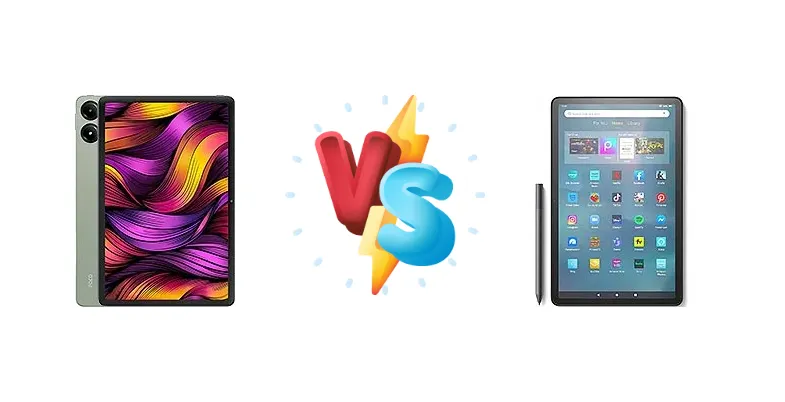
The tablet market is heating up with compelling options at various price points. We're pitting the Xiaomi Poco Pad 5G, a 5G-enabled Android tablet focused on performance, against the Amazon Fire Max 11, a more affordable tablet geared towards media consumption and Amazon's ecosystem. This comparison will dissect their core components to determine which tablet delivers the best value for your needs.
🏆 Quick Verdict
For the average user prioritizing performance and future-proofing, the Xiaomi Poco Pad 5G is the clear winner. Its Snapdragon 7s Gen 2 chipset and 33W fast charging offer a significantly smoother experience and quicker power-ups compared to the Fire Max 11's Mediatek MT8188J and 15W charging.
| Network |
|---|
| 2G bands | GSM 850 / 900 / 1800 / 1900 | N/A |
| 3G bands | HSDPA 900 / 2100 | - |
| 4G bands | LTE | - |
| 5G bands | SA/NSA | - |
| EDGE | - | No |
| GPRS | - | No |
| Speed | HSPA, LTE, 5G | - |
| Technology | GSM / HSPA / LTE / 5G | No cellular connectivity |
| Launch |
|---|
| Announced | 2024, August 23 | 2023, May 23 |
| Status | Available. Released 2024, August 27 | Available. Released 2023, May 23 |
| Body |
|---|
| Build | Glass front (Gorilla Glass 3), aluminum frame, aluminum back | - |
| Dimensions | 280 x 181.9 x 7.5 mm (11.02 x 7.16 x 0.30 in) | 259.1 x 163.7 x 7.5 mm (10.20 x 6.44 x 0.30 in) |
| SIM | Nano-SIM | No |
| Weight | 568 g (1.25 lb) | 490 g (1.08 lb) |
| Display |
|---|
| Protection | Corning Gorilla Glass 3 | - |
| Resolution | 1600 x 2560 pixels, 16:10 ratio (~249 ppi density) | 2000 x 1200 pixels, 5:3 ratio (~212 ppi density) |
| Size | 12.1 inches, 424.5 cm2 (~83.4% screen-to-body ratio) | 11.0 inches, 344.4 cm2 (~81.2% screen-to-body ratio) |
| Type | IPS LCD, 68B colors, 120Hz, Dolby Vision, 600 nits (HBM) | IPS LCD |
| Platform |
|---|
| CPU | Octa-core (4x2.40 GHz Cortex-A78 & 4x1.95 GHz Cortex-A55) | Octa-core (2x2.2 GHz Cortex-A78 & 6x2.0 GHz Cortex-A55) |
| Chipset | Qualcomm SM7435-AB Snapdragon 7s Gen 2 (4 nm) | Mediatek MT8188J |
| GPU | Adreno 710 | Mali-G57 MC2 |
| OS | Android 14, HyperOS | Android 11, Fire OS 8 |
| Memory |
|---|
| Card slot | microSDXC (dedicated slot) | microSDXC (dedicated slot) |
| Internal | 128GB 8GB RAM, 256GB 8GB RAM | 64GB 4GB RAM, 128GB 4GB RAM |
| Main Camera |
|---|
| Features | LED flash | - |
| Single | 8 MP, f/2.0, (wide), 1/4.0", 1.12µm | 8 MP, AF |
| Video | 1080p@30fps | 1080p |
| Selfie camera |
|---|
| Single | 8 MP, f/2.3, (wide), 1/4.0", 1.12µm | 8 MP |
| Video | 1080p@30fps | 1080p |
| Sound |
|---|
| 35mm jack | Yes | No |
| Loudspeaker | Yes, with stereo speakers (4 speakers) | Yes, with stereo speakers |
| Comms |
|---|
| Bluetooth | 5.2, A2DP, LE, aptX HD, aptX Adaptive | 5.3, A2DP, LE |
| NFC | No | No |
| Positioning | GPS | No |
| Radio | No | No |
| USB | USB Type-C 2.0 | USB Type-C 2.0, OTG, magnetic accessory connector |
| WLAN | Wi-Fi 802.11 a/b/g/n/a/6, dual-band, Wi-Fi Direct | Wi-Fi 802.11 a/b/g/n/ac/6, dual-band |
| Features |
|---|
| Sensors | Accelerometer, gyro, proximity (accessories only), compass | Fingerprint (side-mounted), accelerometer, proximity (accessories only) |
| Battery |
|---|
| Charging | 33W wired, PD3.0, QC3+ | 15W wired |
| Type | 10000 mAh | Li-Ion |
| Misc |
|---|
| Colors | Dark Gray, Blue | Gray |
| Models | - | KFSNWI |
| Price | About 220 EUR | About 270 EUR |
Xiaomi Poco Pad 5G
- Significantly faster processor with Snapdragon 7s Gen 2
- Faster 33W charging with PD3.0/QC3+ support
- 5G connectivity for on-the-go access
- Price is likely higher than the Fire Max 11
- Software updates may be less frequent than Amazon's
Amazon Fire Max 11
- More affordable price point
- Deep integration with Amazon's ecosystem
- Good for media consumption and casual use
- Slower Mediatek MT8188J processor
- Slower 15W charging
- Limited app ecosystem compared to Android
Display Comparison
While display specifications are missing for both devices, the Fire Max 11's 11-inch display is likely a standard IPS LCD. The Poco Pad 5G, given Xiaomi's recent tablet offerings, likely features a similar IPS LCD panel. However, the real differentiator will be color accuracy and brightness. The Poco Pad 5G, being a newer device, may benefit from improved calibration. Bezels are likely comparable, focusing on maximizing screen real estate within their respective price brackets.
Camera Comparison
Neither tablet is positioned as a photography powerhouse, and detailed camera specs are unavailable. However, given the market segment, it's safe to assume both will feature basic camera setups suitable for video calls and casual snapshots. The Poco Pad 5G, benefiting from its more powerful ISP within the Snapdragon chipset, may offer slightly better image processing and low-light performance. We anticipate both will have similar limitations in challenging lighting conditions.
Performance
The core of the difference lies in the chipsets. The Poco Pad 5G’s Qualcomm SM7435-AB Snapdragon 7s Gen 2 (4nm) is a significant step up from the Fire Max 11’s Mediatek MT8188J. The Snapdragon 7s Gen 2 utilizes a more modern CPU architecture – Cortex-A78 cores – and a smaller 4nm process node, resulting in superior performance and thermal efficiency. The Poco Pad 5G’s CPU configuration (4x2.40 GHz Cortex-A78 & 4x1.95 GHz Cortex-A55) provides a performance advantage over the Fire Max 11’s (2x2.2 GHz Cortex-A78 & 6x2.0 GHz Cortex-A55). This translates to faster app loading times, smoother multitasking, and a more responsive user experience. The 4nm process also means less heat generation under load, reducing the likelihood of performance throttling during extended use.
Battery Life
Battery capacity is not specified for either device. However, the Poco Pad 5G’s 33W wired charging with PD3.0 and QC3+ support is a substantial advantage over the Fire Max 11’s 15W charging. This faster charging speed significantly reduces downtime, allowing users to quickly replenish the battery. While the Fire Max 11 might have a slightly larger battery capacity, the Poco Pad 5G’s charging speed will likely result in more usable uptime throughout the day.
Buying Guide
Buy the Xiaomi Poco Pad 5G if you need a versatile tablet capable of handling demanding apps, multitasking, and occasional gaming, especially if 5G connectivity is a priority. Buy the Amazon Fire Max 11 if you primarily consume media, are heavily invested in the Amazon ecosystem, and prioritize affordability over raw processing power. The Fire Max 11 is a solid choice for families or casual users.
Frequently Asked Questions
❓ Will the Snapdragon 7s Gen 2 in the Poco Pad 5G handle demanding games like Genshin Impact?
The Snapdragon 7s Gen 2 is capable of running Genshin Impact, but you'll likely need to lower the graphics settings to achieve a smooth frame rate. It's not a flagship chipset, so don't expect maximum settings, but it's a significant improvement over the Fire Max 11's processor for gaming.
❓ How much does the Amazon Fire OS limit app availability compared to standard Android?
Amazon Fire OS is based on Android, but it uses the Amazon Appstore instead of the Google Play Store. While many popular apps are available, the selection is smaller. You can sideload apps from the Google Play Store, but it requires technical knowledge and isn't officially supported.
❓ Is the 5G connectivity on the Poco Pad 5G worth the extra cost if I primarily use Wi-Fi?
If you consistently have access to reliable Wi-Fi, the 5G connectivity may not be essential. However, 5G provides a valuable backup connection for travel or areas with poor Wi-Fi coverage, offering greater flexibility and peace of mind.