
Poco M7 Pro 5G vs Nothing Phone (2): A Detailed Comparison
| Phones Images | |||||
|---|---|---|---|---|---|
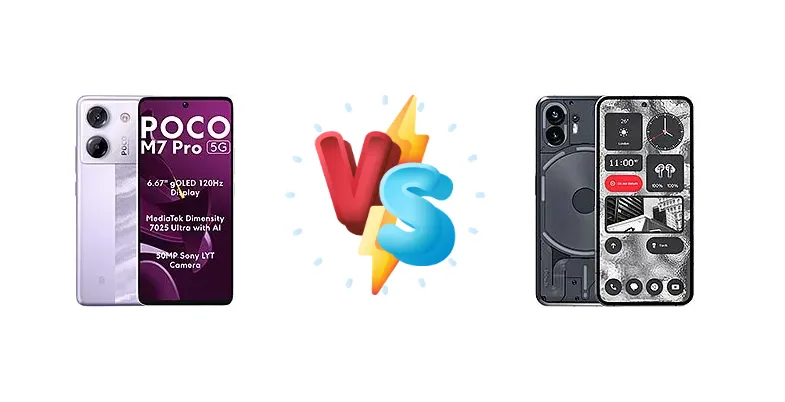
|
🏆 Quick Verdict
For the average user prioritizing a refined experience and longer battery life, the Nothing Phone (2) is the better choice. However, the Poco M7 Pro 5G offers exceptional value, delivering comparable performance in many areas at a significantly lower price point.
| PHONES | ||
|---|---|---|
| Phone Names | Xiaomi Poco M7 Pro 5G | Nothing Phone (2) |
| Network | ||
|---|---|---|
| 2G bands | GSM 850 / 900 / 1800 / 1900 | GSM 850 / 900 / 1800 / 1900 |
| 3G bands | HSDPA 800 / 850 / 900 / 1700(AWS) / 1900 / 2100 - International | HSDPA 800 / 850 / 900 / 1700(AWS) / 1900 / 2100 |
| 4G bands | 1, 2, 3, 4, 5, 7, 8, 12, 13, 17, 18, 19, 20, 26, 28, 32, 38, 40, 41, 42, 48, 66 - International | 1, 2, 3, 4, 5, 7, 8, 12, 17, 18, 19, 20, 25, 26, 28, 30, 32, 34, 38, 39, 40, 41, 42, 48, 66, 71 |
| 5G bands | 1, 2, 3, 5, 7, 8, 12, 20, 26, 28, 38, 40, 41, 48, 66, 77, 78 SA/NSA - International | 1, 2, 3, 5, 7, 8, 12, 20, 25, 28, 30, 38, 40, 41, 66, 71, 75, 77, 78 SA/NSA |
| Speed | HSPA, LTE, 5G | HSPA, LTE, 5G |
| Technology | GSM / HSPA / LTE / 5G | GSM / HSPA / LTE / 5G |
| Launch | ||
|---|---|---|
| Announced | 2024, December 17 | 2023, July 11 |
| Status | Available. Released 2024, December 20 | Available. Released 2023, July 17 |
| Body | ||
|---|---|---|
| Build | Glass front (Gorilla Glass 5), plastic back, plastic frame | Glass front (Gorilla Glass 5), glass back (Gorilla Glass 5), aluminum frame |
| Dimensions | 162.4 x 75.7 x 8 mm (6.39 x 2.98 x 0.31 in) | 162.1 x 76.4 x 8.6 mm (6.38 x 3.01 x 0.34 in) |
| SIM | Nano-SIM + Nano-SIM | Nano-SIM + Nano-SIM |
| Weight | 190 g (6.70 oz) | 201.2 g (7.09 oz) |
| Display | ||
|---|---|---|
| Protection | Corning Gorilla Glass 5, Mohs level 5 | Corning Gorilla Glass 5 |
| Resolution | 1080 x 2400 pixels, 20:9 ratio (~395 ppi density) | 1080 x 2412 pixels, 20:9 ratio (~394 ppi density) |
| Size | 6.67 inches, 107.4 cm2 (~87.4% screen-to-body ratio) | 6.7 inches, 108.0 cm2 (~87.2% screen-to-body ratio) |
| Type | AMOLED, 120Hz, 960Hz PWM, HDR10+, 2100 nits (peak), Dolby Vision (India only) | LTPO OLED, 1B colors, 120Hz, 1920Hz PWM, HDR10+, 1600 nits (HBM), 1600 nits (peak) |
| Platform | ||
|---|---|---|
| CPU | Octa-core (2x2.5 GHz Cortex-A78 & 6x2.0 GHz Cortex-A55) | Octa-core (1x3.0 GHz Cortex-X2 & 3x2.5 GHz Cortex-A710 & 4x1.80 GHz Cortex-A510) |
| Chipset | Mediatek Dimensity 7025 Ultra (6 nm) | Qualcomm SM8475 Snapdragon 8+ Gen 1 (4 nm) |
| GPU | IMG BXM-8-256 | Adreno 730 |
| OS | Android 14, up to 2 (INT) / 4 (EU) major Android upgrades, HyperOS | Android 13, upgradable to Android 15, up to 3 major Android upgrades, Nothing OS 3.0 |
| Memory | ||
|---|---|---|
| Card slot | microSDXC (uses shared SIM slot) | No |
| Internal | 128GB 6GB RAM, 256GB 8GB RAM, 256GB 12GB RAM, 512GB 12GB RAM | 128GB 8GB RAM, 256GB 12GB RAM, 512GB 12GB RAM |
| Main Camera | ||
|---|---|---|
| Dual | 50 MP, f/1.5, 26mm (wide), 1/1.95", 0.8µm, PDAF, OIS Auxiliary lens | 50 MP, f/1.9, 24mm (wide), 1/1.56", 1.0µm, PDAF, OIS 50 MP, f/2.2, 114˚ (ultrawide), 1/2.76", 0.64µm, AF |
| Features | LED flash, HDR, panorama | LED flash, panorama, HDR |
| Video | 1080p@30fps | 4K@30/60fps, 1080p@30/60fps, gyro-EIS, live HDR, OIS |
| Selfie camera | ||
|---|---|---|
| Features | Panorama, HDR | HDR |
| Single | 20 MP, f/2.2, 21mm (wide), 1/4.0", 0.7µm | 32 MP, f/2.5, (wide), 1/2.74", 0.8µm |
| Video | 1080p@30fps | 1080p@30fps |
| Sound | ||
|---|---|---|
| 35mm jack | Yes | No |
| Loudspeaker | Yes, with stereo speakers (with Dolby Atmos) | Yes, with stereo speakers |
| Comms | ||
|---|---|---|
| Bluetooth | 5.0, A2DP, LE | 5.3, A2DP, LE, aptX HD, aptX Adaptive |
| Infrared port | Yes | - |
| NFC | Yes (market/region dependent) | Yes |
| Positioning | GPS, GLONASS, GALILEO, BDS | GPS (L1+L5), GLONASS (L1), BDS (B1I+B1c), GALILEO (E1), QZSS (L1), NavIC |
| Radio | FM radio (market/region dependent) | No |
| USB | USB Type-C | USB Type-C 2.0, OTG |
| WLAN | Wi-Fi 802.11 a/b/g/n/ac, dual-band | Wi-Fi 802.11 a/b/g/n/ac/6, dual-band, Wi-Fi Direct |
| Features | ||
|---|---|---|
| Sensors | Fingerprint (under display, optical), accelerometer, gyro, compass | Fingerprint (under display, optical), accelerometer, proximity, gyro, compass |
| Battery | ||
|---|---|---|
| Charging | 45W wired | 45W wired, PD3.0, PPS, QC4, 100% in 55 min 15W wireless, 100% in 130 min 5W reverse wireless |
| Type | Li-Po 5110 mAh | Li-Ion 4700 mAh |
| Misc | ||
|---|---|---|
| Colors | Lavender Frost, Lunar Dust, Olive Twilight, Classic Black | White, Dark Gray |
| Models | 2409FPCC4G, 2409FPCC4I | A065 |
| Price | € 158.00 / $ 222.50 / £ 129.00 / ₹ 12,255 | $ 379.99 / £ 370.00 |
| SAR | 0.86 W/kg (head) 0.79 W/kg (body) | - |
| EU LABEL | ||
|---|---|---|
| Battery | 37:46h endurance, 1000 cycles | - |
| Energy | Class D | - |
| Free fall | Class D (45 falls) | - |
| Repairability | Class C | - |
Xiaomi Poco M7 Pro 5G
- Excellent value for money
- Powerful processor for the price
- Fast 45W wired charging
- Limited camera information
- Potentially less refined software experience
Nothing Phone (2)
- Flagship-level performance
- Wireless and reverse wireless charging
- Unique design with Glyph Interface
- Higher price point
- Battery life, while good, isn't class-leading
Display Comparison
Both phones feature displays capable of reaching nearly 1000 nits of peak brightness – the Poco M7 Pro 5G hitting 1179 nits and the Nothing Phone (2) at 998 nits – ensuring excellent visibility outdoors. However, the Nothing Phone (2)'s display technology is likely superior, given its brand reputation for color accuracy and panel quality, though this isn't explicitly stated in the provided data. The absence of refresh rate information for the Poco M7 Pro 5G is a notable omission, while the Nothing Phone (2) is known to have a 120Hz LTPO AMOLED display, offering adaptive refresh rates for improved battery efficiency and smoother scrolling.
Camera Comparison
The provided data only indicates that the Nothing Phone (2) has a 'Photo / Video' camera, lacking specific details. However, Nothing Phone (2) is known for its dual 50MP camera system with OIS, offering excellent image quality and video stabilization. The Poco M7 Pro 5G’s camera specifications are entirely absent, making a direct comparison impossible. Given the Poco’s price point, it’s likely to feature a less sophisticated camera system, potentially lacking optical image stabilization and advanced image processing capabilities. Users prioritizing photography and videography will likely find the Nothing Phone (2) a more compelling option.
Performance
The core difference lies in the chipsets. The Nothing Phone (2) boasts the Qualcomm Snapdragon 8+ Gen 1 (4nm), a flagship-level processor from the previous generation, featuring a Cortex-X2 prime core clocked at 3.0 GHz. This contrasts with the Poco M7 Pro 5G’s MediaTek Dimensity 7025 Ultra (6nm). While the Dimensity 7025 Ultra offers a capable octa-core configuration, the Snapdragon 8+ Gen 1’s architecture and smaller node size provide a significant advantage in sustained performance and thermal efficiency. The Snapdragon’s Cortex-A710 cores, clocked at 2.5 GHz, are more powerful than the Poco’s Cortex-A78 cores, translating to faster app loading and smoother multitasking. Gamers will find the Nothing Phone (2) delivers a more consistent frame rate in demanding titles.
Battery Life
The Nothing Phone (2) demonstrates superior battery endurance with an active use score of 14:21 hours, compared to the Poco M7 Pro 5G’s 11:21 hours. While the Poco M7 Pro 5G boasts a claimed 37:46h endurance, this is likely based on lighter usage scenarios. Both phones support 45W wired charging, with the Nothing Phone (2) adding the convenience of 15W wireless charging and 5W reverse wireless charging. The Nothing Phone (2) also claims a full charge in 55 minutes, while the Poco’s charging time is not specified. The combination of longer battery life and wireless charging capabilities gives the Nothing Phone (2) a clear advantage in this category.
Buying Guide
Buy the Xiaomi Poco M7 Pro 5G if you need raw processing power for gaming and demanding tasks on a tight budget, and are willing to compromise on software polish and some camera features. Buy the Nothing Phone (2) if you prefer a distinctive design, a smoother software experience with Glyph Interface, wireless charging, and a more versatile camera system, even if it means paying a premium.