
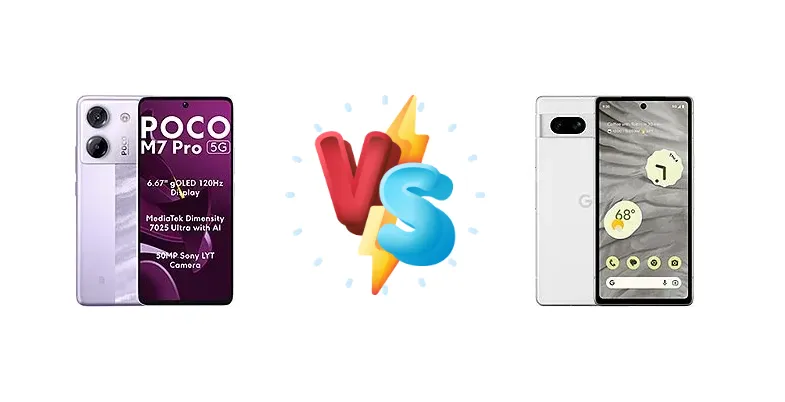
Poco M7 Pro 5G vs Google Pixel 7a: A Deep Dive into Mid-Range Contenders
| Phones Images | |||||
|---|---|---|---|---|---|
|
🏆 Quick Verdict
For the average user prioritizing camera quality and a polished software experience, the Google Pixel 7a is the better choice. However, the Poco M7 Pro 5G delivers exceptional battery life and faster charging at a significantly lower price point, making it ideal for power users and budget-conscious buyers.
| PHONES | ||
|---|---|---|
| Phone Names | Xiaomi Poco M7 Pro 5G | Google Pixel 7a |
| Network | ||
|---|---|---|
| 2G bands | GSM 850 / 900 / 1800 / 1900 | GSM 850 / 900 / 1800 / 1900 |
| 3G bands | HSDPA 800 / 850 / 900 / 1700(AWS) / 1900 / 2100 - International | HSDPA 800 / 850 / 900 / 1700(AWS) / 1900 / 2100 |
| 4G bands | 1, 2, 3, 4, 5, 7, 8, 12, 13, 17, 18, 19, 20, 26, 28, 32, 38, 40, 41, 42, 48, 66 - International | 1, 2, 3, 4, 5, 7, 8, 12, 13, 14, 17, 20, 25, 26, 28, 29, 30, 38, 40, 41, 48, 66, 71 - GWKK3, G0DZQ |
| 5G bands | 1, 2, 3, 5, 7, 8, 12, 20, 26, 28, 38, 40, 41, 48, 66, 77, 78 SA/NSA - International | 1, 2, 3, 5, 7, 8, 12, 14, 20, 25, 28, 30, 38, 41, 48, 66, 71, 77, 78 SA/NSA/Sub6 - GWKK3 |
| Speed | HSPA, LTE, 5G | HSPA, LTE, 5G |
| Technology | GSM / HSPA / LTE / 5G | GSM / HSPA / LTE / 5G |
| - | 1, 2, 3, 5, 7, 8, 12, 20, 25, 28, 38, 40, 41, 66, 75, 76, 77, 78, 79 SA/NSA/Sub6 - GHL1X, G82U8 | |
| Launch | ||
|---|---|---|
| Announced | 2024, December 17 | 2023, May 10 |
| Status | Available. Released 2024, December 20 | Available. Released 2023, May 10 |
| Body | ||
|---|---|---|
| Build | Glass front (Gorilla Glass 5), plastic back, plastic frame | Glass front (Gorilla Glass 3), aluminum frame, plastic back |
| Dimensions | 162.4 x 75.7 x 8 mm (6.39 x 2.98 x 0.31 in) | 152 x 72.9 x 9 mm (5.98 x 2.87 x 0.35 in) |
| SIM | Nano-SIM + Nano-SIM | Nano-SIM + eSIM |
| Weight | 190 g (6.70 oz) | 193.5 g (6.84 oz) |
| - | IP67 dust/water resistant (up to 1m for 30 min) | |
| Display | ||
|---|---|---|
| Protection | Corning Gorilla Glass 5, Mohs level 5 | Corning Gorilla Glass 3 |
| Resolution | 1080 x 2400 pixels, 20:9 ratio (~395 ppi density) | 1080 x 2400 pixels, 20:9 ratio (~429 ppi density) |
| Size | 6.67 inches, 107.4 cm2 (~87.4% screen-to-body ratio) | 6.1 inches, 90.7 cm2 (~81.8% screen-to-body ratio) |
| Type | AMOLED, 120Hz, 960Hz PWM, HDR10+, 2100 nits (peak), Dolby Vision (India only) | OLED, HDR, 90Hz |
| - | Always-on display | |
| Platform | ||
|---|---|---|
| CPU | Octa-core (2x2.5 GHz Cortex-A78 & 6x2.0 GHz Cortex-A55) | Octa-core (2x2.85 GHz Cortex-X1 & 2x2.35 GHz Cortex-A78 & 4x1.80 GHz Cortex-A55) |
| Chipset | Mediatek Dimensity 7025 Ultra (6 nm) | Google Tensor G2 (5 nm) |
| GPU | IMG BXM-8-256 | Mali-G710 MP7 |
| OS | Android 14, up to 2 (INT) / 4 (EU) major Android upgrades, HyperOS | Android 13, upgradable to Android 15, up to 5 major Android upgrades |
| Memory | ||
|---|---|---|
| Card slot | microSDXC (uses shared SIM slot) | No |
| Internal | 128GB 6GB RAM, 256GB 8GB RAM, 256GB 12GB RAM, 512GB 12GB RAM | 128GB 8GB RAM |
| - | UFS 3.1 | |
| Main Camera | ||
|---|---|---|
| Dual | 50 MP, f/1.5, 26mm (wide), 1/1.95", 0.8µm, PDAF, OIS Auxiliary lens | 64 MP, f/1.9, 26mm (wide), 1/1.73", 0.8µm, dual pixel PDAF, OIS 13 MP, f/2.2, 120˚ (ultrawide), 1.12µm |
| Features | LED flash, HDR, panorama | Dual-LED flash, Pixel Shift, Auto-HDR, panorama |
| Video | 1080p@30fps | 4K@30/60fps, 1080p@30/60/120/240fps, OIS |
| Selfie camera | ||
|---|---|---|
| Features | Panorama, HDR | HDR, panorama |
| Single | 20 MP, f/2.2, 21mm (wide), 1/4.0", 0.7µm | 13 MP, f/2.2, 20mm (ultrawide), 1.12µm |
| Video | 1080p@30fps | 4K@30fps, 1080p@30fps |
| Sound | ||
|---|---|---|
| 3.5mm jack | - | No |
| 35mm jack | Yes | No |
| Loudspeaker | Yes, with stereo speakers (with Dolby Atmos) | Yes, with stereo speakers |
| Comms | ||
|---|---|---|
| Bluetooth | 5.0, A2DP, LE | 5.3, A2DP, LE |
| Infrared port | Yes | - |
| NFC | Yes (market/region dependent) | Yes |
| Positioning | GPS, GLONASS, GALILEO, BDS | GPS, GLONASS, GALILEO, BDS, QZSS, NavIC |
| Radio | FM radio (market/region dependent) | No |
| USB | USB Type-C | USB Type-C 3.2 |
| WLAN | Wi-Fi 802.11 a/b/g/n/ac, dual-band | Wi-Fi 802.11 a/b/g/n/ac/6e, tri-band |
| Features | ||
|---|---|---|
| Sensors | Fingerprint (under display, optical), accelerometer, gyro, compass | Fingerprint (under display, optical), accelerometer, gyro, proximity, compass, barometer |
| Battery | ||
|---|---|---|
| Charging | 45W wired | 18W wired, PD3.0 7.5W wireless |
| Type | Li-Po 5110 mAh | Li-Po 4385 mAh |
| Misc | ||
|---|---|---|
| Colors | Lavender Frost, Lunar Dust, Olive Twilight, Classic Black | Charcoal, Snow, Sea, Coral |
| Models | 2409FPCC4G, 2409FPCC4I | GWKK3, GHL1X, G0DZQ, G82U8 |
| Price | € 158.00 / $ 222.50 / £ 129.00 / ₹ 12,255 | € 179.90 / $ 150.00 / £ 170.00 / ₹ 25,980 |
| SAR | 0.86 W/kg (head) 0.79 W/kg (body) | - |
| EU LABEL | ||
|---|---|---|
| Battery | 37:46h endurance, 1000 cycles | - |
| Energy | Class D | - |
| Free fall | Class D (45 falls) | - |
| Repairability | Class C | - |
Xiaomi Poco M7 Pro 5G
- Exceptional battery life (37:46h endurance)
- Faster 45W wired charging
- More affordable price point
- Likely inferior camera performance
- Less refined software experience
Google Pixel 7a
- Superior camera quality and image processing
- Clean Android experience with guaranteed updates
- Powerful Google Tensor G2 chipset
- Slower 18W charging
- Shorter battery life compared to Poco
Display Comparison
Both phones feature displays capable of reaching over 1000 nits of brightness, with the Poco M7 Pro 5G edging out the Pixel 7a at 1179 nits versus 1070 nits. This translates to better visibility in direct sunlight for the Poco. While both likely utilize OLED panels, the lack of refresh rate information for the Poco means we can’t assess motion clarity. The Pixel 7a’s display benefits from Google’s color calibration, ensuring accurate and vibrant visuals, a feature often lacking in this price bracket. The slightly higher peak brightness of the Poco is beneficial for outdoor use, but the Pixel 7a likely offers superior color accuracy.
Camera Comparison
The Pixel 7a is the clear winner in the camera department, though detailed sensor information is missing for both. Google’s computational photography is renowned for its exceptional image processing, delivering consistently excellent results in various lighting conditions. The Pixel 7a’s strength lies in its software algorithms, which compensate for potentially smaller sensor sizes. The Poco M7 Pro 5G, while likely capable, won’t match the Pixel’s image quality, particularly in low-light scenarios. The Pixel 7a’s video capabilities are also superior, benefiting from advanced stabilization and dynamic range. The absence of details on the Poco’s camera system makes a precise comparison difficult, but Google’s track record speaks for itself.
Performance
The chipset battle is intriguing. The Pixel 7a’s Google Tensor G2 (5nm) boasts a more powerful CPU configuration with 2x2.85 GHz Cortex-X1 cores, designed for demanding tasks. The Poco M7 Pro 5G utilizes the Mediatek Dimensity 7025 Ultra (6nm), featuring 2x2.5 GHz Cortex-A78 cores. While the Tensor G2 has a clock speed advantage, the 6nm process of the Dimensity 7025 Ultra *should* offer better power efficiency. The Tensor G2’s strength lies in its AI and machine learning capabilities, enhancing features like image processing and voice recognition. The Poco will likely handle everyday tasks and gaming well, but the Pixel 7a will provide a smoother experience with graphically intensive applications and multitasking. The Pixel 7a's Tensor G2 is optimized for Google's AI features, offering a unique advantage.
Battery Life
The Poco M7 Pro 5G dominates in battery endurance, boasting a measured 37:46h endurance rating and 11:21h of active use. This is significantly higher than the Pixel 7a’s reported 76h endurance (likely an older testing methodology). The Poco also features 45W wired charging, allowing for much faster top-ups compared to the Pixel 7a’s 18W charging with PD3.0 and 7.5W wireless charging. While the Pixel 7a’s battery life is adequate, the Poco offers a substantial advantage for users who heavily rely on their phones throughout the day. The faster charging on the Poco is a game-changer for those who dislike waiting for their phone to recharge.
Buying Guide
Buy the Xiaomi Poco M7 Pro 5G if you need exceptional battery endurance, prioritize fast 45W charging, and want a capable 5G phone without breaking the bank. Buy the Google Pixel 7a if you prefer a superior camera system, Google’s clean Android experience with guaranteed updates, and a more refined overall user experience, even if it means sacrificing some battery life and charging speed.