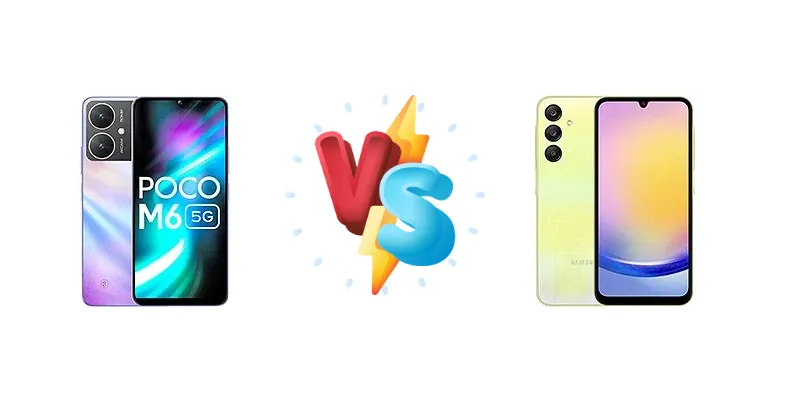
The Xiaomi Poco M6 and Samsung Galaxy A25 represent compelling options in the crowded sub-$250 smartphone market. The Poco M6 aims for raw performance with its Dimensity 6100+ chipset, while the Galaxy A25 prioritizes a refined Samsung experience and strong battery life. This comparison dissects their strengths and weaknesses to help you choose the right device.
🏆 Quick Verdict
For most users, the Samsung Galaxy A25 emerges as the better all-rounder. Its superior display brightness, longer battery life, and Samsung’s software support outweigh the Poco M6’s slight CPU performance edge. However, gamers on a tight budget might find the Poco M6’s processor more appealing.
| Network |
|---|
| 2G bands | GSM 850 / 900 / 1800 / 1900 | GSM 850 / 900 / 1800 / 1900 |
| 3G bands | HSDPA 850 / 900 / 2100 | HSDPA 850 / 900 / 1700(AWS) / 1900 / 2100 |
| 4G bands | 1, 3, 5, 8, 28, 40, 41 | 1, 2, 3, 4, 5, 7, 8, 12, 13, 17, 20, 26, 28, 38, 40, 41, 66 |
| 5G bands | 1, 3, 5, 8, 28, 40, 78 SA/NSA | 1, 3, 5, 7, 8, 26, 28, 40, 41, 66, 77, 78 SA/NSA/Sub6 |
| Speed | HSPA, LTE, 5G | HSPA, LTE, 5G |
| Technology | GSM / HSPA / LTE / 5G | GSM / HSPA / LTE / 5G |
| Launch |
|---|
| Announced | 2023, December 22 | 2023, December 11 |
| Status | Available. Released 2023, December 26 | Available. Released 2023, December 16 |
| Body |
|---|
| Build | - | Glass front, plastic frame, plastic back |
| Dimensions | 168 x 78 x 8.1 mm (6.61 x 3.07 x 0.32 in) | 161 x 76.5 x 8.3 mm (6.34 x 3.01 x 0.33 in) |
| SIM | Nano-SIM + Nano-SIM | · Nano-SIM· Nano-SIM + Nano-SIM |
| Weight | 195 g (6.88 oz) | 197 g (6.95 oz) |
| Display |
|---|
| Protection | Corning Gorilla Glass | - |
| Resolution | 720 x 1600 pixels, 20:9 ratio (~260 ppi density) | 1080 x 2340 pixels, 19.5:9 ratio (~396 ppi density) |
| Size | 6.74 inches, 109.7 cm2 (~83.7% screen-to-body ratio) | 6.5 inches, 103.7 cm2 (~84.2% screen-to-body ratio) |
| Type | IPS LCD, 90Hz, 450 nits (typ), 600 nits (HBM) | Super AMOLED, 120Hz, 1000 nits (HBM) |
| Platform |
|---|
| CPU | Octa-core (2x2.2 GHz Cortex-A76 & 6x2.0 GHz Cortex-A55) | Octa-core (2x2.4 GHz Cortex-A78 & 6x2.0 GHz Cortex-A55) |
| Chipset | Mediatek Dimensity 6100+ (6 nm) | Exynos 1280 (5 nm) |
| GPU | Mali-G57 MC2 | Mali-G68 |
| OS | Android 13, MIUI 14 | Android 14, up to 4 major Android upgrades, One UI 7 |
| Memory |
|---|
| Card slot | microSDXC (dedicated slot) | microSDXC (uses shared SIM slot) |
| Internal | 64GB 4GB RAM, 128GB 4GB RAM, 128GB 6GB RAM, 256GB 8GB RAM | 128GB 4GB RAM, 128GB 6GB RAM, 128GB 8GB RAM, 256GB 6GB RAM, 256GB 8GB RAM |
| Main Camera |
|---|
| Features | LED flash, HDR | LED flash, panorama, HDR |
| Single | 50 MP, f/1.8, 28mm (wide), PDAF
Auxiliary lens | - |
| Triple | - | 50 MP, f/1.8, 27mm (wide), 1/2.76", 0.64µm, PDAF, OIS
8 MP, f/2.2, 120˚ (ultrawide), 1/4", 1.12µm
2 MP (macro) |
| Video | 1080p@30fps | 4K@30fps, 1080p@30/60fps, gyro-EIS |
| Selfie camera |
|---|
| Features | HDR | - |
| Single | 5 MP, f/2.2, (wide) | 13 MP, f/2.2, (wide), 1/3.06", 1.12µm |
| Video | 1080p@30fps | 1080p@30fps |
| Sound |
|---|
| 35mm jack | Yes | Yes |
| Loudspeaker | Yes | Yes, with stereo speakers |
| Comms |
|---|
| Bluetooth | 5.3, A2DP, LE | 5.3, A2DP, LE |
| NFC | No | Yes (market/region dependent) |
| Positioning | GPS, GLONASS, GALILEO, BDS | GPS, GLONASS, GALILEO, BDS, QZSS |
| Radio | FM radio | Market/region dependent |
| USB | USB Type-C 2.0 | USB Type-C 2.0 |
| WLAN | Wi-Fi 802.11 a/b/g/n/ac, dual-band | Wi-Fi 802.11 a/b/g/n/ac, dual-band, Wi-Fi Direct |
| Features |
|---|
| Sensors | Fingerprint (side-mounted), accelerometer, compass | Fingerprint (side-mounted), accelerometer, gyro, compass |
| Battery |
|---|
| Charging | 18W wired, PD | 25W wired |
| Type | Li-Po 5000 mAh | 5000 mAh |
| Misc |
|---|
| Colors | Galactic Black, Orion Blue | Brave Black, Personality Yellow, Fantasy Blue, Optimistic Blue |
| Models | 23128PC33I | SM-A256E, SM-A256E/DS, SM-A256E/DSN, SM-A256B, SM-A256B/DS, SM-A256B/DSN, SM-A256U, SM-A256U1 |
| Price | ₹ 9,388 | € 175.99 / $ 120.32 / ₹ 18,399 |
| SAR EU | - | 0.46 W/kg (head) 1.19 W/kg (body) |
Xiaomi Poco M6
- Potentially higher CPU performance for gaming
- PD charging compatibility
- Generally more affordable
- Likely lower display brightness
- Shorter battery life (estimated)
- MIUI software can be polarizing
Samsung Galaxy A25
- Significantly brighter display
- Excellent battery life (10:19h)
- Faster 25W charging
- Samsung’s One UI software
- Slightly less CPU performance
- Potentially higher price
- May include bloatware
Display Comparison
The Samsung Galaxy A25 boasts a significantly brighter display, reaching a measured 1030 nits, making it far more usable outdoors under direct sunlight compared to the Poco M6 (brightness data unavailable). While both likely utilize LCD panels, the A25’s higher peak brightness is a clear advantage. The absence of high refresh rate information for both devices suggests a standard 60Hz experience, which is typical for this price bracket. Bezels are expected to be similar, with neither phone aiming for flagship-level screen-to-body ratios.
Camera Comparison
Detailed camera analysis is limited by the provided data. Both phones feature a 'Photo / Video' capability, but specifics are missing. The absence of sensor size information makes direct comparison difficult. However, Samsung’s image processing algorithms are generally more refined, potentially delivering more consistent and pleasing results, especially in challenging lighting conditions. The Poco M6 may rely more on software enhancements to compensate for potentially lower-quality hardware. The presence of a 2MP macro camera on either device is largely inconsequential; its utility is limited by its low resolution and lack of optical image stabilization.
Performance
The Samsung Galaxy A25’s Exynos 1280 (5nm) and Cortex-A78 cores offer a theoretical performance advantage over the Poco M6’s Dimensity 6100+ (6nm) and Cortex-A76 cores. The 5nm fabrication process of the Exynos 1280 generally translates to better power efficiency and potentially less thermal throttling under sustained load. While the Poco M6’s CPU clock speeds (2.2 GHz) are slightly higher, the architectural improvements in the Exynos 1280 are more impactful. Both phones likely feature similar RAM configurations, but the A25’s optimized software could lead to smoother multitasking.
Battery Life
The Samsung Galaxy A25 shines in battery life, achieving an active use score of 10:19 hours. While the Poco M6’s battery capacity is unknown, the A25’s longer runtime is a significant advantage for power users. The A25 also supports 25W wired charging, faster than the Poco M6’s 18W charging, reducing the time to fully recharge. The inclusion of Power Delivery (PD) on the Poco M6 is a positive, offering compatibility with a wider range of chargers, but the slower charging speed remains a drawback.
Buying Guide
Buy the Xiaomi Poco M6 if you prioritize maximizing CPU performance for gaming or demanding apps on a strict budget and are comfortable with Xiaomi’s MIUI software. Buy the Samsung Galaxy A25 if you value a brighter, more usable display, significantly longer battery life, and the stability and feature set of Samsung’s One UI, even if it means a slight performance trade-off.
Frequently Asked Questions
❓ Does the Exynos 1280 in the Galaxy A25 tend to overheat during prolonged gaming sessions?
The Exynos 1280, built on a 5nm process, is generally efficient and shouldn't exhibit significant overheating during typical gaming. However, sustained, high-intensity gaming will inevitably generate heat. Samsung’s thermal management system should mitigate throttling, but performance may decrease slightly over extended periods. The Poco M6's Dimensity 6100+ may also throttle, but the Exynos 1280's architecture is more efficient.
❓ Is the 18W charging on the Poco M6 slow compared to other phones in this price range?
Yes, 18W charging is relatively slow compared to the 25W charging offered by the Samsung Galaxy A25 and many other phones in the sub-$250 category. Expect a longer recharge time with the Poco M6, potentially taking over 2 hours for a full charge from 0%. While PD support offers compatibility, it doesn't increase the charging speed itself.
❓ How does the software experience differ between Xiaomi's MIUI and Samsung's One UI?
MIUI is known for its extensive customization options and features, but can also be perceived as bloated with pre-installed apps and aggressive battery management. One UI offers a cleaner, more streamlined experience with a focus on usability and Samsung’s ecosystem integration. One UI generally receives longer software support and security updates than MIUI.