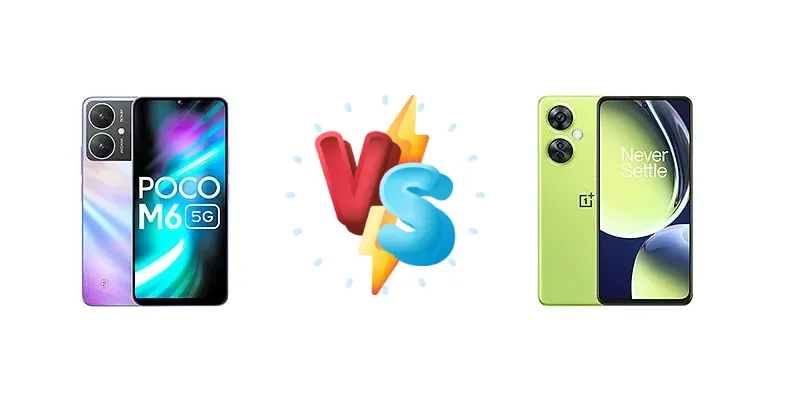
The sub-$250 smartphone market is fiercely competitive, and the Xiaomi Poco M6 and OnePlus Nord CE 3 Lite are two strong contenders vying for your attention. The Poco M6 brings MediaTek’s latest Dimensity 6100+ chipset to the table, while the Nord CE 3 Lite relies on Qualcomm’s Snapdragon 695 5G. This comparison dissects their key differences, focusing on performance, charging speed, and overall value to determine which device reigns supreme.
🏆 Quick Verdict
For most users, the OnePlus Nord CE 3 Lite emerges as the better choice. Its significantly faster 67W SuperVOOC charging – capable of reaching 80% in just 30 minutes – provides a tangible usability advantage over the Poco M6’s 18W charging. While the Poco M6’s Dimensity 6100+ offers a slight CPU performance edge, the Nord CE 3 Lite’s charging convenience and generally smoother software experience make it the more practical daily driver.
| Network |
|---|
| 2G bands | GSM 850 / 900 / 1800 / 1900 | GSM 850 / 900 / 1800 / 1900 |
| 3G bands | HSDPA 850 / 900 / 2100 | HSDPA 800 / 850 / 900 / 1700(AWS) / 1900 / 2100 - International |
| 4G bands | 1, 3, 5, 8, 28, 40, 41 | 1, 2, 3, 4, 5, 7, 8, 12, 13, 17, 18, 19, 20, 26, 28, 32, 38, 39, 40, 41, 66 - International |
| 5G bands | 1, 3, 5, 8, 28, 40, 78 SA/NSA | 1, 3, 5, 7, 8, 20, 28, 38, 40, 41, 66, 77, 78 SA/NSA - International |
| Speed | HSPA, LTE, 5G | HSPA, LTE, 5G |
| Technology | GSM / HSPA / LTE / 5G | GSM / HSPA / LTE / 5G |
| | - | 1, 3, 5, 8, 28, 40, 41, 77, 78 SA/NSA - India |
| Launch |
|---|
| Announced | 2023, December 22 | 2023, April 04 |
| Status | Available. Released 2023, December 26 | Available. Released 2023, April 11 |
| Body |
|---|
| Build | - | Glass front, plastic frame, plastic back |
| Dimensions | 168 x 78 x 8.1 mm (6.61 x 3.07 x 0.32 in) | 165.5 x 76 x 8.3 mm (6.52 x 2.99 x 0.33 in) |
| SIM | Nano-SIM + Nano-SIM | Nano-SIM + Nano-SIM |
| Weight | 195 g (6.88 oz) | 195 g (6.88 oz) |
| Display |
|---|
| Protection | Corning Gorilla Glass | Corning Gorilla Glass |
| Resolution | 720 x 1600 pixels, 20:9 ratio (~260 ppi density) | 1080 x 2400 pixels, 20:9 ratio (~391 ppi density) |
| Size | 6.74 inches, 109.7 cm2 (~83.7% screen-to-body ratio) | 6.72 inches, 109.6 cm2 (~87.1% screen-to-body ratio) |
| Type | IPS LCD, 90Hz, 450 nits (typ), 600 nits (HBM) | IPS LCD, 120Hz, 550 nits (typ), 680 nits (peak) |
| Platform |
|---|
| CPU | Octa-core (2x2.2 GHz Cortex-A76 & 6x2.0 GHz Cortex-A55) | Octa-core (2x2.2 GHz Kryo 660 Gold & 6x1.7 GHz Kryo 660 Silver) |
| Chipset | Mediatek Dimensity 6100+ (6 nm) | Qualcomm SM6375 Snapdragon 695 5G (6 nm) |
| GPU | Mali-G57 MC2 | Adreno 619 |
| OS | Android 13, MIUI 14 | Android 13, OxygenOS 13.1 |
| Memory |
|---|
| Card slot | microSDXC (dedicated slot) | microSDXC (uses shared SIM slot) |
| Internal | 64GB 4GB RAM, 128GB 4GB RAM, 128GB 6GB RAM, 256GB 8GB RAM | 128GB 8GB RAM, 256GB 8GB RAM |
| | - | UFS 2.2 |
| Main Camera |
|---|
| Features | LED flash, HDR | LED flash, HDR, panorama |
| Single | 50 MP, f/1.8, 28mm (wide), PDAF
Auxiliary lens | - |
| Triple | - | 108 MP, f/1.8, (wide), 1/1.67", 0.64µm, PDAF
2 MP (macro)
Auxiliary lens |
| Video | 1080p@30fps | 1080p@30fps |
| Selfie camera |
|---|
| Features | HDR | HDR, panorama |
| Single | 5 MP, f/2.2, (wide) | 16 MP, f/2.4, (wide), 1.0µm |
| Video | 1080p@30fps | 1080p@30fps |
| Sound |
|---|
| 3.5mm jack | - | Yes |
| 35mm jack | Yes | Yes |
| Loudspeaker | Yes | Yes, with stereo speakers |
| Comms |
|---|
| Bluetooth | 5.3, A2DP, LE | 5.1, A2DP, LE, aptX HD |
| NFC | No | Yes (market/region dependent) |
| Positioning | GPS, GLONASS, GALILEO, BDS | GPS, GALILEO, GLONASS, BDS, QZSS |
| Radio | FM radio | No |
| USB | USB Type-C 2.0 | USB Type-C 2.0, OTG |
| WLAN | Wi-Fi 802.11 a/b/g/n/ac, dual-band | Wi-Fi 802.11 a/b/g/n/ac, dual-band |
| Features |
|---|
| Sensors | Fingerprint (side-mounted), accelerometer, compass | Fingerprint (side-mounted), accelerometer, gyro, proximity, compass |
| Battery |
|---|
| Charging | 18W wired, PD | 67W wired, 80% in 30 min |
| Type | Li-Po 5000 mAh | Li-Po 5000 mAh |
| Misc |
|---|
| Colors | Galactic Black, Orion Blue | Pastel Lime, Chromatic Gray |
| Models | 23128PC33I | CPH2467, CPH2465 |
| Price | ₹ 9,388 | £ 169.98 / € 209.99 |
| SAR | - | 1.17 W/kg (head) 0.70 W/kg (body) |
| Tests |
|---|
| Performance | - |
AnTuTu: 412006 (v9)
GeekBench: 2052 (v5)
GFXBench: 17fps (ES 3.1 onscreen) |
Xiaomi Poco M6
- Potentially faster CPU performance with Dimensity 6100+
- Newer chipset architecture
- Competitive price point
- Significantly slower 18W charging
- Xiaomi’s MIUI software can be bloated
- Camera performance is uncertain
OnePlus Nord CE 3 Lite
- Ultra-fast 67W SuperVOOC charging
- Generally smoother software experience with OxygenOS
- Reliable Qualcomm chipset
- Slightly weaker CPU performance compared to Poco M6
- May lack some of the advanced features found on higher-end OnePlus models
- Camera performance is uncertain
Display Comparison
Neither device boasts a standout display. Both likely utilize LCD panels, a common trait in this price bracket. While specific details like peak brightness and color gamut coverage are absent, the focus here is on the processors. Bezels are expected to be similar, and color accuracy will likely be adequate for everyday use, but not professional color work. The display is not a differentiating factor.
Camera Comparison
Camera performance is difficult to assess without detailed sensor information. Both phones likely feature a primary camera accompanied by depth and macro sensors (the latter often being of limited utility). The Poco M6’s image processing will likely lean towards Xiaomi’s vibrant, sometimes oversaturated style, while OnePlus typically aims for more natural-looking images. Without knowing sensor sizes and apertures, it’s impossible to declare a clear winner. The absence of Optical Image Stabilization (OIS) on either device suggests low-light performance will be a challenge.
Performance
The core difference lies in the chipsets. The Poco M6’s MediaTek Dimensity 6100+ (6nm) features a dual-core setup with 2x2.2 GHz Cortex-A76 cores and a hexa-core cluster of 2.0 GHz Cortex-A55s. This architecture generally translates to stronger single-core performance compared to the OnePlus Nord CE 3 Lite’s Qualcomm Snapdragon 695 5G (6nm) with its 2x2.2 GHz Kryo 660 Gold and 6x1.7 GHz Kryo 660 Silver cores. However, the Snapdragon 695 benefits from Qualcomm’s optimized software and potentially better sustained performance due to thermal management. The Poco M6’s newer chipset *should* offer a slight edge in CPU-bound tasks, but real-world differences may be minimal for typical usage. Both devices likely feature similar RAM configurations, impacting multitasking capabilities.
Battery Life
The OnePlus Nord CE 3 Lite’s 67W SuperVOOC charging is a game-changer. Achieving 80% charge in 30 minutes is a significant advantage over the Poco M6’s 18W wired charging, which will take considerably longer to fully replenish the battery. While battery capacity isn’t specified, the faster charging speed effectively mitigates any potential capacity difference. Users who frequently find themselves needing a quick power boost will overwhelmingly prefer the Nord CE 3 Lite.
Buying Guide
Buy the Xiaomi Poco M6 if you prioritize raw CPU performance for tasks like light gaming and multitasking, and are comfortable with slower charging speeds. You'll benefit from the newer chipset architecture. Buy the OnePlus Nord CE 3 Lite if you value fast charging above all else, and prefer a more refined software experience with guaranteed updates and a generally smoother user interface. The Nord CE 3 Lite is ideal for users who need to quickly top up their phone throughout the day.
Frequently Asked Questions
❓ Is the Snapdragon 695 in the Nord CE 3 Lite prone to overheating during extended gaming sessions?
The Snapdragon 695 is generally efficient, but sustained gaming can lead to thermal throttling. However, OnePlus’s software optimization and the phone’s thermal design should mitigate this to a reasonable extent. Expect some performance reduction after prolonged gaming, but it shouldn’t be severe enough to render the experience unplayable.
❓ Does the Poco M6 support carrier aggregation for improved 5G speeds?
While the Dimensity 6100+ supports 5G, the extent of carrier aggregation support will vary depending on the specific model and region. Check with your carrier to confirm compatibility and supported bands for optimal 5G performance.
❓ How does Xiaomi's MIUI software compare to OnePlus's OxygenOS in terms of bloatware and updates?
MIUI is known for being feature-rich but often includes pre-installed bloatware. OxygenOS, on the other hand, offers a cleaner, more streamlined experience with fewer pre-installed apps and a commitment to faster software updates. OnePlus generally provides more consistent and timely updates than Xiaomi.