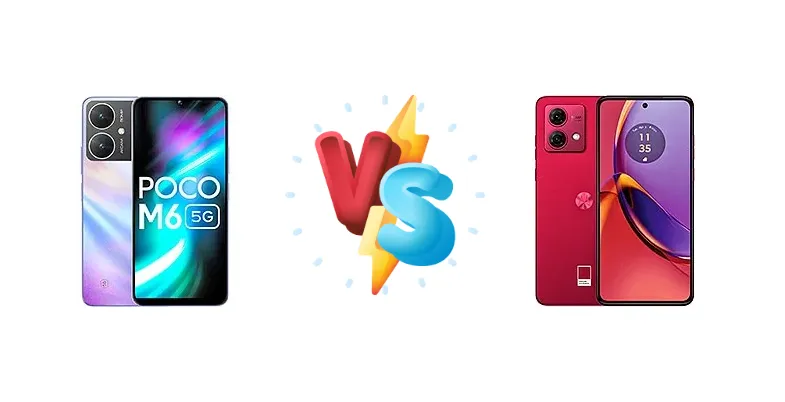
The sub-$200 smartphone market is fiercely competitive, and the Xiaomi Poco M6 and Motorola Moto G84 are two strong contenders vying for your attention. The Poco M6 leverages MediaTek's Dimensity 6100+ for raw processing power, while the Moto G84 opts for Qualcomm's Snapdragon 695, prioritizing a balance of efficiency and 5G connectivity. This comparison dives deep into their strengths and weaknesses to determine which phone delivers the best overall experience.
🏆 Quick Verdict
For users prioritizing raw performance and quick app loading, the Xiaomi Poco M6 is the better choice thanks to its Dimensity 6100+ chipset. However, the Motorola Moto G84 excels in battery endurance and offers a significantly brighter display, making it ideal for media consumption and all-day use.
| Network |
|---|
| 2G bands | GSM 850 / 900 / 1800 / 1900 | GSM 850 / 900 / 1800 / 1900 |
| 3G bands | HSDPA 850 / 900 / 2100 | HSDPA 850 / 900 / 1700(AWS) / 1900 / 2100 - LATAM |
| 4G bands | 1, 3, 5, 8, 28, 40, 41 | 1, 2, 3, 4, 5, 7, 8, 12, 13, 17, 25, 26, 28, 38, 40, 41, 42, 66 - LATAM |
| 5G bands | 1, 3, 5, 8, 28, 40, 78 SA/NSA | 1, 2, 3, 5, 7, 26, 28, 40, 66, 78 SA/NSA/Sub6 - LATAM |
| Speed | HSPA, LTE, 5G | HSPA, LTE, 5G |
| Technology | GSM / HSPA / LTE / 5G | GSM / HSPA / LTE / 5G |
| Launch |
|---|
| Announced | 2023, December 22 | 2023, August 24 |
| Status | Available. Released 2023, December 26 | Available. Released 2023, September 08 |
| Body |
|---|
| Build | - | Glass front, plastic frame, plastic back or eco leather back |
| Dimensions | 168 x 78 x 8.1 mm (6.61 x 3.07 x 0.32 in) | 160 x 74.4 x 7.6 mm (6.30 x 2.93 x 0.30 in) |
| SIM | Nano-SIM + Nano-SIM | Nano-SIM + Nano-SIM |
| Weight | 195 g (6.88 oz) | 166.8 g (5.86 oz) |
| Display |
|---|
| Protection | Corning Gorilla Glass | - |
| Resolution | 720 x 1600 pixels, 20:9 ratio (~260 ppi density) | 1080 x 2400 pixels, 20:9 ratio (~405 ppi density) |
| Size | 6.74 inches, 109.7 cm2 (~83.7% screen-to-body ratio) | 6.5 inches, 102.0 cm2 (~85.7% screen-to-body ratio) |
| Type | IPS LCD, 90Hz, 450 nits (typ), 600 nits (HBM) | P-OLED, 1B colors, 120Hz, 1300 nits (peak) |
| Platform |
|---|
| CPU | Octa-core (2x2.2 GHz Cortex-A76 & 6x2.0 GHz Cortex-A55) | Octa-core (2x2.2 GHz Kryo 660 Gold & 6x1.7 GHz Kryo 660 Silver) |
| Chipset | Mediatek Dimensity 6100+ (6 nm) | Qualcomm SM6375 Snapdragon 695 5G (6 nm) |
| GPU | Mali-G57 MC2 | Adreno 619 |
| OS | Android 13, MIUI 14 | Android 13, upgradable to Android 15 |
| Memory |
|---|
| Card slot | microSDXC (dedicated slot) | microSDXC (uses shared SIM slot) |
| Internal | 64GB 4GB RAM, 128GB 4GB RAM, 128GB 6GB RAM, 256GB 8GB RAM | 256GB 8GB RAM, 256GB 12GB RAM |
| Main Camera |
|---|
| Dual | - | 50 MP, f/1.9 (wide), 1/1.5", 1.0µm, PDAF, OIS
8 MP, f/2.2, 120˚ (ultrawide), 1/4.0", 1.12µm, AF |
| Features | LED flash, HDR | LED flash, HDR, panorama |
| Single | 50 MP, f/1.8, 28mm (wide), PDAF
Auxiliary lens | - |
| Video | 1080p@30fps | 1080p@30/60fps |
| Selfie camera |
|---|
| Features | HDR | - |
| Single | 5 MP, f/2.2, (wide) | 16 MP, f/2.5, (wide), 1.0µm |
| Video | 1080p@30fps | 1080p@30fps |
| Sound |
|---|
| 35mm jack | Yes | Yes |
| Loudspeaker | Yes | Yes, with stereo speakers |
| Comms |
|---|
| Bluetooth | 5.3, A2DP, LE | 5.1, A2DP, LE |
| NFC | No | Yes (market/region dependent) |
| Positioning | GPS, GLONASS, GALILEO, BDS | GPS, GLONASS, GALILEO |
| Radio | FM radio | FM radio (market/region dependent) |
| USB | USB Type-C 2.0 | USB Type-C 2.0 |
| WLAN | Wi-Fi 802.11 a/b/g/n/ac, dual-band | Wi-Fi 802.11 a/b/g/n/ac, dual-band, Wi-Fi Direct |
| Features |
|---|
| Sensors | Fingerprint (side-mounted), accelerometer, compass | Fingerprint (under display, optical), accelerometer, gyro, proximity, compass |
| Battery |
|---|
| Charging | 18W wired, PD | 30W wired |
| Type | Li-Po 5000 mAh | Li-Po 5000 mAh |
| Misc |
|---|
| Colors | Galactic Black, Orion Blue | Marshmallow Blue, Midnight Blue, Viva Magenta |
| Models | 23128PC33I | XT2347, XT2347-1, XT2347-2 |
| Price | ₹ 9,388 | $ 399.00 / £ 189.99 / € 169.00 |
Xiaomi Poco M6
- Potentially faster CPU performance with Dimensity 6100+
- More responsive app loading and multitasking
- Competitive price point
- Likely shorter battery life
- Display brightness likely lower than Moto G84
- Limited camera details available
Motorola Moto G84
- Excellent battery life (12:31h active use)
- Bright and vibrant display (996 nits)
- Faster 30W charging
- CPU performance may be slightly lower than Poco M6
- Snapdragon 695 is an older chipset
- Camera details are limited
Display Comparison
The Motorola Moto G84 boasts a notably brighter display, reaching a measured 996 nits of peak brightness. This is a significant advantage for outdoor visibility compared to the Poco M6, which lacks published brightness data but is expected to be lower given its chipset focus. While both utilize 6nm chipsets, the G84’s display tech is a clear win for users who frequently use their phones in sunlight. The Poco M6’s display specifications are currently unknown, making a detailed comparison of color accuracy and panel type impossible, but it’s likely a more cost-optimized solution.
Camera Comparison
The context data for both devices is limited regarding camera specifics. However, given the market positioning, it’s reasonable to assume both phones will feature a primary camera and potentially an ultrawide/macro lens combination. The Moto G84’s inclusion of 'Photo / Video' suggests a more feature-rich camera experience, potentially with more advanced image processing algorithms. Without sensor size or aperture information, it’s difficult to definitively declare a winner, but Motorola’s history suggests a focus on computational photography, potentially delivering better image quality in challenging lighting conditions. The Poco M6 will likely focus on delivering acceptable image quality at its price point.
Performance
The Poco M6’s MediaTek Dimensity 6100+ (6nm) chipset features a dual-core configuration with 2x2.2 GHz Cortex-A76 cores and 6x2.0 GHz Cortex-A55 cores. This contrasts with the Moto G84’s Qualcomm Snapdragon 695 5G (6nm) which uses 2x2.2 GHz Kryo 660 Gold cores and 6x1.7 GHz Kryo 660 Silver cores. While both CPUs have similar peak clock speeds, the Cortex-A76 cores in the Dimensity 6100+ generally offer superior single-core performance, translating to snappier app launches and smoother multitasking. However, the Snapdragon 695’s optimized power efficiency could lead to better sustained performance under load, preventing thermal throttling during extended gaming sessions. The Poco M6 will likely excel in benchmark scores, while the Moto G84 may offer a more consistent experience.
Battery Life
The Motorola Moto G84 demonstrates a clear advantage in battery life, achieving an active use score of 12:31h and an endurance rating of 117h. This indicates a highly efficient power management system. The Poco M6’s battery capacity and charging speed (18W wired, PD) are less impressive compared to the Moto G84’s 30W wired charging. While faster charging is beneficial, the Moto G84’s superior endurance means users will likely need to charge it less frequently. The 30W charging on the Moto G84 will also likely result in a faster 0-100% charge time than the Poco M6’s 18W solution.
Buying Guide
Buy the Xiaomi Poco M6 if you need a phone for demanding tasks like mobile gaming or frequent multitasking, and are willing to compromise slightly on battery life. Buy the Motorola Moto G84 if you prioritize long-lasting battery, a vibrant and easily visible display, and a more balanced overall experience for everyday use.
Frequently Asked Questions
❓ Will the Snapdragon 695 in the Moto G84 struggle with graphically intensive games like Genshin Impact?
While the Snapdragon 695 is capable of running many games, Genshin Impact and similar titles will likely require reduced graphics settings for a smooth experience. The Poco M6’s Dimensity 6100+ may offer a slightly better gaming experience, but neither phone is a dedicated gaming device.
❓ Does the Motorola Moto G84 support software updates beyond the initial Android release?
Motorola’s software update commitment is typically two major Android updates and three years of security patches. This is a reasonable level of support, but it’s less extensive than some other brands. The Poco M6’s update policy is less predictable, but Xiaomi generally provides updates for at least two years.
❓ Is the 18W charging on the Poco M6 slow compared to the Moto G84's 30W?
Yes, 18W charging is noticeably slower than 30W. While 18W is still usable, the Moto G84 will significantly reduce charging times, getting you back up and running much faster. However, the Moto G84's superior battery life means you may not need to charge as often.