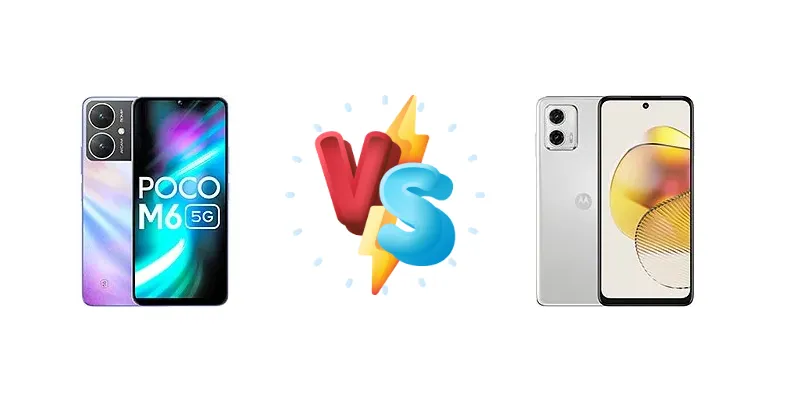
The sub-$200 smartphone market is fiercely competitive, and the Xiaomi Poco M6 and Motorola Moto G73 are two strong contenders vying for your attention. Both leverage Mediatek's Dimensity series, but with significant differences in chipset generation and features. This comparison dives deep into the specifics to determine which phone delivers the best overall experience.
🏆 Quick Verdict
For most users, the Motorola Moto G73 is the better choice. While the Poco M6 offers a respectable processor, the G73’s more powerful Dimensity 930 and significantly faster 30W charging provide a noticeable advantage in performance and convenience, justifying the potentially slight price premium.
| Network |
|---|
| 2G bands | GSM 850 / 900 / 1800 / 1900 | GSM 850 / 900 / 1800 / 1900 |
| 3G bands | HSDPA 850 / 900 / 2100 | HSDPA 850 / 900 / 1900 / 2100 |
| 4G bands | 1, 3, 5, 8, 28, 40, 41 | 1, 2, 3, 5, 7, 8, 18, 19, 20, 26, 28, 32, 38, 40, 41, 42 |
| 5G bands | 1, 3, 5, 8, 28, 40, 78 SA/NSA | 1, 3, 5, 7, 8, 20, 28, 38, 40, 41, 77, 78 SA/NSA |
| Speed | HSPA, LTE, 5G | HSPA, LTE, 5G |
| Technology | GSM / HSPA / LTE / 5G | GSM / HSPA / LTE / 5G |
| Launch |
|---|
| Announced | 2023, December 22 | 2023, January 24 |
| Status | Available. Released 2023, December 26 | Available. Released 2023, January 24 |
| Body |
|---|
| Build | - | Glass front, plastic back, plastic frame |
| Dimensions | 168 x 78 x 8.1 mm (6.61 x 3.07 x 0.32 in) | 161.4 x 73.8 x 8.3 mm (6.35 x 2.91 x 0.33 in) |
| SIM | Nano-SIM + Nano-SIM | Nano-SIM + Nano-SIM |
| Weight | 195 g (6.88 oz) | 181 g (6.38 oz) |
| | - | Water-resistant design |
| Display |
|---|
| Protection | Corning Gorilla Glass | - |
| Resolution | 720 x 1600 pixels, 20:9 ratio (~260 ppi density) | 1080 x 2400 pixels, 20:9 ratio (~405 ppi density) |
| Size | 6.74 inches, 109.7 cm2 (~83.7% screen-to-body ratio) | 6.5 inches, 102.0 cm2 (~85.6% screen-to-body ratio) |
| Type | IPS LCD, 90Hz, 450 nits (typ), 600 nits (HBM) | IPS LCD, 120Hz |
| Platform |
|---|
| CPU | Octa-core (2x2.2 GHz Cortex-A76 & 6x2.0 GHz Cortex-A55) | Octa-core (2x2.2 GHz Cortex-A78 & 6x2.0 GHz Cortex-A55) |
| Chipset | Mediatek Dimensity 6100+ (6 nm) | Mediatek Dimensity 930 (6 nm) |
| GPU | Mali-G57 MC2 | IMG BXM-8-256 |
| OS | Android 13, MIUI 14 | Android 13, planned upgrade to Android 14 |
| Memory |
|---|
| Card slot | microSDXC (dedicated slot) | microSDXC (uses shared SIM slot) |
| Internal | 64GB 4GB RAM, 128GB 4GB RAM, 128GB 6GB RAM, 256GB 8GB RAM | 128GB 8GB RAM, 256GB 8GB RAM |
| Main Camera |
|---|
| Dual | - | 50 MP, f/1.8, (wide), 1.0µm, PDAF
8 MP, f/2.2, 118˚ (ultrawide), 1.12µm, AF |
| Features | LED flash, HDR | LED flash, HDR, panorama |
| Single | 50 MP, f/1.8, 28mm (wide), PDAF
Auxiliary lens | - |
| Video | 1080p@30fps | 1080p@30/60fps |
| Selfie camera |
|---|
| Features | HDR | - |
| Single | 5 MP, f/2.2, (wide) | 16 MP, f/2.4, (wide), 1.0µm |
| Video | 1080p@30fps | 1080p@30fps |
| Sound |
|---|
| 3.5mm jack | - | Yes |
| 35mm jack | Yes | Yes |
| Loudspeaker | Yes | Yes, with stereo speakers |
| Comms |
|---|
| Bluetooth | 5.3, A2DP, LE | 5.3, A2DP, LE |
| NFC | No | Yes |
| Positioning | GPS, GLONASS, GALILEO, BDS | GPS, GLONASS, GALILEO |
| Radio | FM radio | Unspecified |
| USB | USB Type-C 2.0 | USB Type-C 2.0, OTG |
| WLAN | Wi-Fi 802.11 a/b/g/n/ac, dual-band | Wi-Fi 802.11 a/b/g/n/ac, dual-band |
| Features |
|---|
| Sensors | Fingerprint (side-mounted), accelerometer, compass | Fingerprint (side-mounted), accelerometer, proximity, compass |
| Battery |
|---|
| Charging | 18W wired, PD | 30W wired |
| Type | Li-Po 5000 mAh | Li-Po 5000 mAh |
| Misc |
|---|
| Colors | Galactic Black, Orion Blue | Lucent White, Midnight Blue |
| Models | 23128PC33I | - |
| Price | ₹ 9,388 | About 190 EUR |
Xiaomi Poco M6
- Potentially lower price point
- PD charging compatibility
- Respectable performance for basic tasks
- Slower charging speed (18W)
- Less powerful chipset (Dimensity 6100+)
- Likely inferior camera processing
Motorola Moto G73
- Faster charging speed (30W)
- More powerful chipset (Dimensity 930)
- Potentially better camera performance
- May be slightly more expensive
- No specific details on display technology
- Potential for slightly more heat under sustained load
Display Comparison
Neither device’s display specifications are provided, so we must infer. Given the price bracket, both likely utilize LCD panels. However, the Moto G73, being positioned slightly higher, may benefit from a higher peak brightness and potentially better color calibration. The absence of information on refresh rates is notable; a 90Hz panel on the G73 would be a significant advantage for smoother scrolling and animations. Bezels are likely comparable, with both aiming for maximized screen real estate within their respective budgets.
Camera Comparison
Without detailed camera specs, a direct comparison is challenging. However, the chipset difference suggests the Moto G73 will have a more capable image signal processor (ISP), leading to better image processing and potentially improved low-light performance. The G73’s ISP will likely handle noise reduction and dynamic range more effectively. Both phones likely feature a primary camera, ultrawide, and depth sensor configuration, but the G73’s primary sensor is likely larger, capturing more light and detail. The Poco M6 may rely more heavily on software processing to compensate for a potentially smaller sensor.
Performance
The Motorola Moto G73 boasts the Mediatek Dimensity 930 (6nm), a more powerful chipset than the Poco M6’s Dimensity 6100+ (6nm). The key difference lies in the CPU core architecture: the G73 utilizes Cortex-A78 cores (2x2.2 GHz) which offer a performance uplift over the Poco M6’s Cortex-A76 cores (2x2.2 GHz). While both have the same Cortex-A55 efficiency cores (6x2.0 GHz), the A78’s superior architecture translates to faster application loading and smoother multitasking. This difference will be most noticeable in demanding tasks like gaming and video editing. Both phones likely pair their chipsets with 8GB of RAM, but the G73’s chipset will be able to utilize that RAM more effectively.
Battery Life
The Motorola Moto G73’s 30W wired charging is a clear advantage over the Poco M6’s 18W charging. This translates to significantly faster charging times – potentially reducing a full charge from over 2 hours on the Poco M6 to around an hour on the G73. While battery capacity isn’t specified, the faster charging speed of the G73 mitigates any potential disadvantage from a slightly smaller battery. The inclusion of PD (Power Delivery) on the Poco M6 is a positive, ensuring compatibility with a wider range of chargers, but it doesn’t overcome the wattage deficit.
Buying Guide
Buy the Xiaomi Poco M6 if you prioritize a very tight budget and are comfortable with slower charging speeds. It’s a solid option for basic smartphone tasks and light gaming. Buy the Motorola Moto G73 if you value faster performance for multitasking and gaming, and appreciate the convenience of 30W fast charging. It’s ideal for users who want a smoother, more responsive experience without breaking the bank.
Frequently Asked Questions
❓ Will the Dimensity 930 in the Moto G73 get noticeably hotter than the Dimensity 6100+ during extended gaming sessions?
The Dimensity 930 is a more powerful chip and will generate more heat under sustained load. However, Motorola typically implements thermal management solutions to mitigate this. While some throttling is possible, the G73’s superior cooling is likely to maintain higher sustained performance than the Poco M6, even with the increased heat output.
❓ Does the Moto G73 support any form of video stabilization for smoother video recording?
Without specific camera specs, it's difficult to confirm. However, given the Dimensity 930’s ISP capabilities, it’s highly probable that the Moto G73 includes electronic image stabilization (EIS) for smoother video recording, especially at 1080p or 4K resolutions. The Poco M6 may offer basic stabilization, but likely at a lower level of effectiveness.
❓ Is the 18W charging on the Poco M6 slow enough to be a significant inconvenience for daily use?
Yes, 18W charging is relatively slow by today’s standards. Expect a full charge to take well over two hours. This is fine for overnight charging, but if you frequently need to top up your battery quickly, the Moto G73’s 30W charging is a much more convenient option.