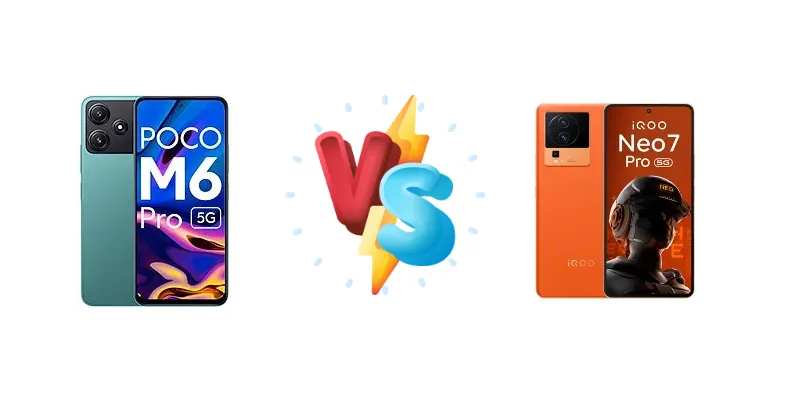
The Xiaomi Poco M6 Pro and vivo iQOO Neo 7 Pro represent distinct approaches to the mid-range smartphone market. The Poco focuses on delivering a solid experience at an incredibly competitive price, while the iQOO Neo 7 Pro aims for near-flagship performance with a focus on gaming and rapid charging. This comparison dissects their key differences to help you choose the right device.
🏆 Quick Verdict
For the average user prioritizing value and everyday tasks, the Xiaomi Poco M6 Pro offers a compelling package. However, the vivo iQOO Neo 7 Pro is the clear winner for gamers and power users who demand significantly higher performance and ultra-fast charging, justifying its higher price point.
| Network |
|---|
| 2G bands | GSM 850 / 900 / 1800 / 1900 | GSM 850 / 900 / 1800 / 1900 |
| 3G bands | HSDPA 850 / 900 / 2100 | HSDPA 800 / 850 / 900 / 1700(AWS) / 1900 / 2100 |
| 4G bands | 1, 3, 5, 8, 40, 41 | 1, 2, 3, 4, 5, 8, 28, 34, 38, 39, 40, 41 |
| 5G bands | 1, 3, 5, 8, 28, 40, 78 SA/NSA | 1, 3, 5, 8, 28, 40, 77, 78 SA/NSA |
| Speed | HSPA, LTE, 5G | HSPA, LTE, 5G |
| Technology | GSM / HSPA / LTE / 5G | GSM / HSPA / LTE / 5G |
| Launch |
|---|
| Announced | 2023, August 05 | 2023, July 04 |
| Status | Available. Released 2023, August 05 | Available. Released 2023, July 15 |
| Body |
|---|
| Build | Glass front (Gorilla Glass), plastic frame, glass back (Gorilla Glass) | Glass front, plastic frame, glass or leather back |
| Dimensions | 168.6 x 76.3 x 8.2 mm (6.64 x 3.00 x 0.32 in) | 164.8 x 76.9 x 8.5 mm or 8.9 mm |
| SIM | Nano-SIM + Nano-SIM | Nano-SIM + Nano-SIM |
| Weight | 199 g (7.02 oz) | 197 g or 202 g (6.95 oz) |
| Display |
|---|
| Protection | Corning Gorilla Glass | - |
| Resolution | 1080 x 2460 pixels (~396 ppi density) | 1080 x 2400 pixels, 20:9 ratio (~388 ppi density) |
| Size | 6.79 inches, 109.5 cm2 (~85.1% screen-to-body ratio) | 6.78 inches, 111.0 cm2 (~87.6% screen-to-body ratio) |
| Type | IPS LCD, 90Hz, 550 nits | AMOLED, 1B colors, 120Hz, HDR10+, 1300 nits (peak) |
| Platform |
|---|
| CPU | Octa-core (2x2.2 GHz Cortex-A78 & 6x1.95 GHz Cortex-A55) | Octa-core (1x3.19 GHz Cortex-X2 & 3x2.75 GHz Cortex-A710 & 4x2.0 GHz Cortex-A510) |
| Chipset | Qualcomm SM4450 Snapdragon 4 Gen 2 (4 nm) | Qualcomm SM8475 Snapdragon 8+ Gen 1 (4 nm) |
| GPU | Adreno 613 | Adreno 730 |
| OS | Android 13, MIUI 14 | Android 13, Funtouch 13 |
| Memory |
|---|
| Card slot | microSDXC (uses shared SIM slot) | No |
| Internal | 64GB 4GB RAM, 128GB 4GB RAM, 128GB 6GB RAM, 256GB 8GB RAM | 128GB 8GB RAM, 256GB 12GB RAM |
| Main Camera |
|---|
| Dual | 50 MP, f/1.8, (wide), PDAF
Auxiliary lens | - |
| Features | LED flash, HDR | LED flash, HDR, panorama |
| Triple | - | 50 MP, f/1.9, 24mm (wide), 1/1.57", 1.0µm, PDAF, OIS
8 MP, f/2.2, 16mm (ultrawide), 1/4.0", 1.12µm
2 MP (macro) |
| Video | 1080p@30fps | 4K@30fps, 1080p@30fps |
| Selfie camera |
|---|
| Features | HDR | HDR |
| Single | 8 MP, f/2.0, (wide), 1.12µm | 16 MP, f/2.5, (wide), 1/3.1", 1.0µm |
| Video | 1080p@30fps | 1080p@30fps |
| Sound |
|---|
| 35mm jack | Yes | No |
| Loudspeaker | Yes | Yes, with stereo speakers |
| Comms |
|---|
| Bluetooth | 5.3, A2DP, LE | 5.3, A2DP, LE, aptX HD, aptX Adaptive |
| Infrared port | Yes | Yes |
| NFC | Unspecified | No |
| Positioning | GPS, GLONASS, GALILEO, BDS | GPS, GLONASS, GALILEO, BDS, QZSS, NavIC |
| Radio | No | No |
| USB | USB Type-C | USB Type-C 2.0, OTG |
| WLAN | Wi-Fi 802.11 a/b/g/n/ac, dual-band | Wi-Fi 802.11 a/b/g/n/ac/6, dual-band, Wi-Fi Direct |
| Features |
|---|
| Sensors | Fingerprint (side-mounted), accelerometer, compass | Fingerprint (under display, optical), accelerometer, gyro, proximity, compass |
| Battery |
|---|
| Charging | 18W wired, PD | 120W wired, 50% in 8 min |
| Type | Li-Po 5000 mAh | 5000 mAh |
| Misc |
|---|
| Colors | Power Black, Forest Green | Fearless Flame, Dark Storm |
| Models | 23076PC4BI | I2217 |
| Price | ₹ 9,990 | About 380 EUR |
Xiaomi Poco M6 Pro
- Exceptional value for money
- Efficient Snapdragon 4 Gen 2 chipset
- Longer battery life for typical usage
- Significantly lower performance than the iQOO Neo 7 Pro
- Slow charging speed (18W)
vivo iQOO Neo 7 Pro
- Flagship-level Snapdragon 8+ Gen 1 performance
- Ultra-fast 120W charging
- Superior gaming capabilities
- Higher price point
- Potential for thermal throttling under heavy load
Display Comparison
While both devices likely utilize LCD panels (data not provided), the core difference lies in their processing power. The iQOO Neo 7 Pro, benefiting from its higher-end chipset, is more likely to support higher refresh rates (120Hz vs. potentially 90Hz on the Poco) for smoother scrolling and animations. The Snapdragon 8+ Gen 1’s image signal processor (ISP) also contributes to potentially more accurate color reproduction and dynamic range. Bezels are likely comparable given the market segment, but the iQOO’s processing power allows for more sophisticated display algorithms.
Camera Comparison
Without specific camera sensor details, we can infer differences based on chipset capabilities. The iQOO Neo 7 Pro’s Snapdragon 8+ Gen 1 boasts a more advanced ISP, enabling superior image processing, better low-light performance, and faster autofocus. While both phones likely feature a primary camera, the iQOO is more likely to include features like optical image stabilization (OIS) and the ability to record higher-resolution video. The Poco M6 Pro will likely rely more on software algorithms to enhance image quality, but will be limited by its less powerful ISP. The presence of a 2MP macro camera on either device is largely a marketing tactic and offers minimal practical benefit.
Performance
The performance gap is substantial. The iQOO Neo 7 Pro’s Snapdragon 8+ Gen 1 (4nm) is a flagship-level chipset featuring a Cortex-X2 prime core clocked at 3.19 GHz, vastly outperforming the Poco M6 Pro’s Snapdragon 4 Gen 2 (4nm). The 8+ Gen 1’s architecture – 1x Cortex-X2, 3x Cortex-A710, and 4x Cortex-A510 – is designed for sustained peak performance, crucial for gaming and demanding applications. The Poco’s 2x Cortex-A78 and 6x Cortex-A55 configuration is optimized for efficiency, not raw power. This translates to significantly faster app loading times, smoother multitasking, and higher frame rates in games on the iQOO. Thermal management will be a key differentiator; the 8+ Gen 1, while powerful, requires robust cooling to prevent throttling under sustained load.
Battery Life
The iQOO Neo 7 Pro’s 120W charging is a game-changer, capable of charging from 0% to 50% in just 8 minutes. This drastically reduces downtime compared to the Poco M6 Pro’s 18W charging, which will take considerably longer to reach a full charge. While battery capacity isn’t specified, the iQOO’s faster charging mitigates the impact of a potentially smaller battery. The Snapdragon 8+ Gen 1, despite its power, is built on a 4nm process, offering better power efficiency than older generation chips, potentially offsetting some of the power draw. The Poco M6 Pro’s Snapdragon 4 Gen 2 prioritizes efficiency, resulting in longer battery life for everyday use, but it won’t match the iQOO’s convenience of ultra-fast charging.
Buying Guide
Buy the Xiaomi Poco M6 Pro if you need a reliable daily driver for social media, browsing, and light gaming, and are on a tight budget. Its efficient Snapdragon 4 Gen 2 chipset and respectable battery life provide a smooth experience without breaking the bank. Buy the vivo iQOO Neo 7 Pro if you prioritize demanding mobile gaming, content creation, and require the fastest possible charging speeds. The Snapdragon 8+ Gen 1 delivers a substantial performance leap, making it ideal for power users.
Frequently Asked Questions
❓ Will the Snapdragon 8+ Gen 1 in the iQOO Neo 7 Pro overheat during prolonged gaming sessions?
The Snapdragon 8+ Gen 1 is a powerful chip, and sustained high performance can generate heat. However, vivo typically implements robust cooling solutions in their iQOO series, including vapor chambers and graphite sheets. While some throttling is possible during extremely demanding games, the iQOO Neo 7 Pro is designed to maintain stable performance for extended periods. Monitoring temperatures during gameplay is recommended.
❓ Is the 18W charging on the Poco M6 Pro sufficient for daily use, or will I be constantly tethered to a charger?
18W charging is relatively slow compared to modern standards. While sufficient for overnight charging, it will take significantly longer to top up the battery during the day. Users who frequently use their phone for extended periods or play demanding games may find the charging speed limiting. It's best suited for users who can charge their phone overnight and don't require quick top-ups.
❓ Does the Poco M6 Pro have enough processing power to run popular games like PUBG Mobile or Call of Duty Mobile?
The Poco M6 Pro’s Snapdragon 4 Gen 2 can run PUBG Mobile and Call of Duty Mobile, but likely at lower graphics settings and frame rates compared to the iQOO Neo 7 Pro. Expect playable performance at medium settings, but don't anticipate a consistently smooth experience at the highest settings. The iQOO Neo 7 Pro is the superior choice for a high-fidelity gaming experience.