
Poco M6 Pro vs Google Pixel 7a: A Deep Dive into Mid-Range Contenders
| Phones Images | |||||
|---|---|---|---|---|---|
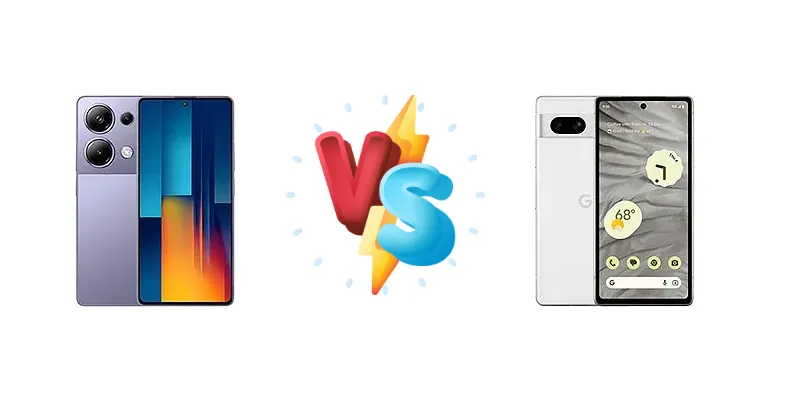
|
🏆 Quick Verdict
For the average user prioritizing camera quality, software experience, and long-term support, the Google Pixel 7a is the clear winner. However, the Poco M6 Pro 4G offers exceptional value and significantly faster charging, making it ideal for users who prioritize those features and are on a tighter budget.
| PHONES | ||
|---|---|---|
| Phone Names | Xiaomi Poco M6 Pro 4G | Google Pixel 7a |
| Network | ||
|---|---|---|
| 2G bands | GSM 850 / 900 / 1800 / 1900 | GSM 850 / 900 / 1800 / 1900 |
| 3G bands | HSDPA 800 / 850 / 900 / 1700(AWS) / 1900 / 2100 | HSDPA 800 / 850 / 900 / 1700(AWS) / 1900 / 2100 |
| 4G bands | 1, 2, 3, 4, 5, 7, 8, 12, 13, 17, 18, 19, 20, 26, 28, 38, 40, 41, 66 | 1, 2, 3, 4, 5, 7, 8, 12, 13, 14, 17, 20, 25, 26, 28, 29, 30, 38, 40, 41, 48, 66, 71 - GWKK3, G0DZQ |
| 5G bands | - | 1, 2, 3, 5, 7, 8, 12, 14, 20, 25, 28, 30, 38, 41, 48, 66, 71, 77, 78 SA/NSA/Sub6 - GWKK3 |
| Speed | HSPA, LTE | HSPA, LTE, 5G |
| Technology | GSM / HSPA / LTE | GSM / HSPA / LTE / 5G |
| - | 1, 2, 3, 5, 7, 8, 12, 20, 25, 28, 38, 40, 41, 66, 75, 76, 77, 78, 79 SA/NSA/Sub6 - GHL1X, G82U8 | |
| Launch | ||
|---|---|---|
| Announced | 2024, January 11 | 2023, May 10 |
| Status | Available. Released 2024, January 12 | Available. Released 2023, May 10 |
| Body | ||
|---|---|---|
| Build | Glass front (Gorilla Glass 5), plastic frame | Glass front (Gorilla Glass 3), aluminum frame, plastic back |
| Dimensions | 161.1 x 75 x 8 mm (6.34 x 2.95 x 0.31 in) | 152 x 72.9 x 9 mm (5.98 x 2.87 x 0.35 in) |
| SIM | Nano-SIM + Nano-SIM | Nano-SIM + eSIM |
| Weight | 179 g (6.31 oz) | 193.5 g (6.84 oz) |
| - | IP67 dust/water resistant (up to 1m for 30 min) | |
| Display | ||
|---|---|---|
| Protection | Corning Gorilla Glass 5 | Corning Gorilla Glass 3 |
| Resolution | 1080 x 2400 pixels, 20:9 ratio (~395 ppi density) | 1080 x 2400 pixels, 20:9 ratio (~429 ppi density) |
| Size | 6.67 inches, 107.4 cm2 (~88.9% screen-to-body ratio) | 6.1 inches, 90.7 cm2 (~81.8% screen-to-body ratio) |
| Type | AMOLED, 120Hz, 1000 nits (HBM), 1300 nits (peak) | OLED, HDR, 90Hz |
| - | Always-on display | |
| Platform | ||
|---|---|---|
| CPU | Octa-core (2x2.2 GHz Cortex-A76 & 6x2.0 GHz Cortex-A55) | Octa-core (2x2.85 GHz Cortex-X1 & 2x2.35 GHz Cortex-A78 & 4x1.80 GHz Cortex-A55) |
| Chipset | Mediatek Helio G99 Ultra | Google Tensor G2 (5 nm) |
| GPU | Mali-G57 MC2 | Mali-G710 MP7 |
| OS | Android 13, MIUI 14, planned upgrade to Android 14, HyperOS | Android 13, upgradable to Android 15, up to 5 major Android upgrades |
| Memory | ||
|---|---|---|
| Card slot | microSDXC (uses shared SIM slot) | No |
| Internal | 256GB 8GB RAM, 512GB 12GB RAM | 128GB 8GB RAM |
| - | UFS 3.1 | |
| Main Camera | ||
|---|---|---|
| Dual | - | 64 MP, f/1.9, 26mm (wide), 1/1.73", 0.8µm, dual pixel PDAF, OIS 13 MP, f/2.2, 120˚ (ultrawide), 1.12µm |
| Features | LED flash, HDR, panorama | Dual-LED flash, Pixel Shift, Auto-HDR, panorama |
| Triple | 64 MP, f/1.8, 25mm (wide), 1/2.0", 0.7µm, PDAF, OIS 8 MP, f/2.2, (ultrawide) 2 MP (macro) | - |
| Video | 1080p@30/60fps, gyro-EIS | 4K@30/60fps, 1080p@30/60/120/240fps, OIS |
| Selfie camera | ||
|---|---|---|
| Features | - | HDR, panorama |
| Single | 16 MP, f/2.5, (wide) | 13 MP, f/2.2, 20mm (ultrawide), 1.12µm |
| Video | 1080p@30/60fps | 4K@30fps, 1080p@30fps |
| Sound | ||
|---|---|---|
| 3.5mm jack | - | No |
| 35mm jack | Yes | No |
| Loudspeaker | Yes, with dual speakers | Yes, with stereo speakers |
| Comms | ||
|---|---|---|
| Bluetooth | 5.2, A2DP, LE | 5.3, A2DP, LE |
| Infrared port | Yes | - |
| NFC | Yes (market/region dependent) | Yes |
| Positioning | GPS, GALILEO, GLONASS, BDS | GPS, GLONASS, GALILEO, BDS, QZSS, NavIC |
| Radio | FM radio | No |
| USB | USB Type-C 2.0, OTG | USB Type-C 3.2 |
| WLAN | Wi-Fi 802.11 a/b/g/n/ac, dual-band | Wi-Fi 802.11 a/b/g/n/ac/6e, tri-band |
| Features | ||
|---|---|---|
| Sensors | Fingerprint (under display, optical), accelerometer, gyro, compass | Fingerprint (under display, optical), accelerometer, gyro, proximity, compass, barometer |
| Battery | ||
|---|---|---|
| Charging | 67W wired, 100% in 44 min | 18W wired, PD3.0 7.5W wireless |
| Type | 5000 mAh | Li-Po 4385 mAh |
| Misc | ||
|---|---|---|
| Colors | Black, Blue, Purple | Charcoal, Snow, Sea, Coral |
| Models | 2312FPCA6G | GWKK3, GHL1X, G0DZQ, G82U8 |
| Price | $ 170.00 | € 179.90 / $ 150.00 / £ 170.00 / ₹ 25,980 |
| SAR | 1.09 W/kg (head) 1.09 W/kg (body) | - |
| SAR EU | 0.99 W/kg (head) 0.99 W/kg (body) | - |
Xiaomi Poco M6 Pro 4G
- Incredibly fast 67W charging
- Excellent value for money
- Solid performance for everyday tasks
- Less powerful processor than the Pixel 7a
- Camera quality likely inferior to the Pixel 7a
Google Pixel 7a
- Powerful Google Tensor G2 chip
- Exceptional camera quality and image processing
- Guaranteed software updates and long-term support
- Slower 18W charging
- Higher price point than the Poco M6 Pro
Display Comparison
Both the Poco M6 Pro and Pixel 7a boast displays capable of reaching approximately 1050-1070 nits of peak brightness, ensuring excellent visibility even outdoors. While the numbers are close, the Pixel 7a’s display benefits from Google’s color calibration expertise, likely resulting in more accurate colors. The Poco M6 Pro’s panel is likely a standard LCD, while the Pixel 7a uses OLED, offering superior contrast and deeper blacks. Bezels appear comparable in marketing materials, but real-world testing would be needed to determine a clear winner in that regard.
Camera Comparison
While both phones offer photo and video capabilities, the Pixel 7a is expected to deliver a superior imaging experience. Google’s computational photography prowess, powered by the Tensor G2, is a key differentiator. The Pixel 7a likely features a larger main sensor and more sophisticated image processing algorithms, resulting in better dynamic range, low-light performance, and overall image quality. The Poco M6 Pro’s camera system, while adequate for casual use, will likely struggle to match the Pixel 7a’s consistency and detail. The inclusion of a 2MP macro camera on the Poco is largely a marketing gimmick and unlikely to provide significant value.
Performance
The performance gap is significant. The Google Pixel 7a’s Tensor G2, built on a 5nm process, is a substantial upgrade over the Poco M6 Pro’s MediaTek Helio G99 Ultra. The Tensor G2’s octa-core configuration, featuring 2x2.85 GHz Cortex-X1 cores, provides a noticeable boost in CPU performance, particularly in demanding tasks like video editing and complex multitasking. The G99 Ultra, while capable, relies on older Cortex-A76 cores and a less efficient 12nm process. This translates to potentially more throttling under sustained load on the Poco. The Pixel 7a’s LPDDR5X RAM further enhances its performance advantage.
Battery Life
The Poco M6 Pro shines in charging speed with its 67W wired charging, achieving a full charge in just 44 minutes. The Pixel 7a, limited to 18W charging, takes considerably longer. However, the Pixel 7a’s older endurance rating of 76 hours suggests efficient power management. While the Poco M6 Pro’s active use score of 11:46h is respectable, the Pixel 7a’s efficiency could offset the Poco’s faster charging for users who don’t require multiple top-ups per day. The Pixel 7a also adds the convenience of 7.5W wireless charging, a feature absent on the Poco.
Buying Guide
Buy the Xiaomi Poco M6 Pro 4G if you need a phone that charges incredibly quickly (fully charged in under an hour) and offers solid performance for everyday tasks and casual gaming, all at a very competitive price. Buy the Google Pixel 7a if you prefer a superior camera system, a cleaner and more intuitive software experience with guaranteed updates, and the power of Google's Tensor G2 chip for demanding applications and AI features.