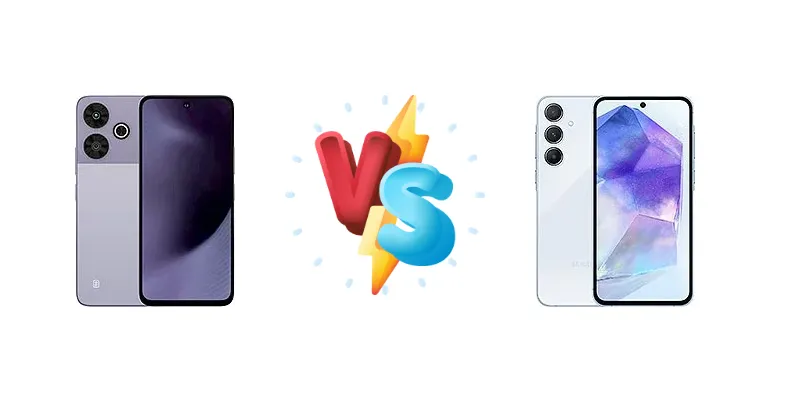
The Xiaomi Poco M6 Plus and Samsung Galaxy A55 represent compelling options in the increasingly competitive mid-range smartphone market. The Poco M6 Plus aims to undercut the competition with a focus on value, while the Galaxy A55 leverages Samsung’s brand recognition and refined software experience. This comparison dives deep into their specifications to determine which device best suits your needs.
🏆 Quick Verdict
For the average user prioritizing long-term software support and a brighter, more vibrant display, the Samsung Galaxy A55 is the better choice. However, the Poco M6 Plus offers a compelling performance-per-dollar ratio, particularly for those focused on gaming and less concerned with Samsung’s ecosystem.
| Network |
|---|
| 2G bands | GSM 850 / 900 / 1800 / 1900 | GSM 850 / 900 / 1800 / 1900 |
| 3G bands | HSDPA 850 / 900 / 2100 | HSDPA 850 / 900 / 1700(AWS) / 1900 / 2100 |
| 4G bands | 1, 3, 5, 8, 28, 40, 41 | 1, 2, 3, 4, 5, 7, 8, 12, 17, 20, 25, 26, 28, 32, 38, 40, 41, 66 |
| 5G bands | 1, 3, 5, 8, 28, 40, 78 SA/NSA | 1, 3, 5, 7, 8, 20, 28, 38, 40, 41, 66, 77, 78 SA/NSA/Sub6 |
| Speed | HSPA, LTE, 5G | HSPA, LTE, 5G |
| Technology | GSM / HSPA / LTE / 5G | GSM / HSPA / LTE / 5G |
| Launch |
|---|
| Announced | 2024, August 01 | 2024, March 11 |
| Status | Available. Released 2024, August 05 | Available. Released 2024, March 15 |
| Body |
|---|
| Build | Glass front, plastic frame, glass back | Glass front (Gorilla Glass Victus+), glass back (Gorilla Glass), aluminum frame |
| Dimensions | 168.6 x 76.3 x 8.3 mm (6.64 x 3.00 x 0.33 in) | 161.1 x 77.4 x 8.2 mm (6.34 x 3.05 x 0.32 in) |
| SIM | Nano-SIM + Nano-SIM | · Nano-SIM· Nano-SIM + eSIM· Nano-SIM + Nano-SIM· Nano-SIM + Nano-SIM + eSIM (max 2 at a time) |
| Weight | 205 g (7.23 oz) | 213 g (7.51 oz) |
| Display |
|---|
| Protection | Corning Gorilla Glass 3 | Corning Gorilla Glass Victus+ |
| Resolution | 1080 x 2460 pixels (~396 ppi density) | 1080 x 2340 pixels, 19.5:9 ratio (~390 ppi density) |
| Size | 6.79 inches, 109.5 cm2 (~85.1% screen-to-body ratio) | 6.6 inches, 106.9 cm2 (~85.8% screen-to-body ratio) |
| Type | IPS LCD, 120Hz, 550 nits (peak) | Super AMOLED, 120Hz, HDR10+, 1000 nits (HBM) |
| Platform |
|---|
| CPU | Octa-core (2x2.3 GHz Cortex-A78 & 6x2.0 GHz Cortex-A55) | Octa-core (4x2.75 GHz Cortex-A78 & 4x2.0 GHz Cortex-A55) |
| Chipset | Qualcomm SM4450 Snapdragon 4 Gen 2 AE (4 nm) | Exynos 1480 (4 nm) |
| GPU | Adreno 613 | Xclipse 530 |
| OS | Android 14, up to 2 major Android upgrades, HyperOS | Android 14, up to 4 major Android upgrades, One UI 6.1 |
| Memory |
|---|
| Card slot | microSDXC (uses shared SIM slot) | microSDXC (uses shared SIM slot) |
| Internal | 128GB 6GB RAM, 128GB 8GB RAM | 128GB 6GB RAM, 128GB 8GB RAM, 256GB 6GB RAM, 256GB 8GB RAM, 256GB 12GB RAM |
| Main Camera |
|---|
| Dual | 108 MP, f/1.8, 28mm (wide), 0.64µm, PDAF
2 MP (macro) | - |
| Features | LED flash, HDR, panorama | LED flash, panorama, HDR |
| Triple | - | 50 MP, f/1.8, (wide), 1/1.56", 1.0µm, PDAF, OIS
12 MP, f/2.2, 123˚ (ultrawide), 1/3.06", 1.12µm
5 MP (macro) |
| Video | 1080p@30fps | 4K@30fps, 1080p@30/60fps, gyro-EIS |
| Selfie camera |
|---|
| Features | HDR, panorama | - |
| Single | 13 MP, f/2.5, (wide) | 32 MP, f/2.2, 26mm (wide), 1/2.74", 0.8µm |
| Video | 1080p@30fps | 4K@30fps, 1080p@30/60fps |
| Sound |
|---|
| 35mm jack | Yes | No |
| Loudspeaker | Yes | Yes, with stereo speakers |
| Comms |
|---|
| Bluetooth | 5.0, A2DP, LE | 5.3, A2DP, LE |
| Infrared port | Yes | - |
| NFC | No | Yes (market/region dependent) |
| Positioning | GPS, GLONASS, GALILEO, BDS | GPS, GALILEO, GLONASS, BDS, QZSS |
| Radio | No | No |
| USB | USB Type-C | USB Type-C 2.0, OTG |
| WLAN | Wi-Fi 802.11 a/b/g/n/ac, dual-band | Wi-Fi 802.11 a/b/g/n/ac/6, dual-band, Wi-Fi Direct |
| Features |
|---|
| Sensors | Fingerprint (side-mounted), accelerometer, gyro, proximity, compass | Fingerprint (under display, optical), accelerometer, gyro, compass |
| Battery |
|---|
| Charging | 33W wired | 25W wired |
| Type | 5030 mAh | Li-Ion 5000 mAh |
| Misc |
|---|
| Colors | Black, Purple, Silver | Iceblue, Lilac, Navy, Lemon |
| Models | - | SM-A556V, SM-A556B, SM-A556B/DS, SM-A556E, SM-A556E/DS, SM-A5560 |
| Price | ₹ 10,299 | $ 324.99 / £ 251.50 / € 319.99 / ₹ 23,998 |
| SAR EU | - | 0.68 W/kg (head) 1.04 W/kg (body) |
Xiaomi Poco M6 Plus
- Potentially faster charging with 33W support
- Likely more affordable price point
- Snapdragon 4 Gen 2 offers good efficiency
- Less powerful CPU compared to the Exynos 1480
- Software support likely shorter than Samsung
- Display quality likely inferior to the A55
Samsung Galaxy A55
- Brighter and more vibrant Super AMOLED display
- More powerful Exynos 1480 processor
- Longer software support and updates from Samsung
- Slower charging speed at 25W
- Potentially higher price tag
- Exynos chips can be prone to thermal throttling
Display Comparison
The Samsung Galaxy A55 boasts a significantly brighter display, reaching a measured 1010 nits, making it far more usable in direct sunlight compared to the Poco M6 Plus (brightness data unavailable). While the Poco M6 Plus’s panel technology isn’t specified, the A55’s Super AMOLED panel delivers superior contrast and color accuracy. Samsung’s display is likely to have a higher PWM dimming rate, potentially reducing eye strain for sensitive users. The A55’s display is a clear advantage for multimedia consumption and outdoor use.
Camera Comparison
Without detailed camera specifications for the Poco M6 Plus, a direct comparison is limited. However, Samsung typically excels in image processing, and the A55 likely benefits from more sophisticated algorithms. The A55’s camera system is expected to deliver more consistent results across various lighting conditions. While the Poco M6 Plus may offer competitive specs on paper, Samsung’s software optimization often provides a superior overall photography experience. We can assume the Poco M6 Plus will include lower resolution auxiliary cameras, while the A55 will focus on the main sensor's quality.
Performance
Both phones utilize 4nm chipsets, but the Samsung Galaxy A55’s Exynos 1480 features a more powerful CPU configuration – 4x2.75 GHz Cortex-A78 cores versus the Poco M6 Plus’s 2x2.3 GHz Cortex-A78 cores. This translates to faster application loading and smoother multitasking on the A55. While both use Cortex-A55 efficiency cores at 2.0 GHz, the A55’s superior CPU architecture provides a noticeable performance edge. The Snapdragon 4 Gen 2 in the Poco M6 Plus is still capable, but the Exynos 1480 is geared towards a more demanding user. Thermal management will be key; the Exynos 1480’s performance could be limited by throttling under sustained load, a common issue with Exynos chips.
Battery Life
The Samsung Galaxy A55 demonstrates superior battery endurance with an active use score of 13:27 hours. While the Poco M6 Plus’s battery capacity is unknown, the A55’s efficiency, combined with its optimized software, provides a significant advantage. The A55 charges at 25W, while the Poco M6 Plus supports 33W charging. This suggests the Poco M6 Plus could potentially charge faster, but the A55’s larger battery and efficient chipset will likely offset this difference in real-world usage.
Buying Guide
Buy the Xiaomi Poco M6 Plus if you need a phone primarily for gaming and media consumption on a tight budget, and are comfortable with Xiaomi’s MIUI software. Buy the Samsung Galaxy A55 if you prefer a polished user experience, a brighter display for outdoor visibility, and the peace of mind that comes with Samsung’s longer software update commitment.
Frequently Asked Questions
❓ Does the Exynos 1480 in the Galaxy A55 tend to overheat during prolonged gaming sessions?
Exynos chips have historically been prone to thermal throttling under sustained load. While the Exynos 1480 is a newer generation, demanding games may still cause the A55 to heat up and experience performance drops after extended play. Monitoring temperatures during gaming is recommended.
❓ Is the 33W charging on the Poco M6 Plus significantly faster than the 25W charging on the Galaxy A55?
While 33W is technically faster, the difference in charging speed may not be substantial in real-world use. The Galaxy A55’s larger battery and optimized power management could offset the slower charging wattage, resulting in comparable overall charging times.
❓ How does the software experience differ between Xiaomi’s MIUI and Samsung’s One UI?
Samsung’s One UI is generally considered more polished and user-friendly, with a cleaner interface and a stronger focus on stability. Xiaomi’s MIUI is highly customizable but can be more prone to bloatware and occasional software glitches. Samsung also offers a longer commitment to software updates.
❓ Is the Poco M6 Plus a good choice for users who frequently use Google services?
Samsung’s integration with Google services is generally smoother and more seamless. While the Poco M6 Plus will run Google apps, you might encounter minor compatibility issues or less optimized performance compared to the Galaxy A55.