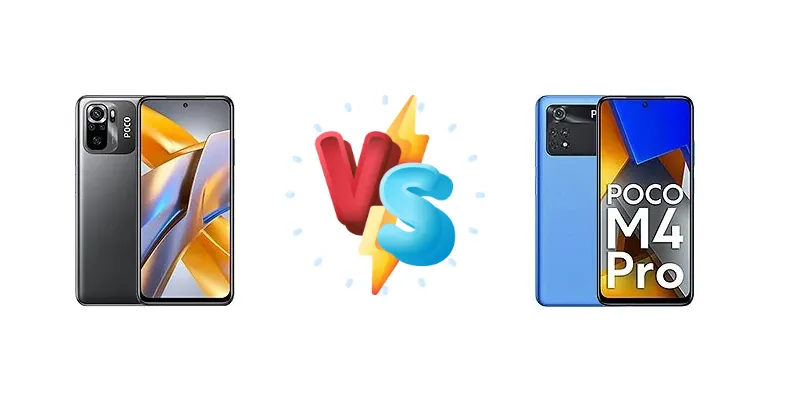
The Xiaomi Poco series consistently delivers impressive value for money. The Poco M5s and M4 Pro are two strong contenders in the budget smartphone arena, offering a blend of features and affordability. But which one reigns supreme? Let's dive into a detailed comparison to help you decide.
🏆 Quick Verdict
The Poco M5s edges out the M4 Pro thanks to its slightly brighter display and marginally better endurance rating. While both offer excellent value, the M5s's Helio G95 chipset provides a small performance advantage, making it the overall winner for most users.
| Network |
|---|
| 2G bands | GSM 850 / 900 / 1800 / 1900 | GSM 850 / 900 / 1800 / 1900 |
| 3G bands | HSDPA 850 / 900 / 1700(AWS) / 1900 / 2100 | HSDPA 850 / 900 / 1700(AWS) / 1900 / 2100 - International |
| 4G bands | 1, 2, 3, 4, 5, 7, 8, 20, 28, 38, 40, 41 | 1, 2, 3, 4, 5, 7, 8, 20, 28, 38, 40, 41 - International |
| Speed | HSPA, LTE | HSPA, LTE |
| Technology | GSM / HSPA / LTE | GSM / HSPA / LTE |
| | - | 1, 3, 5, 8, 40, 41 - India |
| Launch |
|---|
| Announced | 2022, September 05 | 2022, February 28 |
| Status | Available. Released 2022, September 06 | Available. Released 2022, March 16 |
| Body |
|---|
| Build | Glass front (Gorilla Glass 3), plastic frame, plastic back | Glass front (Gorilla Glass 3), plastic frame, plastic back |
| Dimensions | 160.5 x 74.5 x 8.3 mm (6.32 x 2.93 x 0.33 in) | 159.9 x 73.9 x 8.1 mm (6.30 x 2.91 x 0.32 in) |
| SIM | Nano-SIM + Nano-SIM | Nano-SIM + Nano-SIM |
| Weight | 178.8 g (6.31 oz) | 179.5 g (6.31 oz) |
| | IP53, dust and splash resistant | IP53, dust and splash resistant |
| Display |
|---|
| Protection | Corning Gorilla Glass 3 | Corning Gorilla Glass 3 |
| Resolution | 1080 x 2400 pixels, 20:9 ratio (~409 ppi density) | 1080 x 2400 pixels, 20:9 ratio (~409 ppi density) |
| Size | 6.43 inches, 99.8 cm2 (~83.5% screen-to-body ratio) | 6.43 inches, 99.8 cm2 (~84.5% screen-to-body ratio) |
| Type | AMOLED, 450 nits (typ), 700 nits (HBM), 1100 nits (peak) | AMOLED, 90Hz, 700 nits, 1000 nits (peak) |
| Platform |
|---|
| CPU | Octa-core (2x2.05 GHz Cortex-A76 & 6x2.0 GHz Cortex-A55) | Octa-core (2x2.05 GHz Cortex-A76 & 6x2.0 GHz Cortex-A55) |
| Chipset | Mediatek MT6785V/CD Helio G95 (12 nm) | Mediatek MT6781 Helio G96 (12 nm) |
| GPU | Mali-G76 MC4 | Mali-G57 MC2 |
| OS | Android 12, MIUI 13 | Android 11, MIUI 13 for POCO |
| Memory |
|---|
| Card slot | microSDXC (dedicated slot) | microSDXC (dedicated slot) |
| Internal | 64GB 4GB RAM, 128GB 4GB RAM, 128GB 6GB RAM, 256GB 8GB RAM | 64GB 6GB RAM, 128GB 6GB RAM, 128GB 8GB RAM, 256GB 8GB RAM |
| | UFS 2.2 | UFS 2.2 |
| Main Camera |
|---|
| Features | LED flash, HDR, panorama | LED flash, HDR, panorama |
| Quad | 64 MP, f/1.8, 26mm (wide), 1/1.97", 0.7µm, PDAF
8 MP, f/2.2, 118˚ (ultrawide), 1/4.0", 1.12µm
2 MP (macro)
Auxiliary lens | - |
| Single | - | 16 MP, f/2.5, (wide), 1/3.06" 1.0µm |
| Triple | - | 64 MP, f/1.8, 26mm (wide), 0.7µm, PDAF
8 MP, f/2.2, 118˚ (ultrawide), 1/4.0", 1.12µm
2 MP (macro) |
| Video | 4K@30fps, 1080p@30/60/120fps, 720p@960fps | 1080p@30fps |
| Selfie camera |
|---|
| Features | HDR | HDR |
| Single | 13 MP, f/2.4, (wide), 1/3.06", 1.12µm | 16 MP, f/2.5, (wide), 1/3.06" 1.0µm |
| Video | 1080p@30fps | 1080p@30fps |
| Sound |
|---|
| 3.5mm jack | Yes | Yes |
| 35mm jack | Yes | Yes |
| Loudspeaker | Yes, with stereo speakers | Yes, with stereo speakers |
| | - | 24-bit/192kHz audio |
| Comms |
|---|
| Bluetooth | 5.0, A2DP, LE | 5.0, A2DP, LE |
| Infrared port | Yes | Yes |
| NFC | Yes | Yes |
| Positioning | GPS, GLONASS, GALILEO, BDS | GPS, GLONASS, BDS, GALILEO |
| Radio | FM radio | FM radio, recording |
| USB | USB Type-C 2.0 | USB Type-C 2.0, OTG |
| WLAN | Wi-Fi 802.11 a/b/g/n/ac, dual-band, Wi-Fi Direct | Wi-Fi 802.11 a/b/g/n/ac, dual-band, Wi-Fi Direct |
| Features |
|---|
| Sensors | Fingerprint (side-mounted), accelerometer, gyro, compass | Fingerprint (side-mounted), accelerometer, gyro, compass |
| | Virtual proximity sensing | Virtual proximity sensing |
| Battery |
|---|
| Charging | 33W wired, 64% in 30 min | 33W wired, PD3.0, QC3, 100% in 58 min |
| Type | Li-Po 5000 mAh | Li-Po 5000 mAh |
| Misc |
|---|
| Colors | Gray, Blue, White | Power Black, Cool Blue, Poco Yellow |
| Models | 2207117BPG | MZB0B5VIN, 2201117PI, 2201117PG |
| Price | About 120 EUR | € 100.18 |
| SAR | 1.00 W/kg (head) 0.65 W/kg (body) | 0.85 W/kg (head) 0.85 W/kg (body) |
| SAR EU | 0.60 W/kg (head) 0.87 W/kg (body) | 0.59 W/kg (head) 0.84 W/kg (body) |
| Tests |
|---|
| Battery life |
Endurance rating 132h
|
Endurance rating 126h
|
| Camera |
Photo / Video |
Photo / Video |
| Display |
Contrast ratio: Infinite (nominal) |
Contrast ratio: Infinite (nominal) |
| Loudspeaker |
-25.4 LUFS (Very good)
|
-25.2 LUFS (Very good)
|
| Performance |
AnTuTu: 360681 (v9)
GeekBench: 1831 (v5.1)
GFXBench: 18fps (ES 3.1 onscreen) |
AnTuTu: 318444 (v9)
GeekBench: 1836 (v5.1)
GFXBench: 12fps (ES 3.1 onscreen) |
Xiaomi Poco M5s
- Slightly brighter display
- Marginally better performance (Helio G95)
- Slightly better battery endurance
- Good value for money
- Slower charging compared to M4 Pro
- Design may not appeal to everyone
Xiaomi Poco M4 Pro
- Faster charging (PD3.0, QC3)
- Potentially refined software experience (depending on updates)
- Good value for money
- Slightly dimmer display
- Slightly lower battery endurance
- Performance slightly behind M5s
Display Comparison
Both phones feature AMOLED displays with a 90Hz refresh rate and a Full HD+ resolution, offering vibrant colors and smooth scrolling. However, the Poco M5s boasts a slightly higher peak brightness of 756 nits compared to the M4 Pro's 737 nits, resulting in better visibility in direct sunlight. Both have excellent contrast ratios (Infinite nominal).
Camera Comparison
Both phones feature a quad-camera setup, typically including a main sensor, ultrawide lens, macro lens, and depth sensor. While specific sensor details are often similar, image processing and software optimizations can differ. Expect comparable photo quality in most scenarios, with the M5s potentially having a slight edge in low-light conditions due to its chipset.
Performance
The Poco M5s utilizes the Mediatek Helio G95 chipset, while the M4 Pro is powered by the Helio G96. While both are built on a 12nm process and share the same CPU core configuration (2x2.05 GHz Cortex-A76 & 6x2.0 GHz Cortex-A55), the G95 generally offers slightly better GPU performance. Real-world usage will likely feel similar for everyday tasks.
Battery Life
The Poco M5s has a slightly better endurance rating (132h) compared to the M4 Pro (126h), suggesting it will last a bit longer on a single charge. The M4 Pro, however, offers significantly faster charging speeds with support for PD3.0, QC3, reaching 100% in 58 minutes, whereas the M5s takes longer with its 33W wired charging (64% in 30 min).
Buying Guide
Who should buy the Xiaomi Poco M5s? Users prioritizing a slightly brighter display and a bit more performance will appreciate the M5s. Who should buy the Xiaomi Poco M4 Pro? Those seeking faster charging speeds and a potentially more refined software experience (depending on updates) might find the M4 Pro appealing.
Frequently Asked Questions
❓ Which phone has better gaming performance?
The Poco M5s generally offers slightly better gaming performance due to its Helio G95 chipset, although the difference is not substantial.
❓ Is the Poco M4 Pro's faster charging worth it?
If fast charging is a priority, the M4 Pro's PD3.0 and QC3 support is a significant advantage. Otherwise, the M5s's slightly longer battery life might be more appealing.