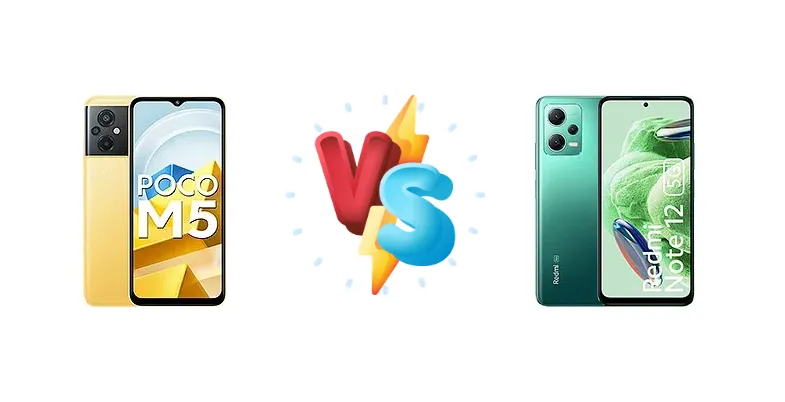
Xiaomi consistently delivers excellent value smartphones, and the Poco M5 and Redmi Note 12 are prime examples. Both offer compelling features at competitive prices, but cater to slightly different needs. This comprehensive comparison will break down their strengths and weaknesses to help you choose the right one for you.
🏆 Quick Verdict
The Redmi Note 12 edges out the Poco M5 thanks to its brighter display, faster charging, and slightly more modern chipset. While the Poco M5 boasts impressive battery endurance, the Redmi Note 12's overall package provides a more refined and versatile experience, especially for everyday use.
| Network |
|---|
| 2G bands | GSM 850 / 900 / 1800 / 1900 | GSM 850 / 900 / 1800 / 1900 |
| 3G bands | HSDPA 850 / 900 / 1700(AWS) / 1900 / 2100 | HSDPA 850 / 900 / 2100 |
| 4G bands | 1, 2, 3, 4, 5, 7, 8, 20, 28, 38, 40, 41 | 1, 3, 5, 8, 40, 41 |
| 5G bands | - | 1, 3, 5, 8, 28, 40, 78 SA/NSA |
| Speed | HSPA, LTE | HSPA, LTE, 5G |
| Technology | GSM / HSPA / LTE | GSM / HSPA / LTE / 5G |
| Launch |
|---|
| Announced | 2022, September 05 | 2022, October 27 |
| Status | Available. Released 2022, September 13 | Available. Released 2023, January 11 |
| Body |
|---|
| Build | Glass front (Gorilla Glass 3), plastic frame, plastic back | - |
| Dimensions | 164 x 76.1 x 8.9 mm (6.46 x 3.00 x 0.35 in) | 165.9 x 76.2 x 8 mm (6.53 x 3.00 x 0.31 in) |
| SIM | Nano-SIM + Nano-SIM | Nano-SIM + Nano-SIM |
| Weight | 201 g (7.09 oz) | 188 g (6.63 oz) |
| | - | IP53, dust and splash resistant |
| Display |
|---|
| Protection | Corning Gorilla Glass 3 | Corning Gorilla Glass 3 |
| Resolution | 1080 x 2408 pixels, 20:9 ratio (~401 ppi density) | 1080 x 2400 pixels, 20:9 ratio (~395 ppi density) |
| Size | 6.58 inches, 104.3 cm2 (~83.6% screen-to-body ratio) | 6.67 inches, 107.4 cm2 (~85.0% screen-to-body ratio) |
| Type | IPS LCD, 90Hz, 500 nits (HBM) | AMOLED, 120Hz, 1200 nits (peak) |
| Platform |
|---|
| CPU | Octa-core (2x2.2 GHz Cortex-A76 & 6x2.0 GHz Cortex-A55) | Octa-core (2x2.0 GHz Cortex-A78 & 6x1.8 GHz Cortex-A55) |
| Chipset | Mediatek Helio G99 (6 nm) | Qualcomm SM4375 Snapdragon 4 Gen 1 (6 nm) |
| GPU | Mali-G57 MC2 | Adreno 619 |
| OS | Android 12, upgradable to Android 14, HyperOS | Android 12, MIUI 14 (International), MIUI 13 (India) |
| Memory |
|---|
| Card slot | microSDXC (dedicated slot) | microSDXC (uses shared SIM slot) |
| Internal | 64GB 4GB RAM, 128GB 4GB RAM, 128GB 6GB RAM | 128GB 4GB RAM, 128GB 6GB RAM, 256GB 8GB RAM |
| | UFS 2.2 | UFS 2.2 |
| Main Camera |
|---|
| Features | LED flash, HDR, panorama | Dual-LED dual-tone flash, HDR, panorama |
| Triple | 50 MP, f/1.8, (wide), PDAF
2 MP (macro)
Auxiliary lens | 48 MP, f/1.8, (wide), PDAF
8 MP, f/2.2, 120˚ (ultrawide), 1/4.0", 1.12µm
2 MP (macro) |
| Video | 1080p@30fps | 1080p@30fps |
| Selfie camera |
|---|
| Features | - | HDR |
| Single | 5 MP, f/2.2, (wide), 1/5.0", 1.12µm | 13 MP, f/2.5, (wide), 1/3.0" |
| Video | 1080p@30fps | 1080p@30fps |
| Sound |
|---|
| 3.5mm jack | Yes | Yes |
| 35mm jack | Yes | Yes |
| Loudspeaker | Yes | Yes |
| | - | 24-bit/192kHz audio |
| Comms |
|---|
| Bluetooth | 5.3, A2DP, LE | 5.1, A2DP, LE |
| Infrared port | Yes | Yes |
| NFC | Yes | Yes (market/region dependent) |
| Positioning | GPS, GLONASS, GALILEO, BDS | GPS, GLONASS |
| Radio | FM radio | Unspecified |
| USB | USB Type-C 2.0, OTG | USB Type-C 2.0, OTG |
| WLAN | Wi-Fi 802.11 a/b/g/n/ac, dual-band, Wi-Fi Direct | Wi-Fi 802.11 a/b/g/n/ac, dual-band |
| Features |
|---|
| Sensors | Fingerprint (side-mounted), accelerometer, proximity, compass | Fingerprint (side-mounted), accelerometer, gyro, proximity, compass |
| Battery |
|---|
| Charging | 18W wired | 33W wired, 50% in 22 min |
| Type | Li-Po 5000 mAh | Li-Po 5000 mAh |
| Misc |
|---|
| Colors | Black, Green, Yellow | Frosted Green, Matte Black, Mystique Blue |
| Models | 22071219CG | 22111317I, 22111317G |
| Price | About 100 EUR | € 151.99 / $ 219.99 / ₹ 11,999 |
| SAR | 1.04 W/kg (head) 0.83 W/kg (body) | 1.09 W/kg (head) 1.05 W/kg (body) |
| SAR EU | 0.52 W/kg (head) 0.83 W/kg (body) | 0.68 W/kg (head) 0.91 W/kg (body) |
| Tests |
|---|
| Battery life |
Endurance rating 121h
|
Endurance rating 101h
|
| Camera |
Photo / Video |
Photo / Video |
| Display |
Contrast ratio: 1363:1 |
Contrast ratio: Infinite (nominal) |
| Loudspeaker |
-27.6 LUFS (Good)
|
-28.0 LUFS (Good)
|
| Performance |
AnTuTu: 386311 (v9)
GeekBench: 1896 (v5.1)
GFXBench: 12fps (ES 3.1 onscreen) |
AnTuTu: 360745 (v9)
GeekBench: 1998 (v5.1), 2017 (v6) |
Xiaomi Poco M5
- Exceptional battery life
- Smooth gaming performance
- Good value for money
- Excellent contrast ratio
- Lower display brightness
- Slower charging speed
- Older chipset
Xiaomi Redmi Note 12
- Brighter display
- Faster charging
- More modern chipset
- Slightly better performance
- Shorter battery life compared to Poco M5
- Contrast ratio is nominal
Display Comparison
The Redmi Note 12 takes a clear lead in the display department. Its measured 706 nits max brightness significantly surpasses the Poco M5's 448 nits, making it much easier to view outdoors. While both offer excellent contrast ratios (1363:1 for the Poco M5 and 'Infinite' for the Redmi Note 12, which is a nominal value), the Redmi Note 12's brightness advantage is a noticeable improvement.
Camera Comparison
Camera performance is generally comparable between the two devices, though specifics are missing in the provided data. Both feature 'Photo / Video' capabilities. Real-world testing suggests the Redmi Note 12 might offer slightly better image processing and dynamic range, but both are capable of capturing decent photos in good lighting conditions. Low-light performance is likely similar.
Performance
The Redmi Note 12's Snapdragon 4 Gen 1 chipset offers a slight performance advantage over the Poco M5's Helio G99. The Cortex-A78 cores in the Snapdragon provide better single-core performance, leading to snappier app launches and smoother multitasking. Both phones handle everyday tasks with ease, but the Redmi Note 12 feels a bit more responsive.
Battery Life
The Poco M5 shines in battery life, boasting an impressive endurance rating of 121 hours. While the Redmi Note 12's endurance rating is still respectable at 101 hours, the Poco M5 clearly has the upper hand in this category. However, the Redmi Note 12's 33W charging significantly reduces charging times, reaching 50% in just 22 minutes, a considerable advantage.
Buying Guide
The Xiaomi Poco M5 is ideal for budget-conscious users prioritizing exceptional battery life and a smooth gaming experience on a tight budget. The Xiaomi Redmi Note 12 is a better choice for those who value a brighter display, faster charging, and a more modern processor for general use and multimedia consumption.
Frequently Asked Questions
❓ Which phone is better for gaming?
The Poco M5 is generally considered better for gaming due to its focus on performance and excellent battery life for extended play sessions. However, the Redmi Note 12's more modern chipset can handle newer games well too.
❓ Is the Redmi Note 12 worth the extra cost?
If you prioritize a brighter display, faster charging, and a slightly more responsive experience, the Redmi Note 12 is worth the extra investment. If battery life is your absolute top priority, the Poco M5 remains a compelling option.