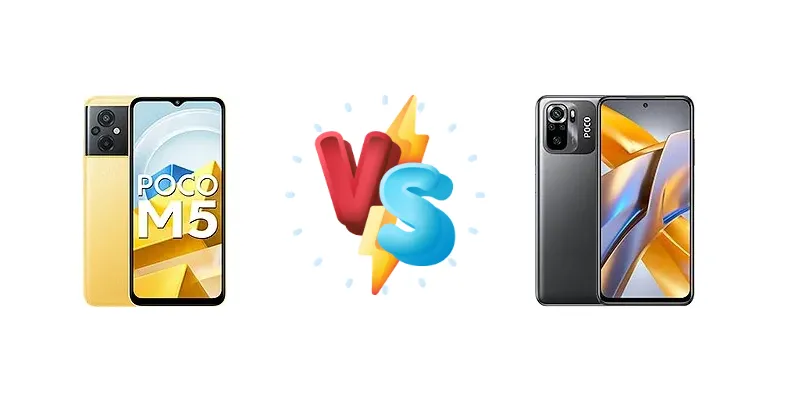
The Xiaomi Poco series consistently delivers impressive value for money. Two popular contenders are the Poco M5 and the Poco M5s, both offering compelling features at affordable prices. But which one reigns supreme? Let's dive into a detailed comparison to help you decide.
🏆 Quick Verdict
The Poco M5s edges out the M5 thanks to its significantly brighter display, faster charging, and slightly more powerful chipset. While the M5 boasts impressive battery endurance, the M5s' overall package makes it the better choice for most users seeking a budget-friendly smartphone.
| Network |
|---|
| 2G bands | GSM 850 / 900 / 1800 / 1900 | GSM 850 / 900 / 1800 / 1900 |
| 3G bands | HSDPA 850 / 900 / 1700(AWS) / 1900 / 2100 | HSDPA 850 / 900 / 1700(AWS) / 1900 / 2100 |
| 4G bands | 1, 2, 3, 4, 5, 7, 8, 20, 28, 38, 40, 41 | 1, 2, 3, 4, 5, 7, 8, 20, 28, 38, 40, 41 |
| Speed | HSPA, LTE | HSPA, LTE |
| Technology | GSM / HSPA / LTE | GSM / HSPA / LTE |
| Launch |
|---|
| Announced | 2022, September 05 | 2022, September 05 |
| Status | Available. Released 2022, September 13 | Available. Released 2022, September 06 |
| Body |
|---|
| Build | Glass front (Gorilla Glass 3), plastic frame, plastic back | Glass front (Gorilla Glass 3), plastic frame, plastic back |
| Dimensions | 164 x 76.1 x 8.9 mm (6.46 x 3.00 x 0.35 in) | 160.5 x 74.5 x 8.3 mm (6.32 x 2.93 x 0.33 in) |
| SIM | Nano-SIM + Nano-SIM | Nano-SIM + Nano-SIM |
| Weight | 201 g (7.09 oz) | 178.8 g (6.31 oz) |
| | - | IP53, dust and splash resistant |
| Display |
|---|
| Protection | Corning Gorilla Glass 3 | Corning Gorilla Glass 3 |
| Resolution | 1080 x 2408 pixels, 20:9 ratio (~401 ppi density) | 1080 x 2400 pixels, 20:9 ratio (~409 ppi density) |
| Size | 6.58 inches, 104.3 cm2 (~83.6% screen-to-body ratio) | 6.43 inches, 99.8 cm2 (~83.5% screen-to-body ratio) |
| Type | IPS LCD, 90Hz, 500 nits (HBM) | AMOLED, 450 nits (typ), 700 nits (HBM), 1100 nits (peak) |
| Platform |
|---|
| CPU | Octa-core (2x2.2 GHz Cortex-A76 & 6x2.0 GHz Cortex-A55) | Octa-core (2x2.05 GHz Cortex-A76 & 6x2.0 GHz Cortex-A55) |
| Chipset | Mediatek Helio G99 (6 nm) | Mediatek MT6785V/CD Helio G95 (12 nm) |
| GPU | Mali-G57 MC2 | Mali-G76 MC4 |
| OS | Android 12, upgradable to Android 14, HyperOS | Android 12, MIUI 13 |
| Memory |
|---|
| Card slot | microSDXC (dedicated slot) | microSDXC (dedicated slot) |
| Internal | 64GB 4GB RAM, 128GB 4GB RAM, 128GB 6GB RAM | 64GB 4GB RAM, 128GB 4GB RAM, 128GB 6GB RAM, 256GB 8GB RAM |
| | UFS 2.2 | UFS 2.2 |
| Main Camera |
|---|
| Features | LED flash, HDR, panorama | LED flash, HDR, panorama |
| Quad | - | 64 MP, f/1.8, 26mm (wide), 1/1.97", 0.7µm, PDAF
8 MP, f/2.2, 118˚ (ultrawide), 1/4.0", 1.12µm
2 MP (macro)
Auxiliary lens |
| Triple | 50 MP, f/1.8, (wide), PDAF
2 MP (macro)
Auxiliary lens | - |
| Video | 1080p@30fps | 4K@30fps, 1080p@30/60/120fps, 720p@960fps |
| Selfie camera |
|---|
| Features | - | HDR |
| Single | 5 MP, f/2.2, (wide), 1/5.0", 1.12µm | 13 MP, f/2.4, (wide), 1/3.06", 1.12µm |
| Video | 1080p@30fps | 1080p@30fps |
| Sound |
|---|
| 3.5mm jack | Yes | Yes |
| 35mm jack | Yes | Yes |
| Loudspeaker | Yes | Yes, with stereo speakers |
| Comms |
|---|
| Bluetooth | 5.3, A2DP, LE | 5.0, A2DP, LE |
| Infrared port | Yes | Yes |
| NFC | Yes | Yes |
| Positioning | GPS, GLONASS, GALILEO, BDS | GPS, GLONASS, GALILEO, BDS |
| Radio | FM radio | FM radio |
| USB | USB Type-C 2.0, OTG | USB Type-C 2.0 |
| WLAN | Wi-Fi 802.11 a/b/g/n/ac, dual-band, Wi-Fi Direct | Wi-Fi 802.11 a/b/g/n/ac, dual-band, Wi-Fi Direct |
| Features |
|---|
| Sensors | Fingerprint (side-mounted), accelerometer, proximity, compass | Fingerprint (side-mounted), accelerometer, gyro, compass |
| | - | Virtual proximity sensing |
| Battery |
|---|
| Charging | 18W wired | 33W wired, 64% in 30 min |
| Type | Li-Po 5000 mAh | Li-Po 5000 mAh |
| Misc |
|---|
| Colors | Black, Green, Yellow | Gray, Blue, White |
| Models | 22071219CG | 2207117BPG |
| Price | About 100 EUR | About 120 EUR |
| SAR | 1.04 W/kg (head) 0.83 W/kg (body) | 1.00 W/kg (head) 0.65 W/kg (body) |
| SAR EU | 0.52 W/kg (head) 0.83 W/kg (body) | 0.60 W/kg (head) 0.87 W/kg (body) |
| Tests |
|---|
| Battery life |
Endurance rating 121h
|
Endurance rating 132h
|
| Camera |
Photo / Video |
Photo / Video |
| Display |
Contrast ratio: 1363:1 |
Contrast ratio: Infinite (nominal) |
| Loudspeaker |
-27.6 LUFS (Good)
|
-25.4 LUFS (Very good)
|
| Performance |
AnTuTu: 386311 (v9)
GeekBench: 1896 (v5.1)
GFXBench: 12fps (ES 3.1 onscreen) |
AnTuTu: 360681 (v9)
GeekBench: 1831 (v5.1)
GFXBench: 18fps (ES 3.1 onscreen) |
Xiaomi Poco M5
- Exceptional battery life
- Smooth performance for the price
- Good value for money
- Dim display
- Slower charging
- Camera slightly less impressive than M5s
Xiaomi Poco M5s
- Brighter and more vibrant display
- Faster charging (33W)
- Slightly better camera performance
- Sleeker design (often with AMOLED option)
- Slightly shorter battery life than M5
- Less efficient chipset (12nm vs 6nm)
Display Comparison
The Poco M5s takes a clear lead in the display department. While the M5 offers a respectable 1363:1 contrast ratio, its 448 nits of brightness can feel dim in direct sunlight. The M5s, on the other hand, boasts a much brighter 756 nits, ensuring excellent visibility even outdoors. The 'Infinite' contrast ratio claim for the M5s is nominal, but the practical brightness difference is significant. Both phones feature similar resolutions and panel types (likely IPS LCD).
Camera Comparison
Both phones feature similar camera setups, typically including a main sensor, ultrawide lens, and macro lens. However, the M5s often has a slightly better main sensor and image processing, resulting in marginally better photo quality, especially in challenging lighting conditions. Video recording capabilities are comparable on both devices.
Performance
The Poco M5 utilizes the Mediatek Helio G99, a 6nm chip, offering solid performance for everyday tasks and moderate gaming. The Poco M5s features the Helio G95 (12nm), which is slightly less efficient but still capable. While the G99 generally offers a slight edge in raw processing power, real-world differences are often negligible. Both phones handle multitasking and common apps with ease.
Battery Life
The Poco M5 shines in battery life, achieving an impressive endurance rating of 121 hours. The Poco M5s, while still offering good battery life (132h endurance rating), falls slightly behind. However, the M5s compensates with significantly faster 33W wired charging, allowing for a 64% charge in just 30 minutes – a considerable advantage.
Buying Guide
The Poco M5 is ideal for users prioritizing maximum battery life and a smooth gaming experience on a tighter budget. The Poco M5s is a better fit for those who value a vibrant display, faster charging, and a slightly more capable camera system, even if it means a small trade-off in battery longevity.
Frequently Asked Questions
❓ Is the Poco M5 good for gaming?
Yes, the Poco M5's Helio G99 chipset provides a smooth gaming experience for most titles, especially at medium settings. However, demanding games may require reduced graphics settings for optimal performance.
❓ Does the Poco M5s have a better camera than the Poco M5?
Generally, yes. The Poco M5s typically features a slightly better main camera sensor and image processing, resulting in marginally improved photo quality, particularly in low-light conditions.